Condition Monitoring vs Predictive Maintenance: Differences
Learn the key differences between condition monitoring vs predictive maintenance for BioGas systems. Reduce downtime, cut costs, & extend equipment life with the right strategy.
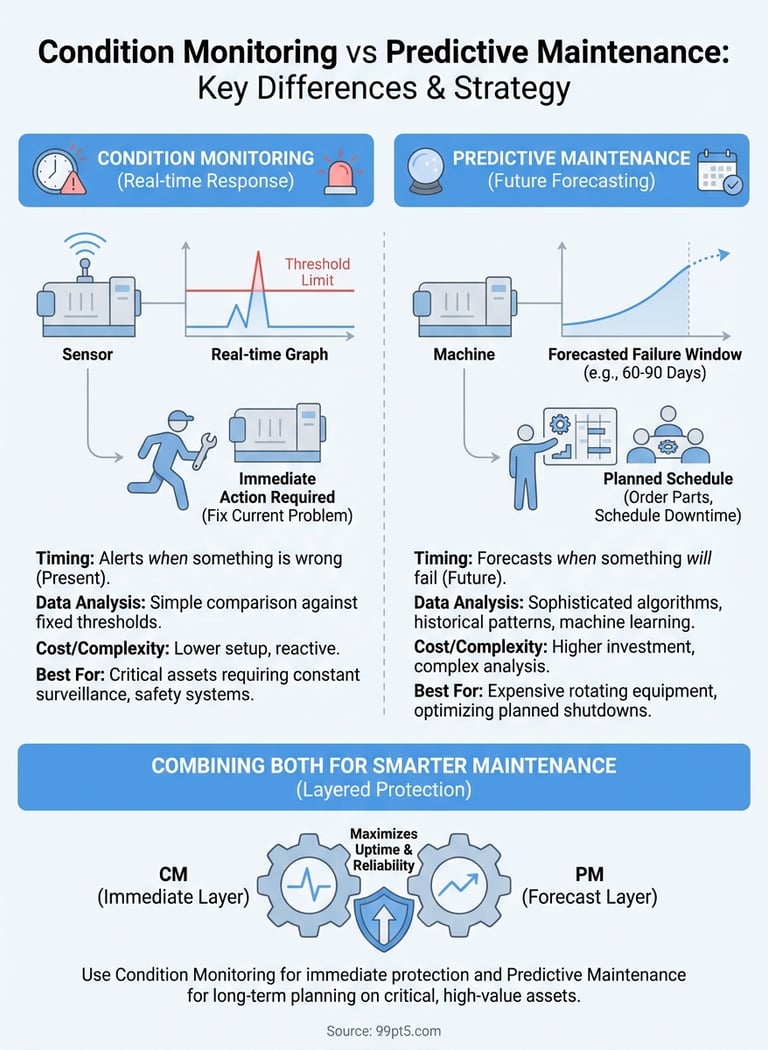
You monitor your equipment to catch problems before they cause failures. But two different approaches exist. Condition monitoring watches your assets in real time and alerts you when something goes wrong right now. Predictive maintenance goes further. It uses data patterns and algorithms to forecast problems weeks or months before they happen. The difference matters because one tells you to act immediately while the other helps you plan repairs when it suits your schedule.
This article breaks down both strategies so you can choose the right approach for your operations. You will learn how each method works, what makes them different, and when to use one versus the other. We cover practical applications, real costs, key advantages and drawbacks, and how combining both can maximize your equipment uptime. By the end, you will know which maintenance strategy fits your BioGas processing systems and how to implement it effectively. Whether you run a small farm operation or manage large industrial facilities, understanding these approaches helps you reduce downtime, cut maintenance costs, and extend equipment life.
Why maintenance strategy choice matters
Your maintenance approach directly affects your bottom line and operational reliability. When you choose the wrong strategy, you either respond too late and face expensive breakdowns or you maintain too early and waste resources on unnecessary work. BioGas processing systems run continuously, so unplanned downtime costs you more than just repair bills. You lose production revenue, miss delivery commitments, and risk damaging your reputation with clients who depend on consistent BioMethane supply.
The financial impact extends beyond immediate repair costs. Equipment that fails unexpectedly requires emergency parts orders, premium shipping fees, and overtime labor rates. Your maintenance team scrambles to fix problems instead of working on scheduled improvements. Production facilities that contract your complete organics-to-BioMethane systems expect guaranteed uptime, and failure to deliver can trigger penalty clauses in service agreements.
Choosing between condition monitoring vs predictive maintenance determines whether you react to problems or prevent them before they impact operations.
Strategic maintenance planning affects your competitive position too. Companies that minimize downtime and maximize equipment life deliver better returns for their clients. You can price projects more competitively when your operating costs stay low and predictable. Your clients notice when systems run smoothly without constant intervention, and that reliability becomes your strongest selling point for future projects.
How to apply condition and predictive maintenance
You implement these strategies differently because they serve distinct purposes in your maintenance program. Condition monitoring requires sensors that track real-time parameters like temperature, vibration, pressure, and flow rates on your BioGas processing equipment. You set threshold limits for each parameter, and when measurements exceed those limits, the system triggers alerts so your team can respond immediately. This approach works best when you need constant surveillance of critical assets that cannot fail without severe consequences.
Setting up condition monitoring
Start by identifying which equipment components require continuous oversight. Your BioTreater system's compressor, catalytic reactor, and desulphurization unit represent critical points where failures directly impact BioMethane production. Install sensors that measure the specific parameters most likely to indicate problems for each component. Vibration sensors on rotating equipment catch bearing wear, temperature probes detect overheating in catalytic processes, and pressure transducers reveal leaks or blockages in gas flow paths.
Configure your monitoring system to send immediate notifications when readings drift outside normal operating ranges. You can integrate these alerts with existing control systems or use standalone monitoring platforms that provide dashboard views and mobile alerts. The key is ensuring your maintenance team receives actionable information the moment a problem develops, not hours later after production has already stopped.
Setting precise alert thresholds prevents false alarms while catching real problems before they cause equipment damage.
Implementing predictive maintenance
Predictive maintenance demands more sophisticated analysis than condition monitoring vs predictive maintenance comparisons often suggest. You collect historical data from multiple sensors over weeks or months, then use algorithms to identify patterns that precede failures. Machine learning models analyze trends in vibration signatures, thermal profiles, and performance metrics to forecast when components will degrade below acceptable levels. This approach requires initial investment in data collection infrastructure and analytical software, but it delivers advance warning that lets you schedule maintenance during planned shutdowns rather than reacting to emergencies.
Apply predictive analytics to equipment with measurable degradation patterns. Rotating machinery, heat exchangers, and filtration systems all show progressive deterioration that algorithms can detect early. Start with your most expensive or critical components where advance notice provides maximum benefit.
Key differences between the two
The distinction between condition monitoring vs predictive maintenance comes down to timing, data usage, and how you respond to equipment issues. Condition monitoring operates in real time, alerting you when parameters exceed preset thresholds so you can act immediately. Predictive maintenance analyzes historical trends to forecast problems before they affect current operations. Understanding these core differences helps you select the right strategy for your BioGas processing systems and avoid costly implementation mistakes.
Timing and response approach
Condition monitoring tells you when something is already wrong and requires immediate attention. Your sensors detect that a bearing temperature has risen above normal limits or vibration has increased beyond acceptable levels right now. You respond by dispatching technicians to diagnose and fix the problem before it causes complete failure. Predictive maintenance forecasts when something will fail in the coming weeks or months based on deterioration patterns. This advance warning lets you order parts, schedule downtime during slow production periods, and complete repairs without emergency response costs.
Condition monitoring reacts to present conditions while predictive maintenance anticipates future failures, giving you control over when and how maintenance happens.
Data processing and analysis
Condition monitoring compares current readings against fixed thresholds you established during system setup. The logic remains simple: if temperature exceeds X degrees or pressure drops below Y bar, send an alert. Predictive maintenance requires sophisticated algorithms that process multiple data streams simultaneously, identify patterns across time periods, and calculate probability of failure based on degradation rates. Your team needs analytical tools and expertise to interpret complex trend data rather than just responding to threshold alerts.
Cost and complexity
Condition monitoring costs less to implement because you only need sensors, basic monitoring software, and threshold configuration. Predictive maintenance demands higher initial investment in data storage infrastructure, analytical software, and personnel training to interpret algorithmic outputs. The complexity difference matters too. You can deploy condition monitoring quickly with standard industrial sensors and control systems. Predictive programs require months of data collection before algorithms generate reliable forecasts, plus ongoing refinement as equipment ages and operating conditions change.
Pros, cons, and best use cases
Each approach delivers distinct benefits and faces specific limitations depending on your operational requirements. Condition monitoring provides immediate visibility into equipment health with straightforward implementation and quick alerts when problems develop. Predictive maintenance offers advance planning capability but demands greater investment in technology and expertise. Your choice depends on equipment criticality, budget constraints, and whether you need to respond quickly or plan maintenance schedules weeks ahead.
Condition monitoring advantages and limitations
Condition monitoring works best for critical assets where immediate response prevents catastrophic failures. Your BioGas compressors and catalytic reactors benefit from real-time surveillance because sudden failures stop production entirely. The low implementation cost and simple setup let you deploy monitoring across multiple systems quickly. You get instant alerts when parameters drift, allowing rapid intervention before small problems become expensive repairs.
However, condition monitoring reveals problems that already exist rather than forecasting future issues. You still face unplanned downtime when alerts trigger because problems have progressed to detectable levels. False alarms occur when you set thresholds too tight, while loose limits miss early degradation. Your maintenance team operates in reactive mode, rushing to fix issues instead of scheduling repairs during convenient windows.
Predictive maintenance strengths and weaknesses
Predictive maintenance eliminates emergency responses by forecasting failures 60 to 90 days before they occur. You schedule repairs during planned shutdowns, order parts at regular prices instead of premium rates, and complete work using standard labor hours rather than overtime. Historical trend analysis catches subtle degradation patterns that threshold-based monitoring misses entirely, extending equipment life by preventing damage from continuing to operate marginal components.
The drawbacks center on complexity and cost. You need months of baseline data before algorithms generate reliable forecasts, delaying benefits after initial investment. Analytical software, data storage infrastructure, and trained personnel to interpret results require substantial budget allocation. Small operations processing limited BioGas volumes may find the investment exceeds potential savings.
Choosing between condition monitoring vs predictive maintenance depends on whether your priority is catching current problems quickly or preventing future failures through advance planning.
When to use each approach
Deploy condition monitoring on safety-critical equipment where immediate notification prevents injuries or environmental releases. Your desulphurization catalyst and oxygen control systems fall into this category because failures create hazardous conditions requiring instant response. Use predictive maintenance for expensive rotating equipment like compressors and blowers where scheduled replacement based on degradation trends reduces total ownership cost. Small BioGas processing units under 100 Nm3/hour often perform better with condition monitoring alone, while larger systems above 500 Nm3/hour justify predictive analytics investment through reduced downtime and extended component life.
Combining both for smarter maintenance
You gain maximum equipment reliability when you deploy condition monitoring and predictive maintenance together rather than choosing one approach exclusively. Hybrid maintenance strategies use condition monitoring for immediate protection while predictive analytics forecast long-term degradation trends. Your BioGas processing systems benefit from both layers because different failure modes require different detection methods. Real-time alerts catch sudden problems like seal failures or pressure drops, while trend analysis identifies gradual wear in bearings or catalyst degradation.
Layered protection approach
Apply condition monitoring as your first defense across all critical equipment to ensure immediate response capability. Add predictive maintenance to high-value rotating machinery where scheduled replacements reduce total ownership costs. Your compressors receive both strategies: sensors trigger alerts if vibration spikes unexpectedly, while algorithms forecast bearing replacement based on gradual degradation patterns. This layered approach catches both sudden failures and progressive wear, maximizing uptime.
Combining condition monitoring vs predictive maintenance creates comprehensive asset protection that responds to immediate problems while preventing future failures through advance planning.
Target predictive analytics at equipment where advance notice delivers clear financial benefits through scheduled maintenance during planned shutdowns. Reserve condition monitoring for components requiring instant response to prevent safety hazards or production losses.
Wrapping things up
Understanding condition monitoring vs predictive maintenance helps you protect your equipment investments and maximize operational efficiency. Both strategies reduce downtime and extend asset life, but you apply them differently depending on your specific needs and budget constraints. Start with condition monitoring for immediate protection, then layer predictive analytics onto your most critical equipment as your program matures. Your BioGas processing systems deserve maintenance strategies that guarantee performance and reliability. Explore how 99pt5's BioTreater systems deliver guaranteed 99.5% BioMethane recovery with built-in monitoring capabilities for optimal asset management.