How Gas Compressors Work: Reciprocating, Screw, Centrifugal
Explore how gas compressors work: reciprocating, screw, and centrifugal. Discover their core principles, key components, and vital applications in biogas operations.
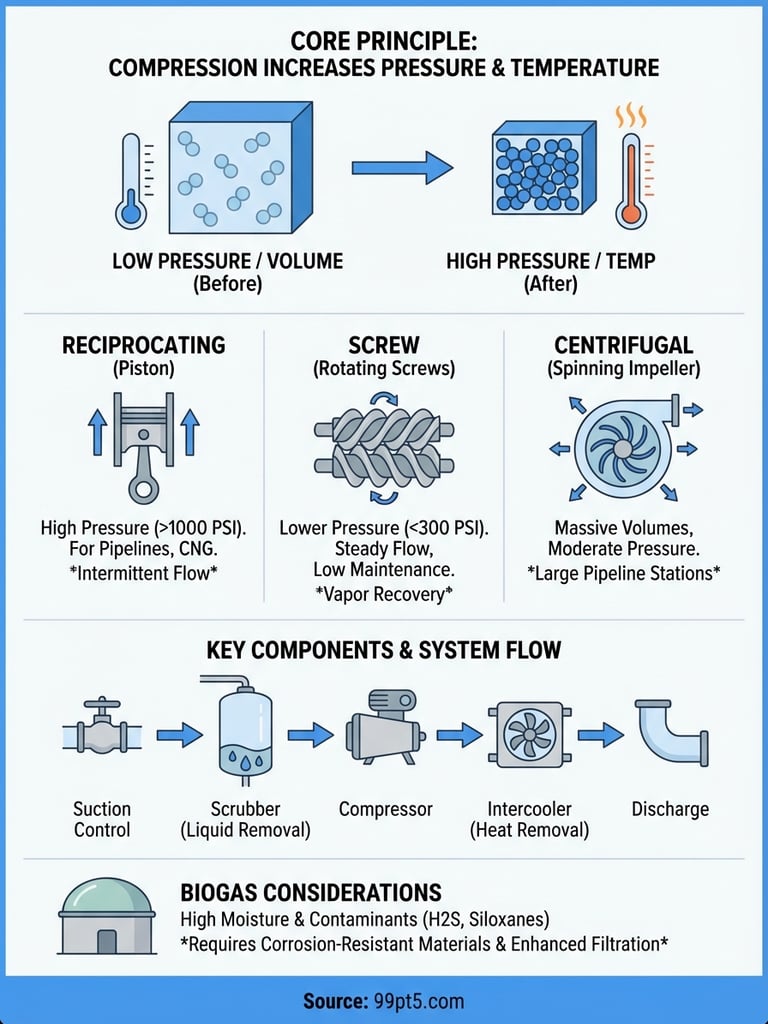
Gas compressors take natural gas or biogas at low pressure and squeeze it into a smaller volume, which increases its pressure. Think of it like pumping air into a tire. The compressor does mechanical work on the gas molecules, forcing them closer together until they reach the pressure you need for transport, processing, or injection into pipelines. This pressure boost is essential because gas naturally wants to expand and equalize. Without compression, you cannot move gas efficiently through pipelines, inject it back into wells, or prepare it for various industrial processes.
This article breaks down how three main compressor types work: reciprocating (piston-based), screw (rotating), and centrifugal (spinning impeller). You'll learn the core principles behind gas compression, see what components make up a compression system, and understand how each type handles different pressure ranges and flow rates. We'll also cover practical considerations for biogas applications, where selecting the right compressor affects both your operating costs and methane recovery rates.
Why gas compressors matter in energy systems
Compressors form the backbone of every natural gas pipeline network, enabling gas to travel thousands of miles from production sites to consumers. Without compression, gas would lose pressure through friction in the pipes and eventually stop flowing. Pipeline operators place compressor stations every 40 to 100 miles along major transmission lines to maintain the pressure needed for continuous flow. These stations boost pressure from around 200 PSI back up to 800-1,200 PSI, counteracting the natural pressure drop that occurs.
Compression accounts for approximately 3-5% of the total natural gas consumed in transmission operations.
Enabling biogas upgrading and injection
Your biogas operation depends on compression at multiple points. Raw biogas typically comes out of digesters at near-atmospheric pressure, but you need higher pressures for upgrading equipment to work efficiently. After purification, compression becomes essential for pipeline injection, which usually requires 600-1,000 PSI depending on your local grid specifications.
Understanding how gas compressors work helps you select equipment matching your flow rates and pressure targets. Vehicle fueling demands the highest pressures at 3,600 PSI for CNG, while industrial processes operate between 100-300 PSI.
How to understand the core working principles
All gas compressors work by applying mechanical force to reduce the volume a gas occupies, which directly increases its pressure. You can picture this as pushing gas molecules closer together inside a confined space. The compressor's moving parts (pistons, screws, or impellers) do this work by consuming power from an engine or electric motor. As the gas gets compressed, its temperature rises because you're adding energy to the molecules. This heat generation is why you'll see cooling systems on nearly every compressor installation.
Compression increases both pressure and temperature
When you compress gas, the molecules collide more frequently because they occupy less space. These collisions create heat, which means your outlet temperature can reach 200-400°F depending on the compression ratio. Understanding this principle helps you plan for intercoolers between compression stages. Without cooling, excessive temperatures damage seals, reduce efficiency, and can create safety hazards.
For every doubling of pressure, gas temperature increases by approximately 50-100°C without cooling.
Multiple stages handle large pressure ratios
Your compressor needs multiple stages when you're boosting pressure from 30 PSI to 1,200 PSI because doing this in one step generates too much heat and requires excessive power. Each stage compresses the gas partway, then an intercooler removes heat before the next stage continues. This stepped approach keeps temperatures manageable and improves overall efficiency by 15-25% compared to single-stage compression for the same final pressure.
Reciprocating, screw, and centrifugal compressors
Understanding how gas compressors work requires knowing the three main types used across natural gas and biogas operations. Reciprocating compressors use pistons moving back and forth in cylinders, screw compressors use rotating helical screws, and centrifugal compressors use spinning impellers to add velocity. Each type suits different pressure ranges and flow rates, so your application dictates which design delivers the best efficiency and operating cost.
Reciprocating compressors use pistons for high pressure
Your reciprocating compressor works exactly like an engine, except it compresses gas instead of burning fuel. Gas enters a cylinder through an inlet valve, then a piston moves up to squeeze the gas into a smaller volume. When pressure reaches your target, a discharge valve opens and pushes the compressed gas out. This positive displacement action makes reciprocating compressors ideal for achieving pressures above 1,000 PSI, which explains why you see them dominating high-pressure pipeline applications and CNG vehicle fueling stations. The trade-off comes from moving parts that require regular maintenance on valves, rings, and bearings.
Screw compressors handle lower pressures efficiently
Two rotating helical screws mesh together inside your screw compressor housing, trapping gas between the threads and moving it toward the discharge end. As the screws turn, the space between threads decreases, which compresses the gas continuously without valves. These units excel at lower pressures (under 300 PSI) and deliver steady flow with minimal pulsation, making them popular for vapor recovery units and smaller biogas operations. Your maintenance costs stay lower because screw compressors have fewer wearing parts than reciprocating designs.
Screw compressors typically achieve 60-70% of the efficiency of reciprocating units but compensate with lower maintenance requirements.
Centrifugal compressors move large volumes
Centrifugal units work by spinning an impeller at high speeds (10,000-20,000 RPM) to accelerate gas outward. This acceleration converts velocity into pressure as the gas slows down in a diffuser section. You get smooth, continuous flow capable of moving massive volumes at moderate pressures, which makes centrifugal compressors the standard choice for large pipeline stations and industrial plants processing over 5,000 cubic feet per minute.
Key components in a gas compression system
Understanding how gas compressors work requires recognizing the essential components that work together in every installation. Your compression system includes far more than just the compressor itself. The suction control valve regulates incoming gas flow, while scrubbers remove liquids before compression begins. Downstream, you'll find intercoolers between stages, discharge valves, and various safety controls. Each component plays a specific role in maintaining pressure, removing contaminants, and protecting equipment from damage.
Suction control and scrubbers
Your suction control valve maintains steady inlet pressure by adjusting gas flow entering the compressor. Scrubbers positioned before each compression stage use gravity to drop out liquids and particulates that would otherwise damage internal components. These vessels give free liquids time to settle while gas continues upward toward the compressor inlet.
Cooling systems and intercoolers
Intercoolers between compression stages remove the heat generated during compression, typically using air or water circulation. This cooling step prevents thermal damage to seals and improves volumetric efficiency by reducing the gas volume before the next stage. You'll also find aftercoolers on the final discharge to bring gas temperatures down to safe handling levels.
Proper cooling between stages can improve overall compression efficiency by 15-25% compared to single-stage designs.
Selecting and operating compressors for biogas
Your biogas operation demands specific compressor characteristics because biogas differs significantly from natural gas in moisture content, contaminant levels, and pressure requirements. Raw biogas typically contains 55-65% methane, 30-40% CO2, plus hydrogen sulfide, moisture, and siloxanes that attack standard compressor materials. Understanding how gas compressors work in biogas applications means accounting for these aggressive compounds that corrode metal parts and degrade lubricants faster than natural gas operations. You need compressors designed with corrosion-resistant materials like stainless steel or special coatings, plus enhanced filtration upstream to protect internal components.
Matching compressor type to your feedstock
Screw compressors handle smaller biogas operations (under 500 CFM) effectively because they tolerate moisture variations better than reciprocating units. Your larger facility producing over 1,000 CFM should consider reciprocating compressors for higher pressure ratios and efficiency, especially when injecting into pipelines at 800+ PSI. Check your H2S levels because concentrations above 100 ppm require special valve materials and more frequent oil changes.
Biogas compressor maintenance intervals are typically 50% shorter than natural gas applications due to higher contaminant exposure.
Operating practices that maximize efficiency
Monitor your inlet scrubber performance daily because biogas carries significantly more liquids than natural gas. Condensate removal prevents liquid slugging that damages valves and pistons in reciprocating compressors. Track oil analysis results monthly to catch corrosion products before they cause failures. Your compression system efficiency improves 10-15% when you maintain proper intercooler temperatures and clean heat exchanger surfaces quarterly.
Key takeaways
Understanding how gas compressors work helps you select the right equipment for your biogas operation and avoid costly mismatches. Reciprocating compressors deliver high pressures above 1,000 PSI for pipeline injection, screw compressors handle smaller flows under 300 PSI efficiently, and centrifugal units move massive volumes at moderate pressures. Your choice depends on matching pressure requirements, flow rates, and maintenance capabilities to your specific application while accounting for the contaminants present in biogas.
Biogas compression demands corrosion-resistant materials and enhanced filtration because your gas contains moisture, H2S, and other contaminants that standard natural gas compressors cannot handle. Proper component selection, from scrubbers to intercoolers, protects your investment and maximizes uptime. 99pt5's BioTreater system integrates compression with advanced purification to guarantee 99.5% methane recovery and the lowest operating expenses in the industry.