How to Calculate Wobbe Index: Step-by-Step, Formula & Units
Learn how to calculate Wobbe Index step-by-step for biomethane. Understand the formula, units, & ensure your gas meets pipeline specifications to avoid rejection.


You need to verify that your biomethane meets pipeline specifications before injection. One critical parameter that determines gas interchangeability is the Wobbe Index. If your Wobbe Index falls outside the acceptable range for your network, your gas turbines might underperform, your burners could run inefficiently, or worse, you might face safety issues and regulatory rejection.
The calculation itself is straightforward. You divide the higher heating value by the square root of the specific gravity. The challenge lies in understanding which values to use, how to interpret your results against regional standards, and what adjustments to make if your gas falls outside specifications.
This guide walks you through the complete calculation process. You'll learn what data you need to collect from your gas composition analysis, how to apply the formula correctly with real examples, and how to compare your results against industry standards. We'll also cover the practical tools and international standards (like ISO 6976) that biomethane producers and system integrators use to ensure gas quality compliance.
What is the Wobbe index in biomethane projects
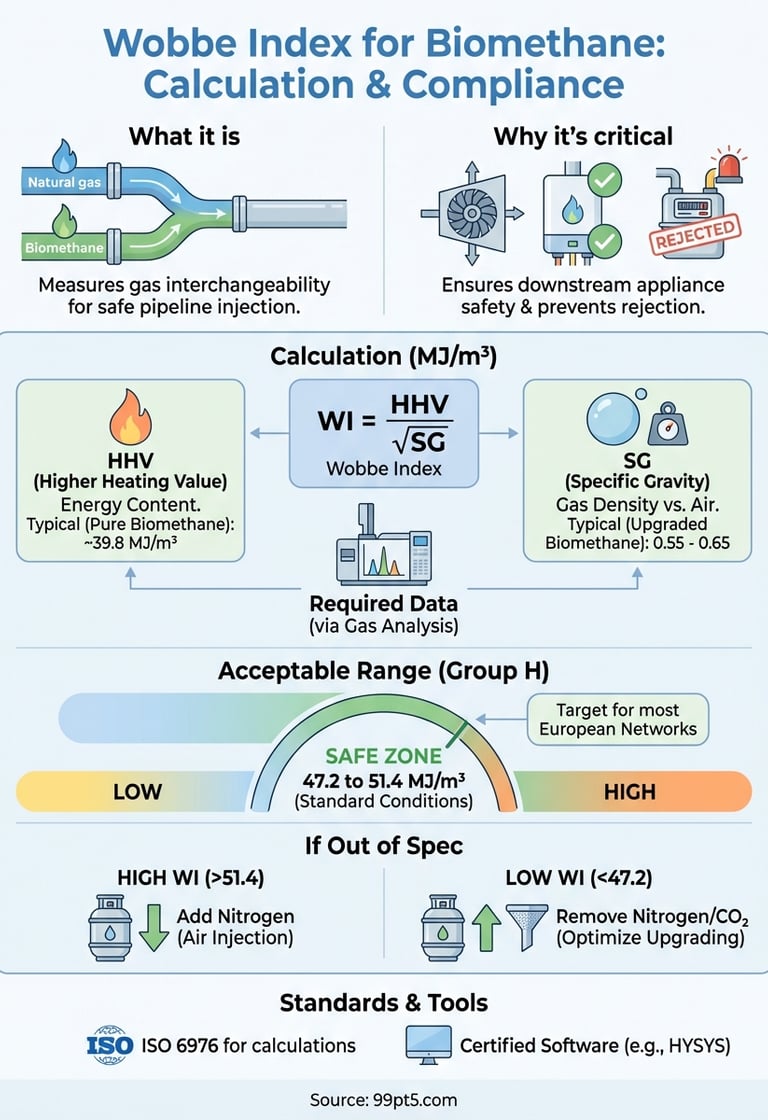
The Wobbe Index measures gas interchangeability in your biomethane system. It tells you whether your processed biogas can safely replace natural gas in existing pipeline infrastructure without requiring burner adjustments or causing equipment problems. Your gas must fall within specific Wobbe Index ranges that match the natural gas family classifications used by your regional network operator, or your biomethane will be rejected at the injection point.
Why the Wobbe index matters for gas interchangeability
When you inject biomethane into a natural gas grid, the end users' appliances (boilers, turbines, industrial burners) were designed for a specific energy delivery rate. The Wobbe Index accounts for both the energy content and the gas density, which together determine how much energy flows through a fixed orifice at constant pressure. Two gases with matching Wobbe Index values will deliver identical heat output through the same burner nozzle, even if their individual heating values differ significantly.
Understanding how to calculate wobbe index becomes critical when you're blending biogas streams or adjusting your upgrading process to meet network specifications.
Your biomethane project can face immediate rejection if the Wobbe Index falls outside the acceptable tolerance. Pipeline operators typically allow variations of only 5% from the target value. Beyond this range, you risk incomplete combustion in downstream equipment, potential safety hazards, and contract violations that can halt your gas injection operations entirely.
Common Wobbe index ranges in biomethane systems
Most European networks require biomethane to match Group H gas specifications, with Wobbe Index values between 47.2 and 51.4 MJ/m³ (measured at standard conditions). Your processed biogas typically achieves values in the 48 to 52 MJ/m³ range after upgrading. Lower values indicate either high nitrogen content or insufficient methane concentration, while higher values suggest excessive propane or butane presence in your feedstock.
Step 1. Collect the data for your gas
You need two specific values to calculate the Wobbe Index: your gas's higher heating value (HHV) and its specific gravity. Before you can begin the calculation, you must obtain a detailed gas composition analysis from your biomethane output stream. Most pipeline operators require this analysis through certified laboratory testing or continuous online gas analyzers installed at your processing facility.
Get a complete gas composition analysis
Your gas chromatograph (GC) provides the molar composition of your biomethane stream. You need the percentage of each component, including methane (CH₄), carbon dioxide (CO₂), nitrogen (N₂), oxygen (O₂), and any trace hydrocarbons like ethane or propane. Quality control standards typically require you to sample at the outlet of your upgrading system, right before the gas enters the pipeline injection point.
The analysis must meet ISO 6974 standards for natural gas composition determination. Your measurement should show methane content above 95% for most pipeline specifications. If your nitrogen content exceeds 5% or you detect significant oxygen presence (above 0.5%), you'll need to adjust your upgrading process before calculating the Wobbe Index.
Identify your higher heating value
The higher heating value (also called gross calorific value) represents the total energy your gas releases during complete combustion, including the latent heat from water vapor condensation. Your gas analyzer typically calculates this automatically from the molar composition using ISO 6976 standards. For pure biomethane with 98% methane, you should see HHV values around 39.8 MJ/m³ at standard conditions (15°C, 1.01325 bar).
Calculate or obtain specific gravity
Specific gravity compares your gas density to air density at identical conditions. Most modern analyzers calculate this value directly from your composition data. You can also manually calculate it by summing the products of each component's molar fraction and its molecular weight, then dividing by 28.96 (air's average molecular weight). Your typical upgraded biomethane shows specific gravity between 0.55 and 0.65, depending on residual CO₂ and nitrogen levels.
Understanding how to calculate wobbe index starts with accurate measurement of these fundamental gas properties at your specific operating conditions.
Step 2. Use the Wobbe index formula
You apply a straightforward mathematical formula once you have your HHV and specific gravity values. The calculation divides your higher heating value by the square root of your gas's specific gravity relative to air. Your result provides the energy delivery rate through a fixed orifice under constant pressure, which determines whether your biomethane can safely substitute for natural gas in existing pipeline infrastructure.
The basic Wobbe index equation
The Wobbe Index (WI) formula follows this structure:
WI = HHV / √(Specific Gravity)
Your HHV appears in the numerator, measured in megajoules per standard cubic meter (MJ/m³) or British thermal units per standard cubic foot (BTU/scf). The denominator contains the square root of your specific gravity, which remains dimensionless since it compares your gas density to air density. Your final result carries the same units as your heating value input.
Alternative formulations express the same calculation differently. Some standards write it as WI = HHV / √(ρgas/ρair), where ρ represents density. Both methods produce identical results because specific gravity equals the density ratio by definition. Pipeline operators in Europe typically work with MJ/m³ at 15°C and 1.01325 bar, while North American systems often use BTU/scf at 60°F and 14.73 psia.
Learning how to calculate wobbe index requires you to maintain consistent units throughout the equation, as mixing measurement systems will produce incorrect results that could lead to gas rejection.
Work through a real calculation example
Your upgraded biomethane stream shows a composition of 97.5% CH₄, 1.5% CO₂, and 1.0% N₂. The ISO 6976 calculation from this composition gives you an HHV of 39.2 MJ/m³ at standard conditions. Your specific gravity calculates to 0.585 based on the molecular weights of your gas components.
Step-by-step calculation:
Identify your HHV value: 39.2 MJ/m³
Identify your specific gravity: 0.585
Calculate the square root of specific gravity: √0.585 = 0.765
Divide HHV by this square root: 39.2 ÷ 0.765 = 51.24 MJ/m³
Your Wobbe Index equals 51.24 MJ/m³ for this biomethane sample. This value sits at the upper limit of the typical Group H gas range (47.2 to 51.4 MJ/m³). The slightly elevated result indicates your gas will deliver more energy per unit volume than standard natural gas, which could require blending with lower-Wobbe gas or adjusting your upgrading process to increase nitrogen content slightly.
Different gas compositions produce varying results. A sample with 95% CH₄, 3% CO₂, and 2% N₂ typically yields an HHV around 38.1 MJ/m³ and specific gravity of 0.595, producing a Wobbe Index of approximately 49.4 MJ/m³. This lower value falls comfortably within specification ranges for most European networks.
Step 3. Interpret and compare your result
You must compare your calculated Wobbe Index against the regional pipeline specifications that apply to your injection point. Your result determines whether your biomethane meets network requirements or needs adjustment before entering the distribution system. Pipeline operators maintain strict tolerances because gas interchangeability affects millions of downstream appliances that were calibrated for specific energy delivery rates.
Compare against regional gas family classifications
Your calculated value must fall within defined gas family ranges that vary by geographic region. European networks primarily use Group H specifications, while other regions follow different classifications. The table below shows the standard ranges you'll encounter:
Gas Family Wobbe Index Range (MJ/m³) Typical Application Group L 39.0 - 45.0 Low-calorific natural gas networks Group H 47.2 - 51.4 High-calorific natural gas (most common) Group E 48.2 - 56.5 Extended range for mixed sources
Most biomethane projects target Group H specifications because this matches conventional natural gas infrastructure. Your result from the previous example (51.24 MJ/m³) sits at the upper boundary, indicating your gas delivers slightly more energy than typical pipeline gas. Network operators typically allow ±5% variation from the nominal value before requiring corrective action.
Understanding how to calculate wobbe index helps you identify gas quality issues before they cause injection failures or contract violations.
Determine required adjustments
Your biomethane needs process adjustments when your Wobbe Index falls outside acceptable ranges. High Wobbe values (above 51.4 MJ/m³) require you to increase nitrogen content through controlled air injection or nitrogen blending at your upgrading facility. Low values (below 47.2 MJ/m³) indicate excessive nitrogen or insufficient methane removal, requiring you to optimize your membrane or PSA upgrading performance. Contact your network operator immediately if your value exceeds tolerance limits by more than 2%.
Extra tools, calculations and standards
You can verify your Wobbe Index calculations using standardized methods and specialized software that automate the complex computation process. These tools help you maintain compliance with international standards and reduce the risk of calculation errors that could lead to gas rejection. Your biomethane facility benefits from using multiple verification methods to ensure your gas quality documentation meets regulatory requirements.
Use ISO 6976 calculation software
The ISO 6976:2016 standard provides the definitive calculation method for gas properties including Wobbe Index, heating value, and relative density. You should implement software that follows this standard exactly, as pipeline operators use the same reference for their acceptance criteria. Several commercial process simulation packages like HYSYS or specialized gas calculation tools incorporate ISO 6976 algorithms directly.
Your calculation software needs these input parameters from your gas chromatograph:
Molar composition of all components (CH₄, C₂H₆, C₃H₈, CO₂, N₂, O₂)
Reference temperature (typically 15°C or 25°C)
Reference pressure (1.01325 bar or 14.696 psia)
Combustion reference temperature (25°C standard)
Calculate modified Wobbe index for turbines
Gas turbine manufacturers often specify the Modified Wobbe Index (MWI) instead of the standard value. This calculation accounts for fuel gas temperature at the injection point, which affects combustion performance. Your MWI formula divides the lower heating value by the square root of specific gravity multiplied by absolute temperature: MWI = LHV / √(SG × Tgas).
Understanding how to calculate wobbe index in both standard and modified forms gives you complete control over your gas quality specifications for different end uses.
Contact your turbine manufacturer for their specific MWI requirements, as tolerance ranges differ from pipeline specifications. Your gas preheating system affects this value significantly, with typical fuel temperatures ranging from 10°C to 40°C depending on your facility design.
Key points on Wobbe index
You calculate the Wobbe Index by dividing your higher heating value by the square root of your gas's specific gravity. This single parameter determines whether your biomethane can enter existing pipeline infrastructure without causing equipment problems downstream. Your calculated value must fall within the 47.2 to 51.4 MJ/m³ range for Group H gas specifications that govern most European networks.
Understanding how to calculate wobbe index gives you direct control over your gas quality compliance. You need accurate gas composition data from ISO 6974-compliant analyzers, proper application of ISO 6976 calculation standards, and immediate comparison against your regional pipeline requirements. Your facility avoids costly injection failures when you verify Wobbe Index values continuously throughout your upgrading process.
BioGas processing systems that guarantee precise methane recovery rates help you maintain consistent Wobbe Index values within specification. Your biomethane project needs reliable gas quality from digester to injection point, with automated monitoring that prevents out-of-spec gas from reaching your pipeline connection.