RNG Upgrading Explained: Process, Tech, Costs, Providers
Learn how RNG upgrading converts biogas to pipeline-quality biomethane. Compare technologies, understand costs, and choose the right provider.
RNG upgrading converts raw biogas into renewable natural gas that meets pipeline quality standards. The process removes carbon dioxide, hydrogen sulfide, water vapor, and other contaminants from biogas produced at landfills, wastewater treatment plants, and anaerobic digesters. What remains is biomethane with methane content typically between 95-99% that can be injected directly into natural gas distribution grids or compressed for use as vehicle fuel.
This guide walks you through the complete RNG upgrading process, from initial pre-treatment to final compression and injection. You'll learn about the core separation technologies available, the equipment required at different project scales, realistic cost ranges for both capital and operating expenses, and what to look for when selecting a technology provider. Whether you're planning a small farm project or a large municipal facility, you'll find the technical and economic details needed to move forward with confidence.
Why RNG upgrading matters for your projects
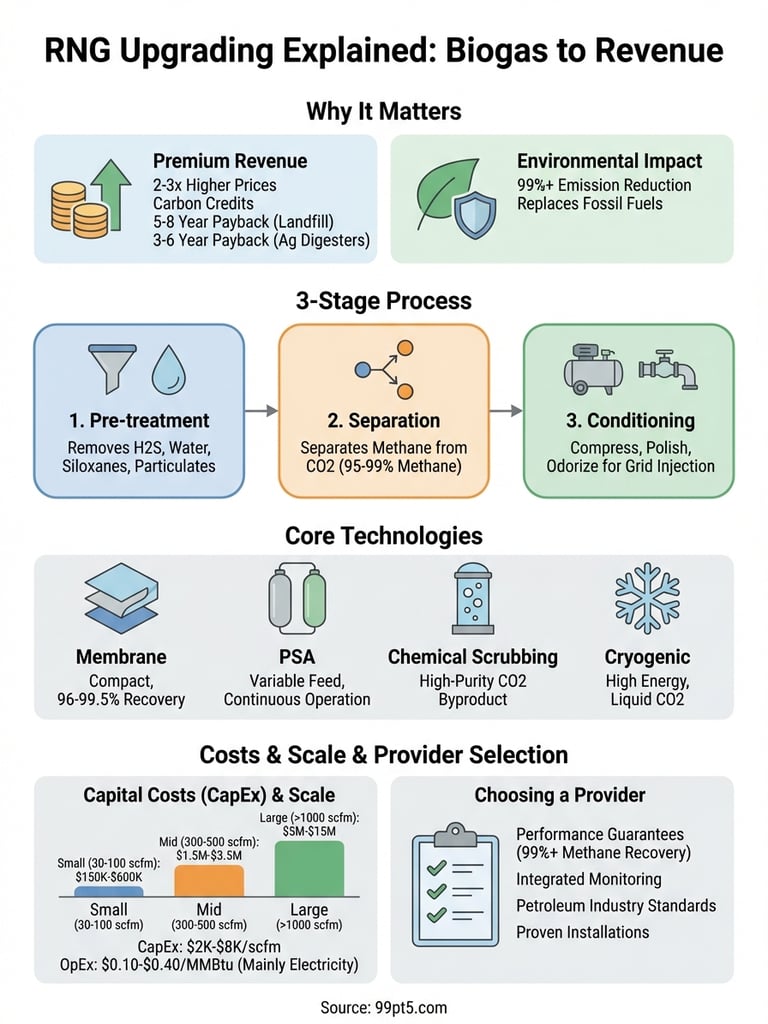
RNG upgrading transforms low-value biogas into a premium revenue stream that generates consistent income over 15-20 years. Your upgraded biomethane commands 2-3 times higher prices than electricity generated from the same biogas volume, while carbon credit programs pay you for every ton of CO2 equivalent you prevent from entering the atmosphere. Projects that skip upgrading and burn biogas in generators leave substantial revenue on the table and face increasing regulatory pressure to reduce methane emissions.
Financial returns that justify the investment
The economics work at almost any scale because you sell directly into existing natural gas infrastructure without building new distribution networks. Your biomethane replaces fossil fuels at commercial rates, and you capture additional revenue through renewable fuel credits like D3 RINs in the US or RTFO certificates in the UK. Landfill operators typically see payback periods of 5-8 years, while agricultural digesters often achieve returns within 3-6 years depending on feed quality and local incentives.
Well-designed RNG upgrading systems deliver the highest cash-on-cash returns in the renewable energy sector.
How to upgrade biogas into RNG step by step
RNG upgrading follows a three-stage process that progressively purifies your biogas from roughly 50-60% methane content up to pipeline-quality biomethane at 95-99%. Your raw biogas first passes through pre-treatment systems that remove bulk contaminants, then enters the main separation unit where CO2 and methane split apart, and finally moves through conditioning equipment that polishes the biomethane to meet injection specifications. Each stage handles specific impurities and operates at different pressures and temperatures optimized for maximum methane recovery.
Pre-treatment removes the heavy contaminants
Your biogas enters desulfurization units that strip out hydrogen sulfide before it can corrode downstream equipment or poison catalysts. Most systems use biological scrubbers, chemical absorption, or activated carbon filters depending on your H2S concentration and budget. The pre-treatment stage also removes siloxanes, ammonia, and particulates through condensation, filtration, and selective adsorption. Water vapor drops out through cooling and compression, reducing moisture content from saturation levels down to less than 50 parts per million.
Separation extracts methane from carbon dioxide
The core separation unit isolates pure methane molecules from the CO2-rich gas stream using membrane permeation, pressure swing adsorption, chemical scrubbing, or cryogenic separation. Your choice of technology determines your methane recovery rate, with advanced systems achieving 99.5% methane recovery versus industry averages around 96-97%. Carbon dioxide exits as a separate stream that you can either vent, capture for sale, or sequester for additional carbon credits.
Every percentage point of methane you lose during separation directly reduces your revenue and increases your environmental footprint.
Final conditioning prepares biomethane for injection
Conditioning equipment adjusts your biomethane's pressure, temperature, and energy content to match pipeline specifications in your region. You compress the gas to distribution pressures between 50-1000 psi, remove trace oxygen through catalytic reactors, and inject precise amounts of odorant for leak detection. Final quality analyzers verify your methane concentration, heating value, and dew point before the gas enters the grid or compression equipment for vehicle fuel applications.
RNG upgrading technologies and equipment
Your choice of separation technology determines your methane recovery rate, operating costs, and equipment footprint for the entire project lifecycle. Four primary technologies dominate the market, each with distinct advantages depending on your biogas volume, composition, and budget constraints. Membrane systems, pressure swing adsorption, chemical scrubbing, and cryogenic separation all achieve pipeline-quality biomethane, but they differ significantly in capital costs, energy consumption, and maintenance requirements.
Membrane separation delivers compact efficiency
Membrane systems push your biogas through selective polymer membranes that allow CO2 molecules to pass while blocking methane molecules. Your upgraded biomethane exits on the high-pressure side while carbon dioxide permeates through to the low-pressure side. These units occupy minimal space, require no chemicals, and operate with fewer moving parts than competitive technologies. Membrane systems work best with consistent biogas quality and achieve recovery rates between 96-99.5% when properly designed.
Pressure swing adsorption handles variable feedstocks
PSA units cycle through adsorption and regeneration phases using specialized carbon molecular sieves that preferentially capture CO2 under pressure. Your biogas flows through packed beds at 4-10 bar, where the adsorbent material traps CO2 while methane passes through. The system then swings to low pressure to release and vent the captured CO2. Multi-bed configurations allow continuous operation while individual beds regenerate, making PSA systems reliable for projects with fluctuating biogas composition.
Well-maintained PSA systems deliver consistent performance across wide ranges of biogas quality without operator intervention.
Chemical scrubbing maximizes CO2 capture
Scrubbing systems use water, amine solutions, or organic solvents to wash CO2 from your biogas stream through physical or chemical absorption. Your biogas bubbles up through the liquid scrubbing medium in absorption columns, where CO2 dissolves while methane remains gaseous. These systems excel when you need high-purity liquid CO2 as a saleable byproduct, turning a waste stream into additional revenue.
Costs, scale, and project economics
RNG upgrading capital costs range from $2,000 to $8,000 per standard cubic foot per minute (scfm) of processing capacity, with economies of scale favoring larger installations. Your total project investment includes the upgrading equipment, gas compression, interconnection infrastructure, and site preparation, which typically doubles the equipment purchase price. Operating expenses run between $0.10 and $0.40 per MMBtu of biomethane produced, covering electricity, maintenance, consumables, and monitoring systems.
Capital investment ranges by system size
Small systems processing 30-100 scfm cost $150,000 to $600,000 installed, making them viable for individual dairy farms and small digesters. Mid-scale projects handling 300-500 scfm require $1.5 to $3.5 million and serve larger agricultural operations or food processing facilities. Large installations above 1,000 scfm demand $5 to $15 million but achieve unit costs below $5,000 per scfm, making them attractive for landfills and wastewater treatment plants with substantial biogas volumes.
Your per-unit capital costs drop by 40-60% when you scale from 100 scfm to 500 scfm capacity.
Operating expenses that impact returns
Electricity consumption drives your largest operating cost, accounting for 40-70% of total OpEx depending on your separation technology and compression requirements. Membrane and PSA systems typically consume 0.25-0.35 kWh per cubic meter of biogas processed, while scrubbing systems may require 0.4-0.6 kWh. Maintenance costs average 2-4% of capital investment annually, covering filter replacements, catalyst regeneration, and routine inspections that prevent costly downtime.
How to choose an RNG upgrading provider
Your provider selection determines whether your project delivers guaranteed performance or disappointing results that erode profitability. You need vendors who back their systems with written guarantees for methane recovery rates, energy consumption, and uptime percentages rather than estimated ranges. Providers who design equipment to petroleum industry standards deliver the ruggedness and safety required for 20+ year operational lifespans, while those using light industrial components force you into frequent repairs and replacements.
Performance guarantees separate leaders from followers
Demand contractual commitments for 99% or higher methane recovery and 95%+ system availability backed by liquidated damages clauses. Your provider should specify exact operating costs per MMBtu produced rather than vague estimates that hide true expenses. Request reference projects where you can verify actual performance data against promised specifications, and avoid vendors who refuse to share operating results from existing installations. The best rng upgrading providers offer integrated monitoring systems that track real-time performance and alert you to issues before they cause downtime or methane losses.
Proven performance data from operating projects matters more than glossy brochures and theoretical calculations.
Key takeaways
RNG upgrading transforms your biogas into a revenue-generating asset that commands premium prices while reducing emissions by 99% or more. Your project economics depend on three factors: capital costs ranging from $2,000 to $8,000 per scfm, operating expenses between $0.10 and $0.40 per MMBtu, and guaranteed methane recovery rates that directly impact your bottom line. Choose separation technologies based on your biogas volume and composition, then select providers who back their systems with written performance commitments rather than estimated ranges.
The most successful projects start with equipment designed to petroleum industry standards that delivers 99.5% methane recovery and the lowest operating costs in the industry. Explore proven RNG upgrading systems from 99pt5 that guarantee maximum cash returns through integrated solutions built for 20+ year operational lifespans.