What Is Condition Monitoring? Methods, Sensors, and Benefits
Master what is condition monitoring: methods, sensors, and benefits. Prevent costly downtime, optimize equipment health, and boost ROI for biogas plants.
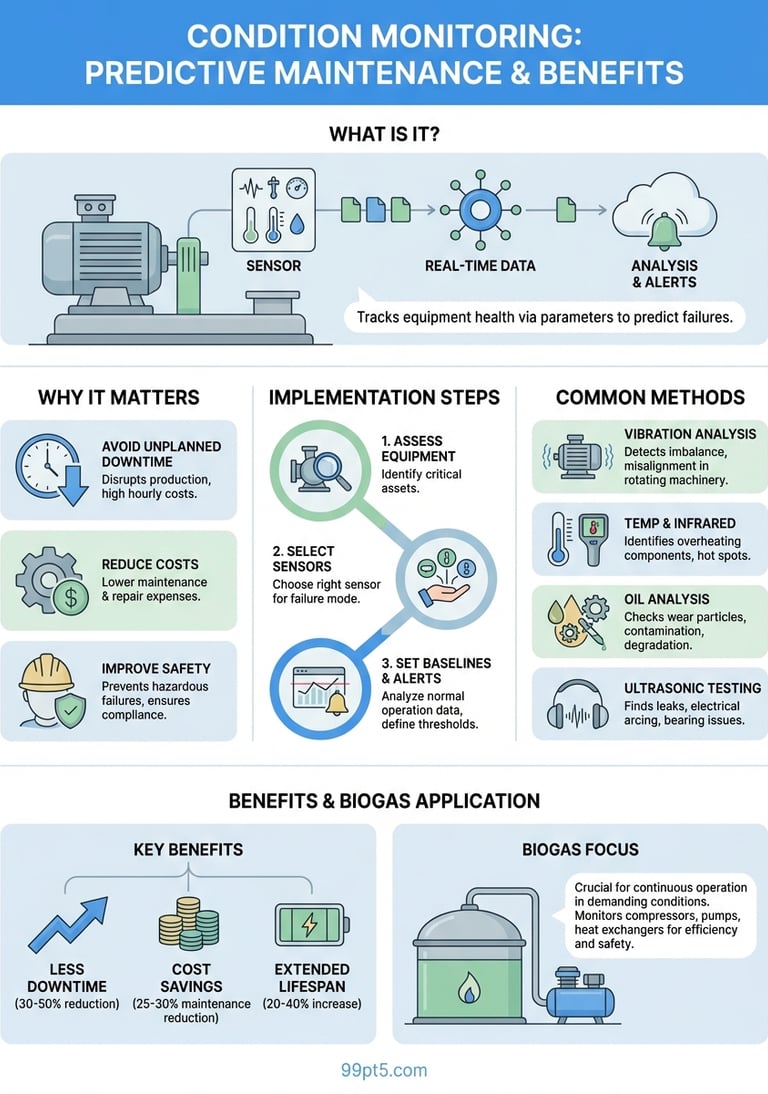
Condition monitoring tracks the health of your equipment by measuring specific parameters like vibration, temperature, and pressure in real time. When these measurements deviate from normal ranges, you get an alert that something needs attention. This approach shifts maintenance from reactive fixes or scheduled intervals to predictive action based on actual equipment condition.
You can catch problems before they cause breakdowns. A compressor running hotter than normal, a pump showing unusual vibration patterns, or a motor drawing excessive current all signal developing issues. Identifying these warning signs early prevents costly failures and unplanned downtime.
This article explains how condition monitoring works, the common methods and sensors you can use, and the practical benefits you gain from implementing it. We cover the implementation process, explore specific applications for biogas plants, and examine the return on investment you can expect. Whether you run a single facility or manage multiple sites, understanding condition monitoring helps you make informed decisions about protecting your equipment and maximizing uptime.
Why condition monitoring matters
Equipment failures cost you far more than repair bills. Unplanned downtime disrupts production schedules, forces you to pay overtime rates for emergency repairs, and puts your delivery commitments at risk. A single breakdown in critical equipment like compressors, pumps, or motors can halt operations for hours or days. Production losses during these shutdowns quickly exceed the cost of the failed component itself, especially in continuous processes like biogas generation where feed material keeps arriving regardless of equipment status.
Financial impact of unplanned downtime
Your facility loses revenue every minute equipment sits idle. Manufacturing plants report downtime costs ranging from $10,000 to over $250,000 per hour depending on industry and scale. These figures include lost production, wasted materials, labor costs, and contractual penalties. Condition monitoring cuts these losses by catching issues early when you can schedule repairs during planned maintenance windows. You maintain control over your operations instead of reacting to emergencies.
Predictive maintenance based on condition monitoring reduces maintenance costs by 25 to 30 percent compared to reactive approaches.
Safety and operational benefits
Failed equipment creates hazardous situations for your personnel. Rotating machinery under stress can break apart violently, pressure vessels can rupture, and overheating components can ignite fires. Monitoring systems alert you before these dangerous conditions develop. You protect your workers while avoiding environmental incidents and regulatory violations. Beyond safety, understanding what is condition monitoring helps you optimize equipment performance between maintenance intervals. Machines running at proper specifications consume less energy, produce higher quality output, and extend their operational lifespan. Your maintenance team shifts from firefighting failures to planned interventions based on actual equipment condition rather than arbitrary time intervals.
How to implement condition monitoring
Implementing condition monitoring requires a systematic approach that starts with identifying your critical assets and ends with continuous data analysis. You build the system in stages, each one adding capability and insight. The process transforms how your maintenance team operates, moving from reactive repairs to proactive interventions based on actual equipment condition.
Assess your critical equipment
Start by identifying which machines and systems impact your operations most significantly. Production-critical equipment like compressors, pumps, motors, and heat exchangers top your priority list. These assets drive your output and generate the highest costs when they fail. Auxiliary systems that support critical equipment come next, because their failure cascades to your main production line. Document each asset's failure history, maintenance costs, and downtime impact. This data helps you prioritize monitoring investments where you gain maximum return.
Calculate the financial impact of failure for each piece of equipment. Consider lost production, repair costs, safety risks, and environmental concerns. Equipment with high failure costs or frequent issues becomes your first monitoring target. Understanding what is condition monitoring helps you make these decisions based on business impact rather than gut feeling.
Select appropriate sensors and monitoring systems
Choose sensors that measure the parameters most relevant to your equipment's failure modes. Vibration sensors detect bearing wear, misalignment, and imbalance in rotating machinery. Temperature sensors identify overheating in motors, bearings, and electrical connections. Pressure sensors monitor hydraulic systems, pneumatic equipment, and process vessels for leaks or blockages. Match sensor specifications to your operating environment, accounting for temperature ranges, humidity, chemical exposure, and vibration levels.
Evaluate monitoring systems based on integration capability, data storage, analysis features, and alert mechanisms. Cloud-based platforms offer remote access and advanced analytics but require reliable internet connectivity. On-premise systems provide complete control and work in isolated facilities but need local IT infrastructure. Your monitoring system must connect seamlessly with existing control systems and maintenance management software.
Establish baseline measurements and alert thresholds
Run your equipment under normal conditions while collecting continuous data for two to four weeks. This period captures typical operating variations across different loads, temperatures, and production rates. Analyze the baseline data to establish normal ranges for each monitored parameter. Statistical analysis identifies acceptable variation boundaries and helps you set meaningful alert thresholds that distinguish real problems from normal fluctuations.
Set warning thresholds at 10 to 15 percent beyond normal operating ranges to catch developing issues before they become critical failures.
Configure your monitoring system with multiple alert levels. Warning alerts trigger when parameters exceed normal ranges, giving you time for planned maintenance. Critical alerts indicate immediate action is required to prevent failure or safety incidents. Test alert mechanisms thoroughly to ensure notifications reach the right personnel through multiple channels like email, SMS, and dashboard indicators.
Condition monitoring methods and techniques
Different monitoring methods detect different types of equipment problems. You select techniques based on your equipment type, failure modes, and operating environment. Each method measures specific parameters that indicate developing faults before they cause failures. Understanding what is condition monitoring means knowing which technique best suits each piece of equipment. Combining multiple methods provides comprehensive coverage and catches problems that single-parameter monitoring might miss.
Vibration analysis for rotating equipment
Vibration analysis detects problems in pumps, motors, compressors, fans, and other rotating machinery. Accelerometers and velocity sensors measure vibration patterns at different frequencies and amplitudes. Changes in these patterns indicate specific faults: excessive vibration at running speed suggests imbalance, vibration at twice running speed points to misalignment, and high-frequency spikes reveal bearing defects. You can identify problems weeks or months before failure occurs.
Modern vibration analyzers perform fast Fourier transform (FFT) analysis to separate complex vibration signals into individual frequency components. This analysis pinpoints exactly which component is failing. A bearing with a defect on its outer race produces vibration at a specific frequency calculated from bearing geometry and shaft speed. Your maintenance team uses this information to order the correct replacement part and schedule repairs during planned downtime.
Temperature and infrared monitoring
Infrared thermography cameras visualize temperature distributions across equipment surfaces. Overheating components appear as hot spots in thermal images long before visible damage occurs. Electrical connections with high resistance generate excess heat, motor windings with insulation breakdown run hotter than normal, and bearings with inadequate lubrication show elevated temperatures. You scan equipment during operation without physical contact or production interruption.
Temperature sensors like resistance temperature detectors (RTDs) and thermocouples provide continuous monitoring at critical points. These sensors track bearing temperatures, motor winding temperatures, and process fluid temperatures. Gradual temperature increases signal developing problems, while rapid changes indicate immediate issues requiring emergency shutdown.
Equipment running 10 degrees Celsius above normal temperature indicates developing problems that will cause failure within weeks if left unaddressed.
Oil analysis and tribology
Oil analysis detects wear particles, contamination, and oil degradation in lubricated equipment. Laboratory testing measures particle counts, identifies metal types, and evaluates oil properties like viscosity and acidity. High iron content indicates gear or bearing wear, silicon particles suggest seal leaks allowing dirt entry, and water contamination leads to corrosion and reduced lubrication effectiveness. You catch problems before they cause catastrophic failure.
Portable oil analysis devices provide on-site testing for quick decisions. These tools measure particle counts, water content, and oil condition in minutes. Regular oil sampling intervals depend on equipment criticality and operating conditions, ranging from monthly checks on critical machinery to quarterly sampling on less vital equipment.
Ultrasonic and acoustic testing
Ultrasonic detectors identify leaks, electrical arcing, and bearing problems by measuring high-frequency sounds inaudible to human hearing. Compressed air leaks waste energy and reduce system pressure, steam leaks represent both energy loss and safety hazards, and vacuum leaks compromise process conditions. You detect these problems by scanning equipment with ultrasonic sensors that convert high-frequency sounds to audible signals through headphones.
Acoustic emission testing monitors structural integrity in pressure vessels, storage tanks, and piping systems. Cracks propagating through metal generate acoustic waves that sensors detect. This technique finds defects deep within materials where visual inspection cannot reach. Your inspection team uses acoustic testing during hydrostatic tests and operational monitoring to ensure vessel safety.
Sensors and data for condition monitoring
Understanding what is condition monitoring requires knowing how sensors collect data and transform it into actionable maintenance decisions. Modern sensors generate continuous streams of information about equipment health, operating conditions, and performance trends. Your monitoring system depends on selecting the right sensors for each application, integrating their data effectively, and analyzing results to catch problems before failures occur. The sensor technology you choose directly impacts detection accuracy, response time, and maintenance planning effectiveness.
Common sensor types and applications
Vibration sensors measure acceleration, velocity, or displacement in rotating equipment. Piezoelectric accelerometers detect high-frequency vibrations indicating bearing defects, while velocity transducers monitor lower frequencies associated with imbalance and misalignment. You mount these sensors permanently on critical equipment or use portable analyzers for periodic measurements. Accelerometers work best at frequencies above 10 Hz, making them ideal for bearing diagnostics, while velocity sensors excel at frequencies between 10 Hz and 1 kHz for general machinery monitoring.
Temperature sensors include thermocouples for high-temperature applications up to 1,200 degrees Celsius and RTDs for precise measurements in lower temperature ranges. You install these sensors at bearing housings, motor windings, and gearbox casings to track thermal conditions. Infrared cameras provide non-contact temperature measurement across entire equipment surfaces, revealing hot spots invisible to installed sensors.
Pressure transducers monitor hydraulic systems, pneumatic equipment, and process vessels. Strain gauge sensors measure static pressures while piezoelectric sensors track rapid pressure changes. Current sensors detect electrical faults by measuring power consumption patterns. Increases in current draw indicate motor overload, bearing friction, or electrical insulation breakdown.
Data collection and integration
Your condition monitoring system collects sensor data at rates from once per second for slow-changing parameters like temperature to thousands of samples per second for vibration analysis. Data acquisition modules convert analog sensor signals to digital format, timestamp each measurement, and transmit information to your monitoring software. These modules connect via industrial protocols like Modbus, OPC, or Ethernet/IP to ensure compatibility with existing control systems.
Effective condition monitoring requires collecting data at sampling rates at least twice the highest frequency you need to detect.
Cloud-based platforms store historical data for trend analysis while providing remote access from any internet-connected device. Edge computing devices process data locally, reducing bandwidth requirements and enabling faster response to critical alerts. Your monitoring system tags each data point with equipment identifiers, measurement types, and operating conditions to enable meaningful comparisons across time and similar assets.
Data analysis and actionable insights
Machine learning algorithms detect subtle pattern changes that indicate developing problems. Anomaly detection compares current measurements against historical baselines to identify deviations requiring investigation. These algorithms learn normal operating patterns automatically, adapting to seasonal changes and production variations without manual threshold adjustments.
Predictive analytics estimate remaining useful life based on degradation rates measured over time. Trend analysis projects when parameters will exceed critical limits, giving you weeks or months advance notice to plan maintenance. Your system generates work orders automatically when predictions indicate intervention within your planning horizon. Diagnostic algorithms identify specific failure modes from sensor signatures, telling you exactly which bearing needs replacement or which component requires adjustment before you dispatch technicians.
Using condition monitoring in biogas plants
Biogas facilities present unique monitoring challenges due to corrosive gases, variable feed materials, and continuous operation requirements. Your anaerobic digester system runs 24/7, processing organic waste into biogas that feeds downstream purification equipment. Equipment failures in this environment cause more than production losses. They can release methane emissions, create safety hazards, and violate environmental permits. Understanding what is condition monitoring becomes critical when your facility handles flammable gases and operates under strict regulatory oversight.
Critical equipment requiring monitoring
Your biogas compressors, pumps, and blowers operate under demanding conditions with sulfur compounds and moisture in the gas stream. Compressor monitoring tracks bearing temperatures, vibration patterns, and discharge pressures to prevent failures that interrupt gas flow to your purification system. Pump systems moving digestate and recirculation streams need monitoring because blockages from fibrous materials cause cavitation and mechanical damage. You install vibration sensors on pump motors and monitor current draw to detect clogging before impellers fail.
Heat exchangers in your biogas upgrading system accumulate fouling that reduces efficiency and increases pressure drop. Temperature differential monitoring across exchanger inlets and outlets reveals fouling patterns weeks before performance degrades noticeably. Pressure sensors track system resistance, alerting you when cleaning becomes necessary to maintain optimal heat transfer rates.
Process-specific monitoring strategies
Your gas conditioning equipment removes hydrogen sulfide and other contaminants before biogas enters the purification system. Desulfurization catalyst beds degrade over time, reducing removal efficiency. You monitor differential pressure across catalyst vessels and track outlet H2S concentrations to schedule catalyst replacement based on actual performance rather than manufacturer time recommendations. This approach extends catalyst life while ensuring specification compliance.
Monitor compressor vibration and bearing temperature continuously because biogas contains corrosive compounds that accelerate wear rates compared to clean gas applications.
Digesters themselves benefit from condition monitoring through temperature stratification measurements, mixing effectiveness tracking, and biogas production rate analysis. You detect feeding problems, mixing failures, or biological upsets early enough to adjust operations before biogas quality deteriorates. Integration between process monitoring and equipment health data gives you complete visibility into facility performance.
Benefits, challenges, and ROI
Implementing condition monitoring delivers measurable returns that extend beyond preventing failures. Your maintenance costs drop by 25 to 30 percent compared to reactive approaches, while equipment lifespan increases by 20 to 40 percent through timely interventions. You gain predictability in operations that transforms how your facility plans production schedules, manages inventory, and allocates resources. These benefits compound over time as your team builds expertise in interpreting data and refining maintenance strategies.
Financial returns and cost savings
Your condition monitoring investment typically pays for itself within 12 to 18 months through avoided downtime and optimized maintenance intervals. Direct savings come from eliminating emergency repair premiums, reducing overtime labor costs, and preventing production losses. Indirect savings accumulate through improved energy efficiency, extended equipment life, and lower spare parts inventory requirements. A facility with ten critical assets might spend $50,000 to $100,000 on monitoring systems but avoid $200,000 to $500,000 in annual downtime costs.
Maintenance teams shift labor hours from reactive firefighting to planned interventions that cost less and deliver better results. You complete repairs during scheduled downtime when parts are ready and technicians are prepared, rather than scrambling at 2 AM with expedited shipping charges. Energy consumption drops as equipment operates within optimal parameters instead of struggling with worn bearings or misalignment that increases friction and power draw.
Organizations implementing condition monitoring report 30 to 50 percent reductions in unplanned downtime within the first year of deployment.
Implementation challenges
Initial setup requires careful planning and resource allocation that some organizations underestimate. Sensor installation may require equipment modifications, scaffolding access, or production shutdowns that complicate project schedules. Your personnel need training to interpret data, respond to alerts appropriately, and adjust maintenance procedures based on condition information rather than calendar intervals. This learning curve extends for three to six months while your team develops confidence in the system.
Data overload presents another challenge as sensors generate thousands of measurements daily. You must establish clear escalation procedures defining who responds to different alert types and under what timeframes. False alarms from improperly set thresholds or sensor issues erode confidence in the system if not addressed quickly through threshold refinement and sensor validation.
Measuring success
Track key performance indicators that demonstrate condition monitoring effectiveness across your facility. Calculate availability by measuring actual operating hours against scheduled hours, targeting increases of 5 to 10 percent in the first year. Monitor mean time between failures for critical equipment, expecting 50 to 100 percent improvements as predictive interventions prevent catastrophic breakdowns. Document maintenance cost per unit of production to quantify efficiency gains that understanding what is condition monitoring brings to your operations.
Key takeaways
Understanding what is condition monitoring gives you the foundation to transform your maintenance approach from reactive to predictive. Your equipment tells you when it needs attention through vibration patterns, temperature changes, and other measurable parameters long before failures occur. Implementing monitoring systems requires upfront investment in sensors and software, but you recover these costs within 12 to 18 months through avoided downtime and optimized maintenance schedules.
Biogas facilities gain particular advantages from condition monitoring because equipment operates continuously under demanding conditions with corrosive gases and variable feedstocks. Your compressors, pumps, and purification systems benefit from real-time health tracking that prevents production interruptions and maintains environmental compliance. Facilities using advanced biogas processing equipment need reliable monitoring to protect their investment and maximize uptime. Discover how 99pt5's BioTreater system integrates with condition monitoring solutions to deliver guaranteed performance and industry-leading efficiency in biogas purification.