What Is Gas Compression? How It Works, Uses, and Equipment
What is gas compression? Learn how it works, explore equipment types, and see how biogas facilities use it to produce pipeline-quality biomethane.
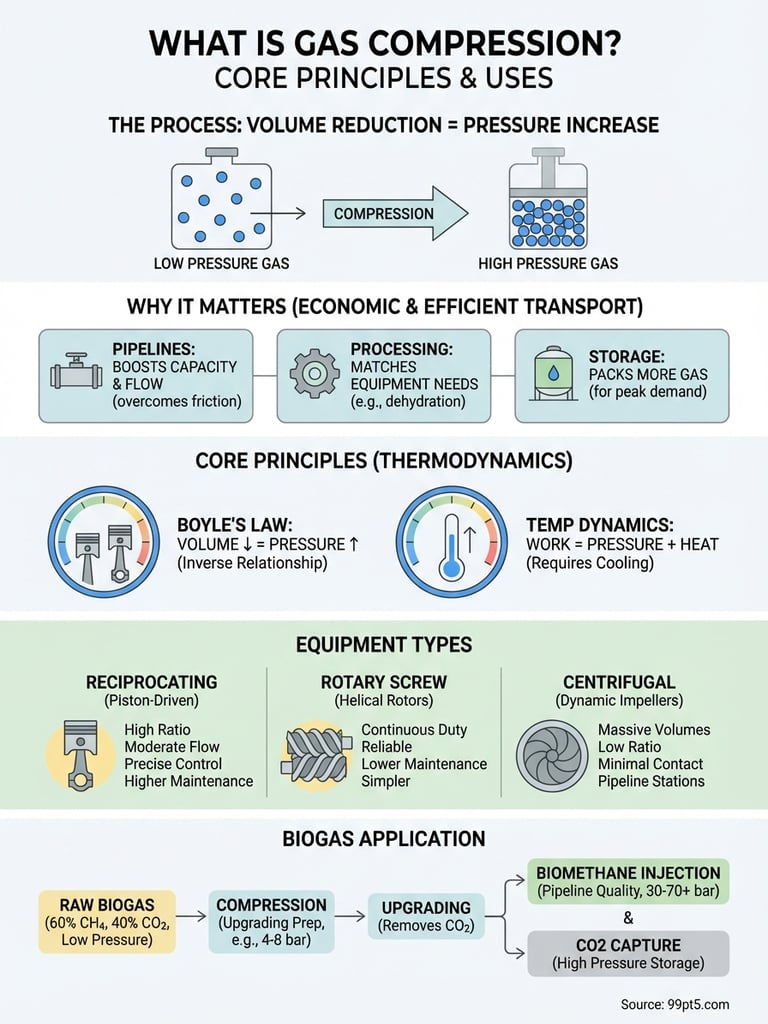
What is gas compression? It's a mechanical process that increases gas pressure by reducing its volume. You take a gas at low pressure and compress it into a smaller space, which raises its pressure and makes it easier to move through pipelines or store for later use. Natural gas producers rely on this process to transport fuel from wells to processing plants and eventually to consumers. Without compression, moving gas over long distances would be impossible because low-pressure gas lacks the force needed to flow through pipelines efficiently.
This guide covers everything you need to know about gas compression systems. You'll learn why compression matters for natural gas operations, how to apply it in your projects, and which equipment types handle different requirements. We'll explain the core principles that make compression work, walk through the main compressor categories, and show you how biogas and biomethane facilities use compression to upgrade raw gas into pipeline-quality fuel. Whether you're planning a new installation or improving an existing system, you'll understand the technical and economic factors that drive successful compression projects.
Why gas compression matters
You need gas compression to move natural gas economically from production sites to end users. Raw gas emerges from wells at pressures too low to push through hundreds of miles of pipeline. Compression systems boost that pressure, creating the force needed to overcome friction and maintain steady flow rates. Without this pressure boost, you would need impractically large pipelines or multiple smaller networks, both of which drive costs up significantly.
Pipeline economics depend on pressure
Higher pressure lets you move more gas through the same pipe diameter. Pipeline capacity increases proportionally with pressure, so doubling the pressure nearly doubles the volume you transport. This relationship makes compression essential for maximizing infrastructure investment.
Understanding what is gas compression means recognizing its direct impact on pipeline economics and transport efficiency.
Processing facilities require specific pressures
Gas processing equipment operates within defined pressure ranges for optimal performance. You need compression to match the pressure requirements of dehydration units, amine systems, and other processing equipment. Storage facilities also require compression to pack more gas into limited volumes, which proves critical for managing supply during peak demand.
How to apply gas compression in projects
You start by calculating your pressure requirements based on pipeline distance, gas composition, and end-use specifications. Your compressor must deliver enough pressure to overcome friction losses throughout the system while maintaining the flow rates your project demands. Survey your gas source pressure, measure the required delivery pressure at your destination, and account for seasonal variations that affect both supply conditions and demand patterns. This baseline analysis determines the compression ratio you need, which directly influences equipment selection and operating costs.
Assess your gas characteristics
Your raw gas composition affects compressor design and material selection. You need to analyze contaminant levels like hydrogen sulfide, water vapor, and particulates before choosing equipment. High moisture content requires upstream dehydration, while corrosive compounds demand special metallurgy or coating systems. Temperature ranges at your site also matter because compressors generate heat during operation, and extreme ambient conditions affect cooling efficiency and mechanical reliability.
Select equipment based on operational goals
Match your compressor type to your project's duty cycle and maintenance capabilities. Reciprocating compressors handle high compression ratios efficiently but require more frequent service intervals. Rotary screw units offer continuous operation with lower maintenance needs, making them suitable for unmanned facilities. Understanding what is gas compression means recognizing that your choice affects both capital expenditure and long-term operating expenses.
Your equipment selection determines operational reliability and total cost of ownership over the project lifecycle.
Calculate energy consumption across different compressor options because fuel costs typically exceed initial equipment prices within the first year of operation.
Core principles of gas compression
You reduce gas volume to increase its pressure according to the fundamental laws of thermodynamics. When you compress gas, you force molecules closer together, which raises both pressure and temperature. This relationship forms the basis of all compression operations, regardless of equipment type or application. The compression ratio equals your discharge pressure divided by suction pressure, and this ratio determines how much work your equipment must perform. Higher ratios require more energy and generate more heat, which affects both operating costs and equipment design requirements.
Pressure and volume relationship
Your compressor works against the natural tendency of gas to expand and occupy available space. Boyle's Law describes this inverse relationship: when you halve the volume, you double the pressure at constant temperature. Real-world compression deviates from this ideal behavior because gas properties change under pressure, especially at high compression ratios. You account for these deviations using compressibility factors specific to your gas composition, which ensure accurate performance predictions and proper equipment sizing.
Energy and temperature dynamics
Compression converts mechanical energy into both pressure and heat. Your gas temperature rises during compression because you add energy to the molecules, increasing their kinetic motion. Understanding what is gas compression requires recognizing that this temperature increase can damage equipment or create safety hazards if you don't manage it properly. You remove heat through intercoolers or jacketed cylinders, which improves efficiency and protects mechanical components.
Effective heat management during compression directly impacts both equipment longevity and operational efficiency.
Main types of gas compression equipment
You choose from three primary compressor categories based on your flow rates, pressure requirements, and operational constraints. Each type uses different mechanical principles to compress gas, which affects performance characteristics, maintenance needs, and capital costs. Reciprocating compressors dominate applications requiring high compression ratios with moderate flow volumes. Rotary screw units serve continuous-duty operations where reliability matters more than peak efficiency. Centrifugal compressors handle large volumes at lower compression ratios, making them ideal for major pipeline stations and processing facilities. Rotary vane compressors offer the best features for processing BioGas.
Rotary Vane Compressors
Rotary vane compressors are engineered to outperform traditional oil-flooded screw and reciprocating models. Its pure rotary motion ensures whisper-quiet, vibration-free, and pulse-free BioGas processing. The design features a single moving part and direct-coupled motor, eliminating belts, pulleys, and unnecessary complexity. Further advantages include industry leading energy efficiency and responsive control. A servo-modulated intake compresses only the BioGas demanded - providing more precise, responsive, and energy-efficient operation than traditional slide or inlet valves, especially under variable loads. This smooth operation reduces mechanical stress and extends service life to reduce overall OPEX. 99pt5 uses only rotary vane compressors on all its BioTreater™ upgrading equipment.
Reciprocating compressors
Piston-driven reciprocating units compress gas through back-and-forth motion inside cylinders, similar to automotive engines. You achieve high compression ratios in single or multiple stages, with each stage increasing pressure incrementally. These compressors deliver precise flow control and handle varying inlet conditions effectively. Your maintenance schedule requires regular inspection of pistons, rings, and valves because these components experience significant wear. Applications requiring high discharge pressures for long-distance pipeline transport favor reciprocating designs despite their higher service requirements.
Rotary screw compressors
Helical rotors trap gas between meshing screws and reduce volume continuously as the gas moves toward the discharge port. You operate these units at constant speed with minimal vibration, which reduces foundation requirements and simplifies installation. Their design includes fewer moving parts compared to reciprocating types, cutting maintenance frequency and extending service intervals. Understanding what is gas compression helps you recognize that screw compressors sacrifice some efficiency for operational simplicity, making them suitable for remote sites or unmanned facilities.
Rotary screw compressors provide reliable continuous operation with significantly reduced maintenance compared to reciprocating units.
Centrifugal compressors
Dynamic compression through rotating impellers accelerates gas outward, converting velocity into pressure. You handle massive flow volumes exceeding what reciprocating or screw types can manage economically. These units require minimal maintenance because they operate without contacting metal surfaces, though they need precise alignment and vibration monitoring. Large pipeline booster stations use centrifugal designs to move billions of cubic feet daily at compression ratios below 3:1.
Gas compression in biogas and biomethane
You apply gas compression differently in biogas operations compared to conventional natural gas systems. Raw biogas emerges from anaerobic digesters at near-atmospheric pressure containing 60% methane, 40% CO2, plus trace contaminants like hydrogen sulfide and water vapor. Your compression system must handle this corrosive mixture while preparing it for upgrading equipment that removes CO2 and produces pipeline-quality biomethane. Understanding what is gas compression in this context means recognizing that you're not just moving gas but enabling the entire purification process.
Processing and injection requirements
Biogas upgrading systems require specific inlet pressures to operate efficiently, typically between 4-8 bar depending on technology. Your compressor provides this pressure while maintaining steady flow rates that match digester output. After upgrading, you need additional compression to inject biomethane into natural gas pipelines, which operate at 30-70 bar in distribution networks. Projects that capture and liquefy CO2 for sale require separate compression trains to reach storage pressures exceeding 50 bar.
Biogas compression enables both the upgrading process and final pipeline injection, making it essential for renewable natural gas projects.
Bringing gas compression together
You now understand what is gas compression means for both conventional natural gas and biogas operations. Your compression system choice affects every aspect of project economics, from capital investment through decades of operating costs. Companies designing complete biomethane generation systems need equipment that guarantees performance while minimizing operational expenses. 99pt5's BioTreater™ system uses rotary vane compressors to delivers 99.5% BioMethane recovery with industry-leading efficiency, combining advanced compression with complete gas processing in a single integrated solution. Contact us to discuss how our proven technology reduces your project costs while maximizing environmental and financial returns.