ATEX Certification Explained: Zones, Codes, And Requirements
Learn to navigate hazardous zones and equipment codes. Get ATEX certification explained to ensure safety and compliance in explosive atmospheres.
BioGas contains methane, a highly flammable substance that creates serious explosion risks when mixed with air. Any equipment operating in these environments must meet strict safety standards, which is where ATEX certification explained becomes essential knowledge for anyone specifying or installing BioMethane systems. At 99pt5, we build our BioTreater™ systems to petroleum industry standards precisely because we understand what's at stake when equipment fails in hazardous atmospheres.
ATEX certification isn't just a regulatory checkbox. It's a comprehensive framework established by the European Union that classifies hazardous zones, sets equipment requirements, and defines the safety measures necessary to prevent ignition sources in explosive environments. For system integrators working with farmers, industrial facilities, or government projects, understanding these classifications directly impacts equipment selection, installation compliance, and long-term operational safety.
This article breaks down the ATEX framework into practical terms: what the different zones mean, how to read equipment classification codes, and what requirements your BioGas processing equipment must meet.
Why ATEX certification matters
BioGas processing equipment operates in environments where ignition sources meet explosive atmospheres daily. You're dealing with methane concentrations that can reach dangerous levels during normal operations, maintenance shutdowns, or equipment malfunctions. Without proper ATEX-rated equipment, a single spark from a motor, static discharge from a control panel, or hot surface from a compressor could trigger an explosion that destroys facilities and injures personnel.
What happens when equipment fails
Non-compliant equipment creates direct liability for system integrators and end-clients. Insurance companies scrutinize equipment specifications after incidents, and claims get denied when non-ATEX equipment operates in classified zones. You also face project shutdowns when inspectors discover equipment that doesn't match the hazardous area classification. Regulatory bodies across the EU enforce ATEX requirements strictly, with penalties ranging from fines to facility closures.
ATEX certification isn't optional in explosive atmospheres. It's the baseline requirement that protects your business, your clients, and their workers.
Beyond safety compliance
ATEX certification delivers operational advantages that impact your bottom line. Equipment built to these standards undergoes rigorous testing for reliability, which means fewer failures and lower maintenance costs over the system's lifetime. When you specify ATEX-compliant equipment like the BioTreater™ system, you're selecting components engineered with petroleum industry standards for durability and performance. Your clients benefit from reduced downtime, and you build a reputation for delivering systems that meet the highest safety benchmarks without compromising efficiency or requiring constant oversight.
The two ATEX directives and key duties
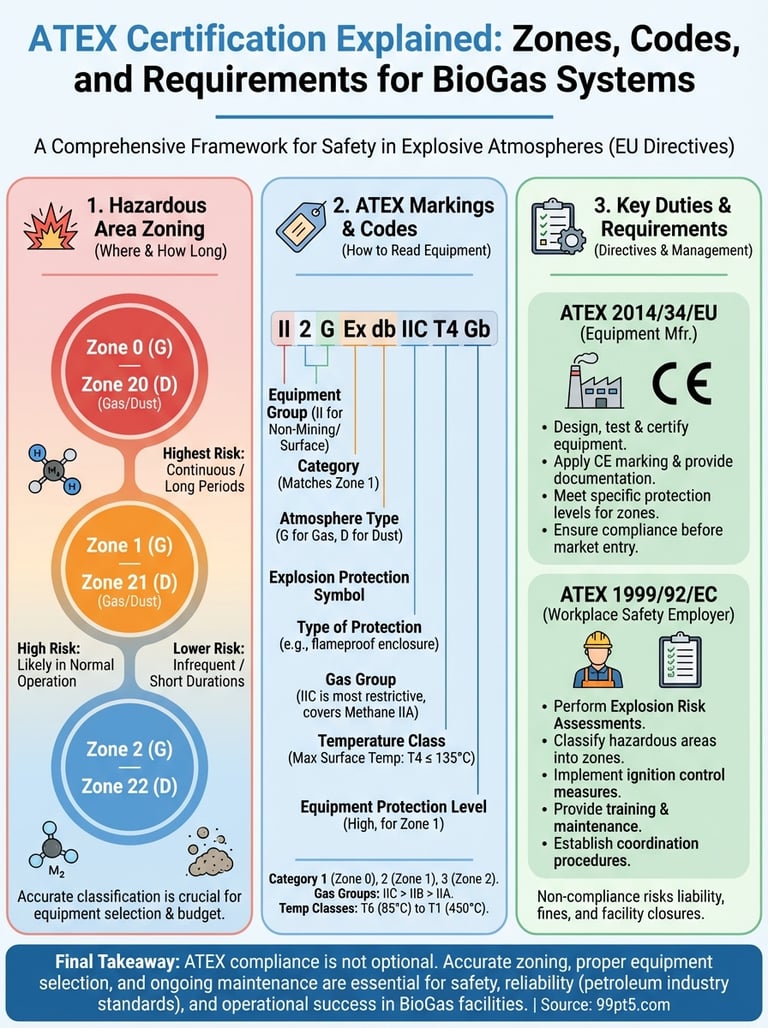
The ATEX framework operates through two separate EU directives that work together to create comprehensive protection in explosive atmospheres. ATEX 2014/34/EU governs equipment manufacturers, while ATEX 1999/92/EC regulates workplace safety for employers. When you specify BioGas processing equipment, both directives impact your responsibilities because you're selecting equipment (manufacturer's duty) that will operate in classified zones (employer's duty).
ATEX 2014/34/EU: Equipment standards
This directive requires manufacturers to design, test, and certify equipment before it enters explosive atmospheres. Equipment must undergo conformity assessment procedures through notified bodies that verify compliance with essential health and safety requirements. Manufacturers apply CE marking and provide technical documentation proving their equipment meets specific protection levels for the intended zone classification.
Your equipment selection starts here because only properly certified equipment can legally operate in ATEX zones.
ATEX 1999/92/EC: Workplace safety
Employers must perform explosion risk assessments, classify hazardous areas into zones, and implement measures that eliminate or reduce ignition sources. You're responsible for ensuring workers receive proper training, maintaining equipment according to manufacturer specifications, and establishing coordination procedures when contractors work on-site. This directive explains why proper equipment selection matters: your workplace classification determines which equipment protection levels you need.
How hazardous area zoning works
ATEX classifies hazardous areas into specific zones based on how frequently explosive atmospheres appear and how long they persist. You need to understand this zoning system because it determines which equipment protection levels your installation requires. The classification process examines gas and dust concentrations, ventilation effectiveness, and operational patterns to assign the appropriate zone designation for each area of your facility.
Gas and dust classifications
BioGas facilities deal primarily with gas atmospheres rather than dust, but ATEX certification explained covers both scenarios. Gas zones (0, 1, 2) apply to environments where flammable vapors or gases like methane create explosion risks. Dust zones (20, 21, 22) apply to facilities handling combustible particulates. Your BioMethane system typically operates under gas classification rules, though facilities processing biosolids may encounter both classifications in different areas.
Zone classification system
Zone 0 represents the highest risk: explosive atmospheres exist continuously or for long periods. Zone 1 covers areas where explosive atmospheres will likely occur during normal operations. Zone 2 applies where explosive atmospheres appear infrequently and for short durations. Equipment protection requirements increase as you move from Zone 2 to Zone 0, with Zone 0 demanding the most rigorous safety features.
Your zone classification directly determines equipment costs and installation complexity, making accurate assessment critical for project budgeting.
How to read ATEX markings and codes
Every ATEX-certified piece of equipment carries specific markings that tell you exactly where it can operate safely. These codes follow a standardized format revealing the equipment's protection level, suitable zones, temperature class, and approved gas groups. You need to match these markings against your facility's zone classification to ensure compliance and avoid regulatory issues during inspections.
Equipment group and category codes
ATEX markings start with the equipment group (I for mining, II for surface industries like BioGas) followed by a category number (1, 2, or 3). Category 1 equipment provides the highest protection level and works in Zone 0, Category 2 suits Zone 1, and Category 3 fits Zone 2. You'll see "II 2G" on equipment designed for surface industry gas atmospheres in Zone 1, which covers most BioGas processing applications.
Temperature classes and gas groups
The marking continues with a temperature class (T1 through T6) indicating the maximum surface temperature the equipment produces. T1 allows up to 450°C while T6 restricts surfaces to 85°C. Gas groups (IIA, IIB, IIC) specify which flammable substances the equipment safely handles, with IIC offering the broadest protection. Methane falls under IIA, but choosing IIC-rated equipment provides additional safety margins for facilities processing varying feedstocks.
Understanding these codes ensures you select equipment that matches your facility's specific hazardous area classification.
How to choose and manage ATEX equipment
Selecting the right ATEX equipment starts with accurate zone classification for every area where processing components operate. You must verify that equipment category markings match your facility's zones, checking both gas group compatibility and temperature class ratings before purchase. The BioTreater™ system comes with complete ATEX documentation that simplifies this verification process, letting you focus on integration rather than compliance research.
Match equipment to zone requirements
Your zone assessment determines which equipment categories you need for each location. Zone 0 areas require Category 1 equipment with the highest protection levels, while Zone 2 locations accept Category 3 with basic safeguards. Equipment ratings must meet or exceed your zone classification requirements. Never install lower-rated equipment in higher-risk zones, even temporarily during maintenance or testing procedures.
Equipment selection errors create liability that audits and inspections will expose, potentially shutting down operations.
Ongoing maintenance and documentation
ATEX certification explained includes post-installation responsibilities that system integrators must communicate to end-clients. You need documented maintenance schedules following manufacturer specifications, regular inspections verifying equipment integrity, and worker training programs covering explosion prevention procedures. Keep certification documents accessible for regulatory inspections, and replace any equipment showing damage that compromises its protection rating before resuming operations in classified zones.
Final takeaways
ATEX certification explained boils down to three critical components: accurate zone classification, proper equipment selection, and ongoing compliance management. You need equipment that matches your facility's specific hazardous area designations, documentation that proves certification, and maintenance procedures that preserve safety ratings throughout the system's operational life. These requirements protect your business from regulatory penalties while ensuring worker safety in explosive atmospheres.
System integrators building BioMethane facilities face unique challenges when specifying ATEX-compliant equipment. The BioTreater™ system addresses these requirements by incorporating petroleum industry standards into every component, eliminating guesswork from compliance decisions. Our engineering team understands the zones, codes, and safety measures necessary for BioGas processing environments because we design equipment that operates reliably in hazardous atmospheres where safety cannot be compromised.
Explore how 99pt5 builds ATEX-compliant BioGas processing systems that deliver guaranteed performance while meeting the strictest safety standards your projects demand.