CE Marking Definition: A Complete Guide to EU Compliance
Learn the ce marking definition and follow our 6-step guide to EU compliance. Master technical files, notified bodies, and secure European market access.
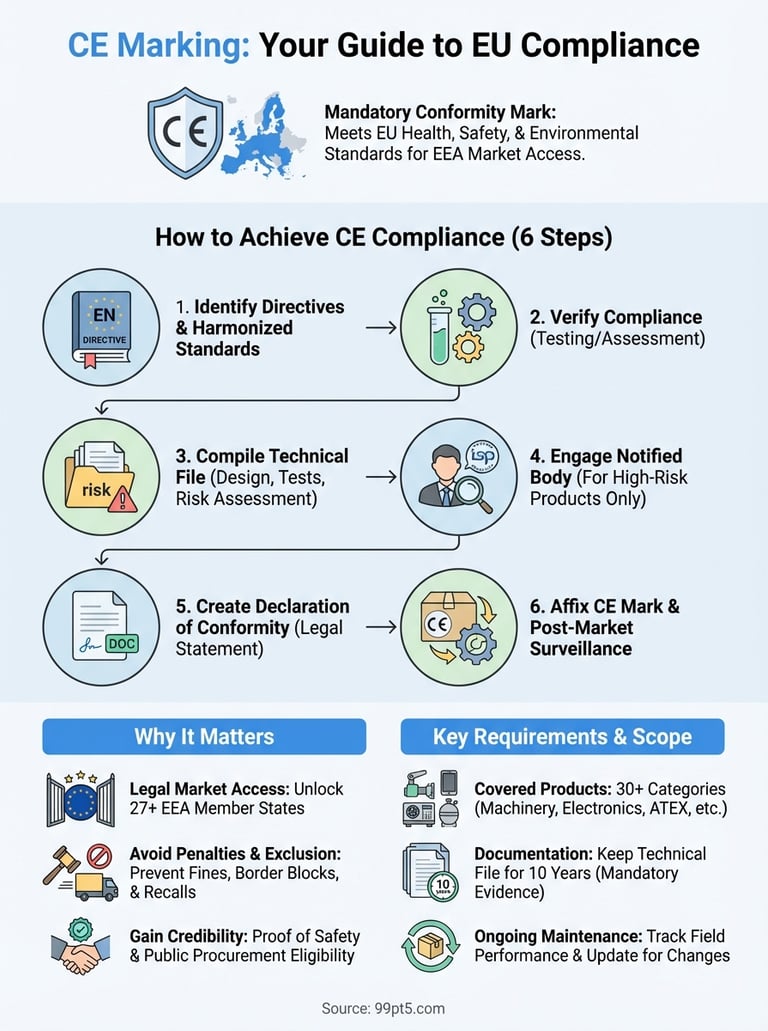
The CE marking definition describes a mandatory conformity mark for products sold within the European Economic Area. This mark confirms that your product meets EU health, safety, and environmental protection standards. You cannot legally sell most manufactured goods in the EEA without it. The letters CE stand for Conformité Européenne, which means European Conformity. Think of it as your product's passport to European markets.
This guide walks you through everything you need to know about CE compliance. You'll learn why CE marking matters for market access, how to achieve compliance in six practical steps, and which products require this certification. We'll cover when you need a notified body for independent assessment, what goes into your technical documentation, and how to maintain ongoing compliance. Whether you're launching new equipment or expanding into European markets, this guide gives you the framework to navigate CE requirements with confidence.
Why CE marking is essential for European market access
You cannot legally place most manufactured products on the European market without CE marking. The European Union enforces this requirement across all 27 member states plus Iceland, Liechtenstein, and Norway, creating a unified market of over 450 million consumers. Without this mark, customs authorities will block your products at borders, and market surveillance authorities can force retailers to remove your goods from shelves. The financial penalties vary by country but can reach hundreds of thousands of euros, plus you risk product recalls and legal liability.
Legal obligations and enforcement actions
Your company faces immediate market exclusion if you skip CE marking requirements. EU regulations place the legal responsibility directly on manufacturers, importers, and authorized representatives who place products on the market. Market surveillance authorities conduct regular inspections of retailers, online marketplaces, and warehouses to verify compliance. They have the power to seize non-compliant products, issue fines, and ban companies from selling in the EEA. The ce marking definition clarifies that this isn't optional or negotiable for covered products.
CE marking transforms from a regulatory checkbox into a business necessity when you consider that one non-compliant shipment can shut down your entire European distribution channel.
Competitive advantages beyond basic compliance
Products with proper CE marking gain immediate credibility with European buyers, distributors, and procurement teams. Your customers recognize the mark as proof that you've verified your product against EU safety standards. This certification opens doors to public procurement contracts, which often require CE compliance as a baseline qualification. Distributors prefer working with manufacturers who understand European regulations because it reduces their own liability exposure. You also avoid the costs of emergency retrofits, shipment delays, and customer complaints that plague competitors who treat compliance as an afterthought.
How to achieve CE compliance in six steps
You need a systematic approach to CE compliance that covers technical requirements, documentation, and legal declarations. The process follows a standard sequence regardless of your product type, though specific technical requirements vary based on applicable directives. Your timeline depends on product complexity, but most manufacturers complete these steps within three to six months when they allocate proper resources.
The complete certification pathway
Start by identifying which EU directives and standards apply to your product, as this determines your entire compliance pathway. You'll typically work with harmonized European standards (EN standards) that provide technical specifications for meeting directive requirements. Next, verify your product meets these standards through internal testing or external laboratory assessment. You must then compile a technical file containing all test results, design documentation, and risk assessments. The ce marking definition specifies that manufacturers themselves assess conformity for most products, though some high-risk items require notified body involvement.
Your compliance pathway isn't complete until you create and sign a Declaration of Conformity, which legally confirms your product meets all applicable requirements.
Affix the CE mark visibly on your product and packaging according to specific size and placement rules. Finally, establish post-market surveillance procedures to track product performance and address any safety issues that emerge after launch.
Products and industries that require CE marking
The CE marking requirement covers over 30 product categories across industrial and consumer markets. Your product falls under CE regulations if it belongs to any category defined by EU directives, from machinery and pressure equipment to toys and medical devices. The European Commission maintains the complete list of applicable directives, which expand as technology evolves and new safety concerns emerge. Most manufacturers in the BioGas processing industry work with multiple directives simultaneously because their equipment combines electrical components, pressure vessels, and machinery elements.
Industrial equipment and machinery
Your industrial equipment requires CE marking if it includes moving parts, processes gas under pressure, or operates with electrical components above certain voltage thresholds. The Machinery Directive covers everything from BioGas compressors to conveyor systems, while the Pressure Equipment Directive regulates vessels, piping, and safety accessories that handle pressurized fluids. Equipment processing BioMethane typically falls under the ATEX Directive as well, which addresses explosion risks in potentially explosive atmospheres. The ce marking definition applies equally to complete machines and safety components sold separately.
Electronics and electrical safety requirements
All electrical equipment operating between 50 and 1,000 volts AC requires CE compliance under the Low Voltage Directive. You must also meet Electromagnetic Compatibility requirements to prevent your equipment from interfering with other devices or being susceptible to electromagnetic disturbance. Control panels, monitoring systems, and automated processing units all need separate assessment against these electrical safety standards.
Your BioGas processing equipment triggers multiple directives simultaneously, which means you coordinate compliance across several technical requirements rather than following a single pathway.
When to use a notified body for independent assessment
You need a notified body when your product falls into high-risk categories that require independent verification beyond self-assessment. These are third-party organizations authorized by EU member states to assess compliance with specific directives. The ce marking definition permits manufacturer self-declaration for many products, but certain categories demand this additional oversight. Your pressure equipment, gas appliances, or machinery with elevated risk characteristics typically trigger this requirement. The relevant directive specifies which conformity assessment procedures apply based on your product's hazard classification.
High-risk products requiring third-party certification
Pressure equipment containing fluids above specific pressure and volume thresholds requires notified body involvement under the Pressure Equipment Directive. Your BioGas processing equipment almost certainly crosses these limits if it handles pressurized BioMethane or CO2 streams. Equipment operating in potentially explosive atmospheres under ATEX regulations also demands third-party assessment, particularly for Category 1 and 2 products. Gas appliances and medical devices always require notified body certification regardless of risk level.
A notified body becomes your compliance partner when self-certification isn't legally sufficient, adding credibility but extending your timeline by several weeks or months.
Selecting a notified body requires matching their authorization scope with your product type and applicable directives. Each body maintains specific competencies, so verify they cover your requirements before engaging their services. Their assessment adds both validation and cost to your compliance process.
Creating the technical file and declaration of conformity
Your technical file serves as the comprehensive evidence package proving your product meets all applicable EU requirements. You must compile this documentation before placing your product on the market and keep it available for ten years after your last unit enters circulation. This file remains your primary defense if market surveillance authorities question your compliance. The ce marking definition establishes this documentation requirement as mandatory, not optional, for all covered products.
Essential technical file documentation
Your technical file includes detailed design drawings, material specifications, risk assessments, and complete test reports showing compliance with harmonized standards. You need manufacturing procedures that demonstrate consistent production of conforming units, along with calculations proving structural integrity and safety margins. Include your supplier declarations for purchased components, quality control procedures, and user instructions in all required languages.
Your technical file proves you followed a systematic approach to compliance rather than simply affixing a mark without proper verification.
Declaration of conformity requirements
The Declaration of Conformity represents your legal statement that your product meets all applicable directives and standards. You must include specific information: your company details, product identification, applicable directives and standards, notified body details if used, and your authorized signature. This single-page document accompanies your product and confirms you accept full responsibility for compliance.
Ensuring product safety and market compliance
Your CE compliance work extends beyond initial certification into ongoing product monitoring and quality maintenance. You must track field performance, address safety concerns immediately, and update your technical file when you modify designs or manufacturing processes. The ce marking definition requires manufacturers to maintain compliance throughout a product's lifecycle, not just at launch. Market surveillance authorities can request your documentation at any time, so keep records accessible and current.
Companies producing BioGas processing equipment face particularly complex compliance requirements due to the combination of pressure vessels, electrical components, and potentially explosive atmospheres. Your equipment must meet multiple directives simultaneously while delivering guaranteed performance metrics. 99pt5 designs BioMethane processing systems that achieve full EU compliance while maintaining the industry's lowest operating expenses and highest recovery rates. Proper CE certification protects your market access, reduces liability exposure, and demonstrates your commitment to safety standards that customers expect from professional equipment suppliers.