Biogas Production Spain: Current State and Future Outlook
Explore the 2030 roadmap for biogas production Spain. Learn to meet grid standards, navigate regulations, and target high-growth regions for new projects.
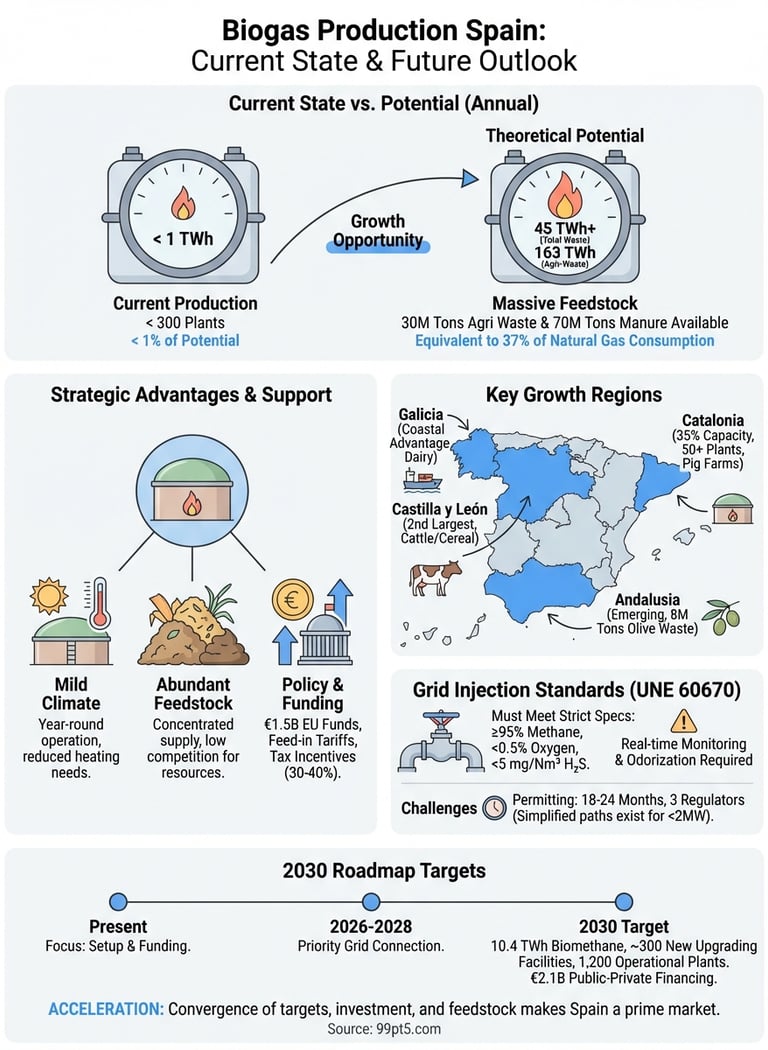
Biogas production Spain refers to the country's growing effort to convert organic waste into renewable energy through anaerobic digestion. Spain transforms agricultural residue, livestock manure, food waste, and sewage sludge into biogas and biomethane that can power vehicles, heat buildings, or feed into the natural gas grid. The sector remains significantly underdeveloped compared to European neighbors like Germany and France, but recent government initiatives and industrial investments signal a major expansion ahead. Right now, Spain produces less than 1 TWh of biogas annually, while its theoretical potential exceeds 45 TWh based on available organic feedstock.
This article breaks down Spain's current biogas capacity, government roadmap targets through 2030, and the regulatory framework shaping the sector's growth. You'll learn why Spain represents a strategic opportunity for biogas developers, which regions lead the expansion, and what technical standards your biomethane must meet for grid injection. We'll also examine the key challenges holding back faster deployment and highlight recent industrial projects driving momentum in this emerging market.
Why Spain is a strategic biogas market
Spain presents a unique opportunity for biogas developers because the country combines massive untapped feedstock potential with ambitious government targets and minimal existing competition. You'll find over 30 million tons of agricultural waste and 70 million tons of livestock manure available annually, yet the country operates fewer than 300 biogas plants compared to Germany's 10,000+. This supply-demand gap creates favorable economics for early movers who can secure long-term feedstock agreements before the market saturates.
Geographic and agricultural advantages
Your biogas facility in Spain benefits from year-round mild temperatures that reduce heating requirements for digesters and enable continuous feedstock collection without seasonal freeze disruptions. The country's intensive livestock farming in regions like Catalonia, Aragón, and Castilla y León generates concentrated manure volumes that minimize transportation costs. Spain also produces 24 million tons of food waste annually from its agricultural processing, hospitality, and municipal sectors, providing diverse feedstock blending options that optimize gas yields and operational stability.
The Spanish agricultural sector generates sufficient organic waste to produce 163 TWh of biogas annually, equivalent to 37% of the country's total natural gas consumption.
Policy momentum and funding support
Spain's government committed €1.5 billion in EU Recovery Funds specifically for renewable gas infrastructure between 2023 and 2026, with biogas production Spain projects receiving priority processing for grid connection permits. You can access feed-in tariffs up to €95 per MWh for electricity from biogas and preferential pricing mechanisms for biomethane grid injection under the 2022 Renewable Gas Roadmap. The government fast-tracks environmental permits for facilities under 1 MW capacity and offers tax incentives worth 30-40% of capital investment for projects that demonstrate CO₂ capture or advanced waste treatment capabilities.
How to meet Spanish biomethane grid standards
Your biomethane must comply with UNE 60670 specifications before any Spanish gas network accepts it for injection. This technical standard requires your gas to contain at least 95% methane by volume, with oxygen levels below 0.5% and hydrogen sulfide under 5 mg/Nm³. The regulation also sets strict limits on total sulfur (30 mg/Nm³), water dew point (minus 8°C at operating pressure), and heating value (38-46 MJ/Nm³) to prevent pipeline corrosion and ensure compatibility with end-user appliances.
Quality specifications you must achieve
Spanish network operators demand real-time monitoring of your biomethane composition using calibrated gas chromatography equipment that reports values every 15 minutes to the grid control center. You need to install odorization equipment that adds tetrahydrothiophene at 6-20 mg/Nm³ to match natural gas safety requirements, plus pressure regulation systems that maintain injection within 3-6% of network operating pressure. Your facility must also capture CO₂ concentrations below 2.5% and remove all particles larger than 5 microns through filtration systems that meet ISO 8573-1 Class 1 standards.
Grid operators can disconnect your facility within 30 minutes if your biomethane quality falls outside specification windows, making reliable upgrading systems critical for biogas production Spain operations.
Major regulatory challenges and opportunities
Your biogas production Spain project faces permitting timelines averaging 18-24 months from application to final approval, with regional environmental agencies requiring separate permits for waste treatment, gas production, and grid connection. Spain's 2023 Administrative Simplification Decree allows single-window applications for facilities under 2 MW and guarantees responses within 6 months for priority renewable gas projects, creating faster pathways if you structure your development correctly.
Permit delays you'll encounter
You navigate three separate regulatory bodies for typical biomethane facilities: regional environmental departments for waste permits, the national energy regulator (CNMC) for gas production licenses, and local distribution operators for grid injection approval. Each agency requires independent environmental impact assessments, adding €50,000-150,000 in consulting costs to project budgets. Regional governments in Catalonia and Galicia established dedicated renewable gas offices that reduce approval times to 8-12 months.
Revenue incentives available
Spain offers guaranteed purchase agreements lasting 15 years for biomethane injected into the gas grid, with prices indexed to natural gas wholesale rates plus a renewable premium. Your facility qualifies for carbon credit revenues worth €15-25 per ton of CO₂ avoided, typically adding 20-30% to annual income.
Projects that secure regional co-financing can access combined support covering 60-70% of total capital investment through stacked EU, national, and regional funding programs.
Key regions driving Spanish biogas growth
Catalonia accounts for 35% of Spain's operational biogas capacity, with over 50 active plants concentrated in Girona, Lleida, and Barcelona provinces where intensive pig farming generates consistent manure feedstock. You'll find the strongest grid infrastructure and most experienced developers in this region, making it the easiest entry point for new biogas production Spain projects. Castilla y León follows as the second-largest producer, leveraging its position as Spain's primary cattle and cereal farming zone to support 28 biomethane facilities that blend agricultural residues with livestock waste for optimized gas yields.
Andalusia's emerging opportunity
Your projects in Andalusia benefit from untapped olive oil processing waste exceeding 8 million tons annually, plus government incentives specifically targeting rural biogas development in Jaén and Córdoba provinces. The region installed 12 new plants in 2025 alone, driven by EU agricultural funds and cooperative farming structures that simplify feedstock agreements.
Andalusia's renewable gas strategy prioritizes biomethane over biogas electricity, creating preferential grid access terms for upgrading facilities that exceed those available in other Spanish regions.
Galicia's coastal advantage
Galicia combines dairy farm concentration with proximity to liquefied biomethane export terminals in Ferrol and Vigo, allowing you to access international markets if domestic grid capacity constraints emerge.
Future outlook for the 2030 roadmap
Spain's National Roadmap for Biogas targets 10.4 TWh of annual biomethane production by 2030, requiring installation of approximately 300 new upgrading facilities across the next four years. You'll see the government prioritize agricultural waste projects that combine livestock manure with crop residues, as these systems deliver the highest CO₂ reduction per investment euro while supporting rural economic development. The roadmap allocates €2.1 billion in public-private financing specifically for biomethane infrastructure, with grid operators committing to expand injection capacity from current levels of 150 GWh to 3,000 GWh annually.
Implementation timeline and capacity targets
Your biogas production Spain projects developed between 2026 and 2028 receive priority grid connection slots under the roadmap's first phase, which focuses on regions with existing gas networks and concentrated feedstock availability. The government expects 1,200 plants operational by 2030, with average facility sizes increasing from today's 500 kW to 2-3 MW as developers gain technical confidence and access larger feedstock supply chains.
Spain's biomethane injection capacity must grow 20-fold by 2030 to meet roadmap targets, creating urgent demand for proven upgrading technologies that guarantee grid-quality specifications.
Accelerating Spain's renewable gas sector
Spain's renewable gas sector stands at a critical inflection point where government targets, industrial investment, and feedstock availability converge to create exceptional opportunities for biogas production Spain developers. You can capitalize on this momentum by securing feedstock agreements now, navigating the streamlined permitting processes, and implementing proven upgrading technologies that guarantee grid-quality biomethane. The country's 2030 roadmap creates predictable revenue streams through guaranteed purchase agreements, carbon credits, and stacked funding programs that reduce your capital exposure while maximizing returns.
Your success depends on selecting equipment that delivers guaranteed performance metrics rather than estimated ranges. 99pt5's BioTreater™ system guarantees 99.5% BioMethane recovery and 99.5% CO₂e emission reduction, meeting Spain's strict UNE 60670 specifications while maintaining the lowest operating expenses in the industry. You'll achieve faster project approval and grid connection when you demonstrate precise, calculated performance that regulatory authorities can verify and trust.