Master EPA Greenhouse Gas Reporting for Biomethane
Learn to navigate the EPA greenhouse gas reporting program and understand the requirements and vital policy changes that impact your biomethane project compliance. Stay informed and ensure your project meets all necessary regulations.
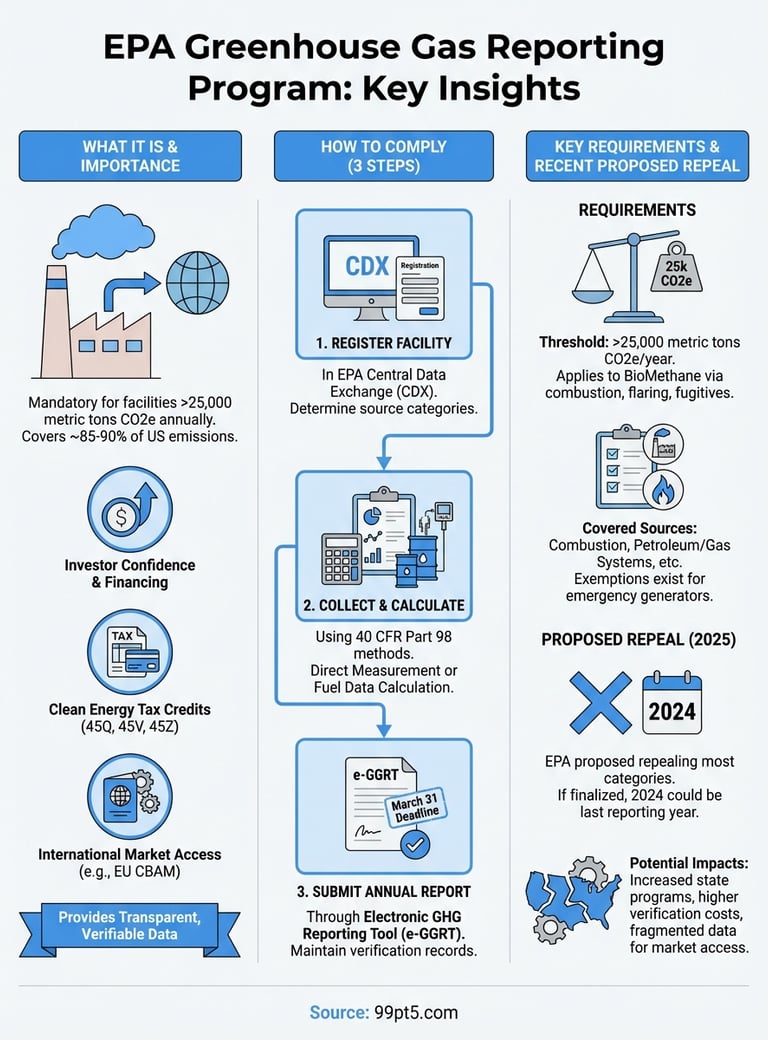
The EPA Greenhouse Gas Reporting Program requires facilities that emit more than 25,000 metric tons of CO2 equivalent per year to measure and report their emissions annually. Large fuel suppliers, industrial gas producers, and CO2 injection sites also fall under the program. Created in 2009, the program covers roughly 8,200 facilities across 47 industries and accounts for about 85 to 90 percent of total U.S. emissions. The program provides transparent, verifiable data that businesses, investors, and regulators use to track emissions and make informed decisions.
This guide walks you through everything you need to know about complying with the reporting program. You'll learn who must report, what thresholds trigger reporting requirements, how to collect and calculate your emissions data, and how to submit reports through the EPA portal. We'll also cover recent policy changes that could significantly impact reporting obligations and explain what these changes mean for companies in the BioMethane and anaerobic digestion space. Whether you're determining if your facility needs to report or refining your existing compliance process, this guide gives you the practical information you need.
Why the EPA greenhouse gas reporting program matters
The EPA greenhouse gas reporting program provides standardized, verifiable data that you need to compete in today's market. Investors and project financiers demand EPA-verified emissions data before funding BioMethane projects. Customers require proof of environmental performance from government sources, not just manufacturer claims. This program delivers that proof through transparent, auditable reporting that meets regulatory standards across multiple jurisdictions.
EPA verification gives your projects instant credibility that private certifications cannot match, reducing costs and accelerating approvals.
Access to clean energy incentives depends on this data. Tax credits under sections 45Q, 45V, and 45Z require verified emissions calculations that EPA reporting provides. International markets increasingly mandate government-certified data for carbon border adjustments. The EU Carbon Border Adjustment Mechanism specifically recognizes EPA data, giving U.S. exporters competitive pricing advantages. Without EPA reporting, your clients face higher verification costs, duplicative state requirements, and potential market exclusions.
How to comply with the EPA reporting program
Compliance with the epa greenhouse gas reporting program follows three core steps that you must complete each year. First, you register your facility in the EPA system and determine which reporting categories apply to your operations. Second, you collect and calculate emissions data using the methodologies specified in 40 CFR Part 98. Third, you submit your annual report through the EPA's electronic portal by the March 31 deadline. Each step requires specific documentation and verification to ensure data accuracy and regulatory acceptance.
Register your facility in the EPA system
You start by creating an account in the EPA Central Data Exchange (CDX) and registering each facility that meets reporting thresholds. Your registration requires facility identification details, including physical location, primary NAICS codes, and emission source categories. The EPA assigns each facility a unique identifier that you use for all future submissions. Registration typically takes two to four weeks for approval, so you need to complete this process well before your first reporting deadline. Update your registration whenever facility operations change, ownership transfers, or new emission sources come online.
Complete your CDX registration at least 60 days before your first reporting deadline to avoid last-minute access issues.
Submit annual reports through e-GGRT
The Electronic Greenhouse Gas Reporting Tool (e-GGRT) is where you submit all emissions data. You access e-GGRT through your CDX account and complete separate reporting forms for each applicable source category. Upload your calculated emissions, supporting documentation, and required certifications by March 31 for the previous calendar year. The system validates your data against EPA methodologies and flags errors or inconsistencies before submission. You must digitally sign your report to certify accuracy under penalty of law. Save draft versions throughout the year as you collect data to streamline final submission.
Maintain verification and documentation
Keep detailed records of all calculations, measurements, and assumptions for at least three years after each reporting year. Document your monitoring equipment calibration, fuel analyses, and any estimation methodologies you applied. The EPA conducts random audits and may request verification of your reported data. Store records electronically in organized folders that match your e-GGRT submission structure. Third-party verification, while not required for most facilities, strengthens your data credibility for investors and international markets.
Key requirements and reporting thresholds
The epa greenhouse gas reporting program applies to your facility when annual emissions exceed 25,000 metric tons of CO2 equivalent. You calculate this threshold by adding direct emissions from all sources at your facility, including combustion units, process equipment, and fugitive emissions. Reporting becomes mandatory the year after you first exceed this threshold, and you must continue reporting every subsequent year even if emissions drop below 25,000 metric tons. Facilities that process BioGas typically exceed this threshold through combustion equipment, flaring systems, and fugitive methane releases from anaerobic digesters.
Emission threshold calculations
You determine your reporting obligation by totaling all Scope 1 emissions from your facility over the calendar year. This includes CO2, methane, nitrous oxide, and fluorinated gases, each converted to CO2 equivalent using global warming potential factors. Count emissions from fuel combustion in boilers, process heaters, emergency generators, and any thermal oxidizers or flares. Include fugitive emissions from equipment leaks, storage tanks, and loading operations. If you operate multiple BioGas processing units at a single location, you aggregate their emissions under one facility ID for threshold determination.
Calculate your threshold using the EPA's approved global warming potentials: 25 for methane and 298 for nitrous oxide over a 100-year timeframe.
Covered source categories for BioMethane operations
Your BioMethane facility typically reports under Subpart C (General Stationary Fuel Combustion) for boilers and engines. Petroleum and natural gas systems under Subpart W apply if you process, compress, or inject BioMethane into pipelines. Adipic acid production, lime manufacturing, and other industrial categories may apply if your facility includes those processes. Anaerobic digestion operations without significant combustion equipment often fall below reporting thresholds unless you flare large volumes of excess BioGas. Review all 47 source categories in 40 CFR Part 98 to identify which apply to your specific operations and equipment configuration.
Exemptions and special cases
Emergency generators and equipment used fewer than 100 hours annually for emergencies only qualify for exemption from emission calculations. Residential or commercial BioGas systems serving fewer than 10,000 people generally remain exempt regardless of emissions. You can cease reporting if your facility permanently shuts down or emissions drop below 15,000 metric tons for five consecutive years. Document all exemption claims with operational records, fuel consumption logs, and engineering calculations to support audit requests.
Data collection and calculation methods
The epa greenhouse gas reporting program requires precise measurement and calculation protocols that you must follow for each emission source at your facility. You choose between direct measurement using continuous emission monitoring systems or calculation-based methods using fuel consumption data and emission factors. EPA specifies which method applies to each source category in 40 CFR Part 98, and you cannot substitute unapproved methods even if they appear more accurate. BioMethane facilities typically use calculation methods for most sources because continuous monitors cost significantly more than the compliance benefit they provide for smaller emission points.
Direct monitoring systems for large sources
You install continuous emission monitoring systems (CEMS) when your facility operates large combustion units or when EPA regulations specifically require direct measurement. CEMS equipment measures CO2 concentration, volumetric flow rates, and operating hours in real time, automatically calculating total emissions. You must calibrate monitors quarterly according to EPA Method 19 or manufacturer specifications, whichever is more stringent. Record all calibration dates, reference gas certifications, and drift check results in your quality assurance documentation. Most BioMethane upgrading facilities avoid CEMS requirements by staying below capacity thresholds that trigger mandatory continuous monitoring.
Calculation methods using fuel data
Fuel consumption records form the basis for calculating emissions when direct monitoring is not required. You multiply your total fuel usage by EPA emission factors found in Tables C-1 and C-2 of Subpart C, adjusting for fuel characteristics when you have laboratory analysis data. Track fuel deliveries through bills of lading, meter readings, or tank level measurements with documented accuracy of at least 1 percent. Calculate BioGas combustion emissions using either default methane content of 50 percent or actual gas composition from monthly sampling. Apply equation C-1 from 40 CFR Part 98.33 for stationary combustion, substituting your facility-specific higher heating values when available.
Laboratory fuel analysis reduces uncertainty in your emission calculations and often lowers reported emissions compared to conservative default factors.
Quality assurance protocols
You implement missing data procedures specified in 40 CFR Part 98.35 whenever monitoring equipment fails or fuel records are incomplete. Estimate missing values using averages from similar operating periods within the same calendar quarter. Document every estimation in your annual report with explanations of why data was missing and how you calculated substitute values. Perform internal audits quarterly to verify that your calculation spreadsheets match EPA equations exactly and that all unit conversions are correct.
Recent changes and policy outlook
The EPA proposed repealing most of the greenhouse gas reporting program in September 2025, targeting 46 of the 47 covered source categories for elimination. Under this proposal, the EPA argues that Section 114 of the Clean Air Act does not authorize continued data collection because the agency has no immediate plans to develop new emission standards using the reported information. Petroleum and natural gas systems would retain reporting requirements until 2034 to support the waste emissions charge under the Inflation Reduction Act, though those obligations are currently suspended. The comment period closed on November 3, 2025, and if the EPA finalizes the proposal, 2024 becomes the last reporting year for most facilities.
If finalized, this repeal would eliminate the federal framework that currently provides standardized emissions data to 20 states and multiple federal programs.
Potential impacts of the repeal
You face increased compliance costs and market access challenges if the repeal takes effect. States that currently rely on EPA data will likely create their own reporting programs, forcing you to navigate multiple state-specific methodologies and deadlines. Your ability to demonstrate emissions performance for international markets weakens without government-verified data, potentially excluding your BioMethane from carbon border adjustment mechanisms. Federal tax credits for carbon sequestration and clean fuel production may require new verification processes that cost more and take longer than current EPA reporting.
What this means for your projects
The epa greenhouse gas reporting program creates both challenges and opportunities for your BioMethane installations. Verified emissions data remains essential for securing tax credits, accessing international markets, and demonstrating project performance to investors, regardless of federal policy changes. Your clients will continue demanding credible environmental metrics that justify project financing and meet state-level compliance requirements across all jurisdictions. Equipment that guarantees measurable emissions reductions becomes increasingly valuable as reporting systems fragment and state requirements multiply across the country.
State programs will likely expand their own monitoring frameworks, making precise, documented performance guarantees from your equipment suppliers more critical than ever. 99pt5's BioTreater™ system delivers the performance certainty you need with guaranteed 99.5% BioMethane recovery and 99.5% CO2e emission reduction. These documented metrics provide the verifiable data your projects require for reporting compliance and carbon credit calculations.