What Is Carbon Accounting? Scopes 1-3, Standards, and Tools
Uncover what is carbon accounting, from Scopes 1-3 to global standards. Gain methods & tools to measure GHG emissions, boost compliance & business value.
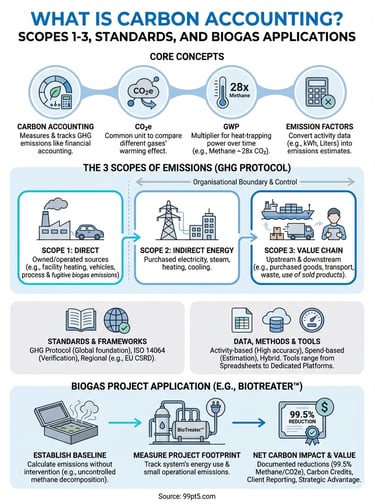
Carbon accounting measures how much greenhouse gas your organization produces. Think of it like financial accounting but for emissions instead of money. You collect data on activities that generate carbon dioxide and other gases, calculate the total output, and track changes over time. This process helps you identify emission sources, meet reporting requirements, and make decisions about reduction strategies.
This guide walks you through everything you need to understand carbon accounting. You'll learn why it matters for businesses processing biogas and biomethane, how the three emission scopes work, which standards and frameworks apply to your operations, and what methods and tools can streamline the calculation process. We'll also cover practical applications for biogas projects and show you how accurate emissions data supports both environmental goals and business performance.
Why carbon accounting matters
Your business faces increasing pressure from regulators, investors, and customers to measure and report greenhouse gas emissions. Carbon accounting gives you the data foundation you need to meet legal requirements, avoid penalties, and demonstrate environmental responsibility. Without accurate emissions tracking, you operate blind to risks that can affect market access, insurance costs, and project financing. Companies that implement carbon accounting early gain strategic advantages over competitors who wait until compliance becomes mandatory.
Regulatory compliance and risk management
Governments worldwide now require emissions disclosure from businesses above certain thresholds. The EU's Corporate Sustainability Reporting Directive mandates detailed carbon reporting for thousands of companies, while similar regulations emerge across North America and Asia. You risk fines, project delays, and loss of operating licenses if you cannot provide verified emissions data when authorities request it. Carbon accounting creates an audit trail that protects your business during inspections and reduces liability exposure when regulations tighten.
Accurate emissions data transforms compliance from a burden into a strategic asset that opens doors to new markets and partnerships.
Business value and competitive advantage
Understanding what is carbon accounting helps you identify where your operations waste energy and money. Emissions hotspots often reveal inefficiencies in fuel use, equipment performance, or supply chain logistics. Many biogas system providers discover that detailed carbon tracking helps them win contracts with clients who need guaranteed emission reductions for their own reporting. Projects with verified carbon reduction claims qualify for higher carbon credit values and attract investment at better terms. Your ability to quantify emissions accurately also strengthens proposals to environmental funds and government grants that prioritize measurable climate impact. Customers increasingly demand proof of environmental performance, and carbon accounting gives you the evidence they require before signing contracts.
How to get started with carbon accounting
Starting carbon accounting requires three foundational steps: defining your boundaries, identifying emission sources, and selecting calculation methods. You don't need perfect data on day one. Begin with the information you already collect through utility bills, fuel receipts, and operational records. Most biogas system providers start by measuring their own direct emissions before expanding to value chain calculations. This staged approach builds internal expertise while delivering immediate insights that inform equipment choices and process improvements.
Set clear objectives and boundaries
Define what you want to achieve before collecting data. Your objectives might include regulatory compliance, carbon credit generation, or client reporting requirements. Each goal shapes which emissions you track and how precisely you measure them. You also need to establish organizational boundaries that determine which facilities, operations, and subsidiaries fall within your carbon accounting scope. Companies typically choose either operational control or equity share approaches to define boundaries. Operational control includes all facilities where you make operating decisions, regardless of ownership percentage. Equity share allocates emissions based on your percentage ownership in each operation. Document your boundary choices in a written policy that explains which entities you include and why. This documentation becomes critical when auditors or regulators review your emissions reports.
Identify your emission sources
Map every activity that burns fuel, uses electricity, or releases gases across your operations. Walk through your facilities and note equipment like boilers, vehicles, generators, and process machinery. Check your procurement records to understand what is carbon accounting capturing in your supply chain, from raw materials to contractor services. Create a simple spreadsheet listing each source with estimated activity levels such as liters of diesel consumed monthly or kilowatt-hours of electricity purchased quarterly. Priority ranking helps you focus measurement efforts on sources that likely contribute the most emissions. Transportation fuel and electricity purchases typically account for the largest shares in biogas equipment manufacturing and installation businesses.
Starting with high-impact emission sources gives you meaningful results faster while building confidence in your carbon accounting process.
Choose your measurement approach
Select calculation methods that match your data availability and accuracy requirements. Spend-based calculations use financial records to estimate emissions when you lack detailed activity data. You multiply dollars spent on goods or services by emission factors specific to each category. Activity-based calculations provide higher accuracy by measuring physical quantities like gallons of fuel or tons of materials. Start with spend-based methods for categories where you only track invoices, then transition to activity-based approaches as you implement better data collection systems. Hybrid methods combine both techniques, applying activity-based calculations to major sources and spend-based estimates to minor categories. Most biogas project developers begin measuring scope 1 and 2 emissions before tackling complex scope 3 value chain calculations. This progression lets you deliver early reporting wins while building the systems needed for comprehensive carbon accounting later.
Core concepts you need to know
Understanding what is carbon accounting requires familiarity with several technical terms that standardize how organizations measure emissions. These concepts form the language of carbon reporting and appear in every framework, regulation, and verification process you'll encounter. You need to grasp these fundamentals before calculating your own emissions because they determine how you convert diverse activities into comparable metrics. Mastering these core ideas takes less time than learning basic accounting principles, but they unlock the ability to interpret carbon reports, compare performance across projects, and identify calculation errors that could invalidate your data.
Carbon dioxide equivalents (CO2e)
Carbon dioxide equivalents provide a common unit that lets you add up different greenhouse gases into a single number. You cannot directly compare one kilogram of methane to one kilogram of carbon dioxide because they trap different amounts of heat in the atmosphere. CO2e solves this problem by converting all gases to the amount of carbon dioxide that would create the same warming effect. When you see emissions reported as "tons CO2e," this figure includes carbon dioxide, methane, nitrous oxide, and other gases weighted by their climate impact. Your biogas processing equipment might release small amounts of methane during maintenance. Converting that methane to CO2e shows its true climate significance and lets you add it to emissions from electricity use or transportation.
Global warming potential
Global warming potential assigns each greenhouse gas a multiplier that reflects its heat-trapping power compared to carbon dioxide. Methane has a GWP of about 28 over 100 years, meaning one ton of methane creates the same warming as 28 tons of CO2 over that period. You multiply the physical quantity of each gas by its GWP to calculate CO2e values. Different time horizons change GWP numbers because some gases break down faster than others in the atmosphere. Most carbon accounting uses 100-year GWP values, though some regulations specify 20-year or 500-year periods. Nitrous oxide carries a GWP near 265, which explains why even tiny releases from certain industrial processes contribute significantly to overall emissions.
Understanding global warming potential helps you prioritize reduction efforts by focusing on gases that deliver the biggest climate impact per unit reduced.
Emission factors
Emission factors translate activity data into emissions estimates by providing standard conversion rates. You multiply quantities like liters of diesel burned or kilowatt-hours consumed by the appropriate emission factor to calculate CO2e output. Government agencies and research institutions publish databases of emission factors organized by fuel type, electricity grid region, material category, and other variables. Factors for electricity vary by location because different grids rely on different fuel mixes. Your diesel generator produces roughly 2.7 kg CO2e per liter burned, while the emission factor for grid electricity in Ireland averages around 0.3 kg CO2e per kWh. These factors evolve over time as energy systems decarbonize, so you need to update your calculations with current data.
Scopes 1 2 and 3 explained
The Greenhouse Gas Protocol divides emissions into three categories based on where they originate and who controls them. Understanding what is carbon accounting across these scopes helps you determine which activities you need to measure and how deeply you need to examine your value chain. Each scope presents different measurement challenges and reduction opportunities. Your biogas equipment business generates emissions in all three categories, though the relative contribution of each scope varies based on your operations, supply chain complexity, and service offerings. This classification system appears in every carbon reporting framework worldwide, making it essential knowledge for anyone involved in environmental data collection or sustainability strategy.
Scope 1 direct emissions
Scope 1 captures all greenhouse gases you release directly from sources your business owns or operates. This includes fuel burned in company vehicles, natural gas used in facility heating, diesel consumed by backup generators, and process emissions from manufacturing equipment. You exercise direct control over these sources, making them easier to measure and reduce compared to other scopes. Fugitive emissions also fall under scope 1, such as refrigerant leaks from air conditioning systems or methane releases during equipment maintenance. If you manufacture biogas processing equipment, welding operations and solvent use contribute to your scope 1 totals. Installation crews driving to client sites add diesel or gasoline combustion emissions. Each fuel type requires its specific emission factor, and you need accurate consumption records to calculate totals correctly.
Biogas system providers often overlook small scope 1 sources that collectively add up to significant emissions. Testing and commissioning activities consume fuel, portable generators power tools at remote sites, and facility maintenance equipment burns gasoline or diesel. You measure scope 1 by tracking fuel purchases, meter readings, and equipment run-time logs. Converting volume or weight measurements to CO2e requires applying the correct emission factors for each fuel grade and accounting for incomplete combustion in older engines or equipment. Companies with vehicle fleets should track mileage and fuel efficiency to identify high-emission vehicles that need replacement or maintenance.
Scope 2 purchased energy emissions
Scope 2 covers indirect emissions from electricity, steam, heating, and cooling that you purchase from utilities or other suppliers. The emissions occur at power plants and energy generation facilities, not at your business location, but you bear responsibility because you consume the energy. Your manufacturing operations, office buildings, warehouses, and testing facilities all draw grid electricity, creating scope 2 emissions proportional to your consumption and the carbon intensity of your local grid. Ireland's electricity grid carries different emission factors than grids in other European countries due to varying renewable energy penetration and fossil fuel reliance. You calculate scope 2 by multiplying kilowatt-hours purchased by the regional grid emission factor, which utilities or government agencies publish regularly.
Two calculation methods exist for scope 2: location-based and market-based. Location-based methods apply average grid emission factors for the region where you consume electricity. Market-based methods reflect specific energy purchasing choices like renewable energy certificates or power purchase agreements. If you buy certified green electricity, the market-based method lets you claim lower scope 2 emissions while location-based calculations remain unchanged. Companies pursuing aggressive carbon reduction often prioritize scope 2 because switching to renewable electricity contracts delivers large emission cuts without operational changes. However, you must carefully document renewable energy purchases with contracts and certificates to satisfy auditors. Your scope 2 emissions typically fluctuate with production volumes, seasonal heating and cooling needs, and equipment efficiency improvements.
Scope 3 value chain emissions
Scope 3 encompasses all other indirect emissions that occur in your value chain, both upstream and downstream of your operations. This includes purchased goods and materials, transportation and distribution services, business travel, employee commuting, waste disposal, and the use of products you sell. The Greenhouse Gas Protocol divides scope 3 into 15 categories, though not every category applies to every business. For biogas equipment providers, the most significant scope 3 categories typically include purchased goods and materials, upstream transportation, and downstream use of sold products. Steel, electronics components, and specialty materials in your equipment carry substantial embedded emissions from mining, smelting, and manufacturing processes. Shipping completed systems to client sites adds freight emissions. The electricity your clients use to run installed equipment generates scope 3 emissions attributable to your business.
Scope 3 represents the largest emission source for most companies but receives less attention because measurement requires extensive supplier engagement and data collection across organizational boundaries.
Calculating scope 3 demands data from parties outside your control, making it the most challenging scope to measure accurately. You can start with spend-based estimates that multiply procurement costs by industry-average emission factors, then refine calculations as you collect supplier-specific data. Many biogas system providers discover that scope 3 emissions dwarf their combined scope 1 and 2 totals because equipment manufacturing is materials-intensive and product lifespans extend decades. Engaging suppliers to provide product-specific emission data improves calculation accuracy and helps identify lower-carbon material alternatives. Some categories like business travel offer straightforward calculation methods using distance traveled and standard emission factors for flights, trains, or rental vehicles. Others like downstream processing of sold products require modeling based on typical use patterns and average product lifespans. You prioritize scope 3 categories based on their likely contribution to your total footprint and the availability of data to support calculations.
Standards and frameworks for reporting
Multiple international standards guide how you measure and report emissions, but they share common principles that make carbon data comparable across organizations and countries. Understanding what is carbon accounting through these frameworks helps you choose reporting methods that satisfy regulatory requirements while providing decision-useful information. You don't need to master every standard immediately, but you must know which ones apply to your business based on your geographic markets, customer requirements, and the regulations affecting your industry. Most biogas equipment providers encounter at least three major frameworks during their carbon accounting journey: the Greenhouse Gas Protocol, ISO standards, and region-specific regulations that mandate disclosure formats and verification levels.
GHG Protocol as the global standard
The Greenhouse Gas Protocol provides the foundation that most other frameworks reference or incorporate. This standard establishes the three-scope classification system and defines calculation methodologies you use to translate activity data into emissions totals. You find detailed guidance for 15 scope 3 categories, rules for setting organizational boundaries, and principles for ensuring completeness, consistency, transparency, and accuracy in your calculations. Corporate entities use the Corporate Standard, while project-based carbon reduction initiatives follow the Project Protocol. Your biogas systems might qualify for project-level accounting if you document baseline emissions and demonstrate additionality, meaning the reductions would not occur without your intervention. The protocol updates regularly to address emerging issues like biogenic carbon, renewable energy claims, and supply chain traceability, so you need to reference the current version when preparing reports.
The GHG Protocol's widespread adoption means learning this framework prepares you for most other carbon reporting requirements you'll encounter.
ISO 14064 for verification and assurance
ISO 14064 complements the GHG Protocol by specifying requirements for third-party verification of your emissions data. Part 1 covers organizational-level quantification and reporting, Part 2 addresses project-level quantification, and Part 3 defines validation and verification processes. When clients or regulators demand audited carbon reports, they typically reference ISO 14064-3 as the verification standard. You prepare your inventory according to GHG Protocol methods, then engage accredited verifiers who assess your data quality, calculation accuracy, and documentation completeness. Verification levels range from limited assurance to reasonable assurance, with reasonable assurance requiring more extensive testing and providing higher confidence in reported figures. Your biogas equipment manufacturing operations benefit from ISO 14064 certification when bidding on projects where carbon performance affects contract awards or when seeking carbon credit certification for the reductions your systems deliver.
Regional and industry-specific requirements
European Union regulations mandate carbon reporting through the Corporate Sustainability Reporting Directive, which requires detailed emissions disclosure using the European Sustainability Reporting Standards. These standards align with GHG Protocol principles but add specific disclosure requirements about reduction targets, transition plans, and climate risk assessment. Companies operating in California must comply with state disclosure laws that cover scope 1, 2, and 3 emissions for businesses above revenue thresholds. Industry groups publish sector-specific guidance that interprets general standards for biogas, renewable energy, and waste management contexts. You should monitor developments in the EU's Carbon Border Adjustment Mechanism, which places carbon reporting obligations on importers of covered goods. Understanding these regional differences helps you structure your carbon accounting system to serve multiple markets without duplicating data collection efforts or maintaining parallel calculation methodologies.
Data and methods for calculating emissions
Accurate emissions calculations depend on collecting the right data and applying appropriate calculation methods to convert that information into CO2e totals. You need both activity data that describes what your business does and emission factors that translate those activities into greenhouse gas outputs. The methods you choose affect accuracy, cost, and the level of effort required to maintain your carbon accounting system over time. Companies processing biogas or manufacturing equipment typically combine multiple approaches to balance precision against practical data collection constraints across different emission sources and organizational boundaries.
Activity-based calculation methods
Activity-based methods deliver the highest accuracy by measuring physical quantities directly tied to emissions. You collect data on liters of fuel burned, kilowatt-hours consumed, kilometers traveled, or kilograms of materials purchased, then multiply these quantities by scientifically derived emission factors specific to each activity type. This approach works best for scope 1 and scope 2 emissions where you control measurement points and can install meters or tracking systems. Your diesel generators produce calculable emissions when you record fuel consumption and apply the standard emission factor of 2.68 kg CO2e per liter. Electricity purchases convert to emissions by multiplying your monthly kilowatt-hour consumption by your grid's published emission factor. Material purchases require mass measurements and product-specific factors that account for extraction, processing, and transportation emissions embedded in each input.
Gathering activity data demands systematic record-keeping across your operations. You establish data collection procedures that capture fuel receipts, utility bills, vehicle logbooks, and material specifications before calculation periods close. Many biogas equipment providers discover that production systems already track most needed information for inventory management and quality control purposes, making activity-based accounting feasible without major new investments.
Spend-based estimation approaches
Spend-based methods offer a practical starting point when activity data proves difficult or expensive to collect. You use financial records showing dollars or euros spent on goods and services, then multiply expenditures by economic input-output emission factors that represent average emissions per currency unit in specific industry sectors. This approach suits scope 3 categories where you lack visibility into supplier operations or purchase diverse items that would require tracking hundreds of individual emission factors. Your professional services spending, office supplies, and minor equipment purchases typically work better with spend-based estimates because detailed activity data adds little value relative to collection effort.
Economic emission factors come from national statistics that model how money flows through economic sectors and the emissions associated with each sector's production processes. You might apply a factor of 0.15 kg CO2e per euro spent on business services or 0.45 kg CO2e per euro spent on metal products, depending on published databases for your region. Understanding what is carbon accounting through spend-based methods helps you complete initial inventories quickly, then identify which categories justify investment in more precise activity-based tracking.
Hybrid methodology for practical implementation
Most businesses adopt hybrid approaches that apply activity-based calculations to major emission sources and spend-based estimates to minor categories. You might track fuel and electricity consumption with meters while estimating purchased services through financial data. This method concentrates effort where precision matters most for decision-making and reporting credibility. Companies refine their hybrid models over time by shifting categories from spend-based to activity-based as data systems improve and supplier engagement increases.
Hybrid methods let you start carbon accounting immediately with available data, then systematically improve accuracy as you identify which emission sources deserve deeper measurement investment.
Tools and software for carbon accounting
Software solutions transform raw data into verified emissions inventories, but your choice of tools depends on organizational maturity, budget constraints, and reporting complexity. You can start carbon accounting with basic spreadsheet systems and progress to specialized platforms as your data volumes grow and stakeholder demands increase. Most biogas equipment businesses begin tracking emissions manually before investing in dedicated software. Early-stage tools help you establish data collection routines and identify which emission sources require automated monitoring before you commit to enterprise platforms that demand significant implementation effort.
Spreadsheet-based systems for early-stage tracking
Spreadsheets offer the simplest entry point for understanding what is carbon accounting delivers to your business. Microsoft Excel or similar applications let you organize fuel records, utility bills, and procurement data alongside emission factors in structured templates that calculate CO2e totals through basic formulas. You create separate worksheets for scope 1, 2, and 3 categories, then build summary tables that roll up totals across your organization. This approach costs nothing beyond staff time and gives you complete control over calculation logic and data structure. However, spreadsheets break down when multiple people need simultaneous access, version control becomes critical for audit purposes, or you manage emissions across numerous facilities with complex reporting hierarchies.
Purpose-built carbon management platforms
Dedicated carbon accounting platforms automate data collection, factor updates, and multi-framework reporting that spreadsheets cannot handle efficiently. These systems connect directly to utility providers, procurement databases, and operational systems to pull activity data without manual entry. You configure organizational hierarchies that match your legal structure and reporting boundaries, then the platform calculates emissions according to GHG Protocol standards while maintaining audit trails that satisfy verifiers. Built-in emission factor libraries update automatically when governments publish new values, eliminating the risk that outdated factors compromise your calculations. Advanced platforms model reduction scenarios, track progress against targets, and generate disclosure reports formatted for specific frameworks like CSRD or CDP.
Purpose-built platforms justify their cost when manual data management consumes excessive staff time or when audit requirements demand documentation rigor beyond spreadsheet capabilities.
Integration with existing business systems
Your carbon accounting tools deliver maximum value when they integrate with enterprise resource planning, procurement, and financial systems that already capture relevant data. Integration eliminates duplicate data entry, reduces errors from manual transcription, and keeps emissions calculations synchronized with operational reality. You connect accounting software to pull supplier invoices, link transportation management systems to capture freight data, and interface with building automation platforms to monitor energy consumption in real time.
Applying carbon accounting to biogas projects
Biogas projects create measurable climate benefits that carbon accounting quantifies and validates for clients, investors, and regulators. Your equipment transforms organic waste into renewable energy while preventing methane emissions that would otherwise escape from landfills or manure lagoons. Understanding what is carbon accounting in this context means tracking both the emissions your systems avoid and the operational footprint they create. You calculate net carbon impact by subtracting project emissions from baseline scenarios where waste decomposes without capture or treatment. This methodology proves the climate value your technology delivers and supports carbon credit generation that increases project returns for your clients.
Establishing baseline emissions scenarios
You must document how much methane would release into the atmosphere without your biogas system intervention. Agricultural operations letting manure decompose in open lagoons emit substantial methane that has 28 times the warming impact of carbon dioxide over 100 years. Your baseline calculation multiplies waste quantities by standard emission factors for uncontrolled decomposition, accounting for climate conditions, waste composition, and storage duration. Industrial food processing facilities sending organics to landfills generate baseline emissions from both waste transportation and methane production during anaerobic breakdown in disposal sites. You gather historical waste management data from your client, apply published emission factors from government databases, and project forward over your equipment's operational lifespan. This baseline becomes the reference against which you measure reductions your BioTreater™ system achieves.
Measuring project operational footprint
Your biogas processing equipment consumes electricity and produces small fugitive emissions during normal operation that you must account for in net impact calculations. The BioGas booster, catalytic reactors, and control systems draw grid power whose emissions depend on your client's local electricity carbon intensity. You track kilowatt-hour consumption through integrated monitoring systems and apply regional grid emission factors that reflect the fuel mix powering each installation location. Process emissions occur during maintenance activities, startup sequences, and occasional venting required for safety or quality control purposes. Installing flow meters and operational sensors lets you quantify these releases precisely rather than relying on conservative estimates that inflate your equipment's carbon footprint. You also include transportation emissions from delivering systems to client sites and periodic service visits throughout the operational period.
Precise operational tracking proves your guaranteed 99.5% methane recovery and 99.5% CO2e emission reduction deliver genuine climate benefits beyond marketing claims.
Documenting carbon credits and client reporting
Carbon credit certification requires third-party verification of your emission reduction calculations and documentation quality. You compile monitoring data, calibration records, and operational logs that demonstrate your BioTreater™ system performed as guaranteed throughout the reporting period. Verification bodies assess whether your baseline scenarios reflect realistic alternatives, your measurement methods follow recognized protocols, and your calculations apply correct emission factors without errors. Clients increasingly demand annual carbon performance reports that show how their biogas investment contributes to corporate sustainability targets and regulatory compliance obligations. Your BioView™ software captures real-time emissions data that feeds directly into standardized report templates formatted for frameworks like GHG Protocol or EU sustainability regulations. This automated reporting capability reduces client administrative burden while ensuring consistency across multiple installations.
Supporting client carbon strategy integration
Forward-thinking clients integrate biogas emission reductions into comprehensive corporate carbon management programs that span their entire value chain. You help them understand how methane capture fits within their scope 1 direct emissions if they own the waste management operation or scope 3 value chain emissions if they contract waste processing to third parties. Your carbon accounting data supports their materiality assessments that identify which sustainability metrics matter most to stakeholders. Clients pursuing science-based targets need granular emissions data that shows progress toward absolute reduction goals or intensity improvements per unit of production. You provide calculation methodologies and documentation templates that their sustainability teams incorporate into enterprise reporting systems, making your equipment's climate contribution visible to executives tracking company-wide environmental performance.
Next steps for your business
Carbon accounting transforms abstract environmental claims into verified performance data that regulators, investors, and customers demand. You now understand what is carbon accounting across all three scopes, which standards apply to your operations, and how to measure emissions accurately using activity-based or spend-based methods. Starting with scope 1 and 2 emissions builds measurement confidence before you tackle complex value chain calculations that require supplier engagement and systematic data collection protocols.
Your biogas equipment projects deliver measurable climate benefits that carbon accounting quantifies and validates for stakeholders. 99pt5's BioTreater™ systems guarantee 99.5% methane recovery and 99.5% CO2e emission reduction, providing the documented performance data your clients need for carbon reporting and credit generation. Accurate emissions tracking proves your technology's climate impact while supporting client sustainability strategies with audit-ready documentation that satisfies verification requirements.