Gross Calorific Value vs Net Calorific Value: How to Convert
Master gross calorific value vs net calorific value conversions. Understand why NCV is crucial for biogas equipment, performance guarantees, and carbon credit calculations.
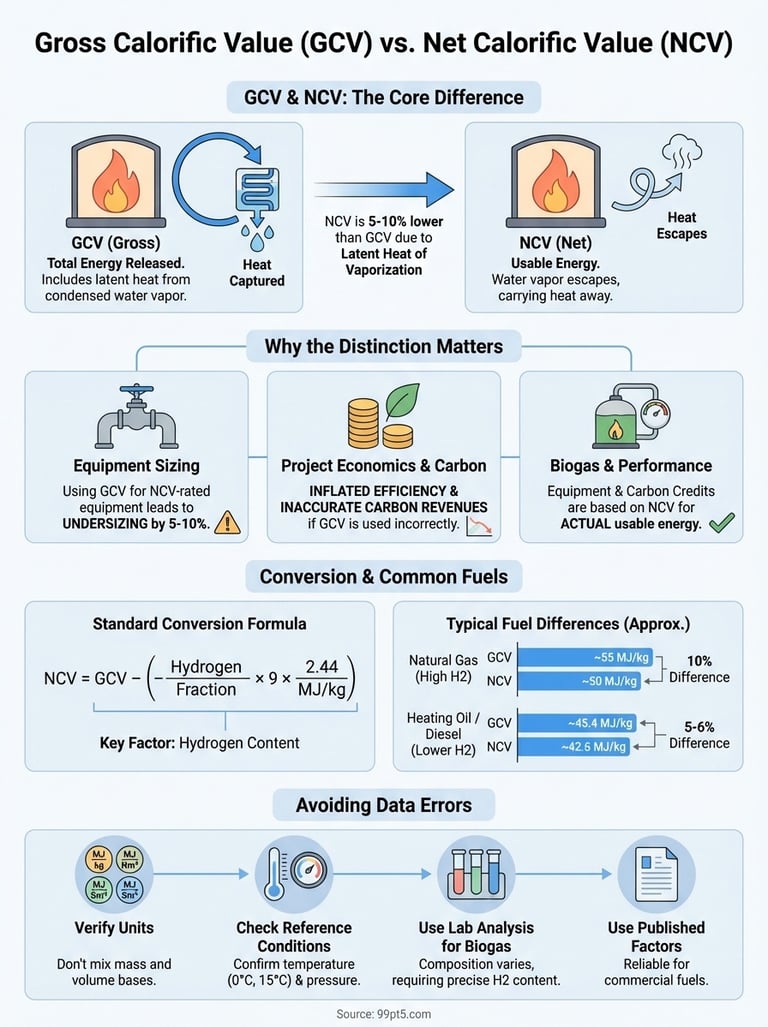
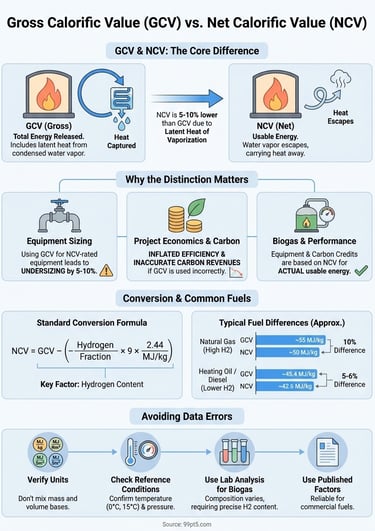
Gross calorific value (GCV) tells you the total energy released when fuel burns completely. Net calorific value (NCV) tells you the usable energy after accounting for water vapor losses. The difference matters because when hydrogen in fuel burns, it creates water vapor that carries away heat. GCV assumes you capture that heat by condensing the vapor back to liquid. NCV assumes the vapor escapes. For most fuels, NCV runs about 5 to 10% lower than GCV depending on hydrogen content.
This guide shows you how to convert between GCV and NCV, explains typical differences for natural gas and other fuels, and helps you avoid data errors that skew project calculations. You'll learn which value to use when sizing biogas equipment, comparing fuel options, or calculating carbon credits. The conversions are straightforward once you understand the water vapor factor. By the end, you'll know exactly which number to plug into your calculations and why it matters for accurate system design and performance guarantees.
Why gross vs net calorific value matters
Your equipment specifications, fuel contracts, and performance guarantees all reference one value or the other. Mixing up GCV and NCV creates errors that compound through every calculation. If you size equipment using GCV when the manufacturer lists NCV ratings, you'll undersize by 5 to 10%. The gross calorific value vs net calorific value distinction affects carbon calculations and efficiency reporting.
Impact on system design
Project economics shift when you base calculations on the wrong calorific value. A biogas system designed around GCV numbers will show inflated efficiency that operation cannot match.
Using gross values where net values apply overstates system efficiency by 5 to 10 percent.
Carbon revenues depend on accurate energy content. You need the right baseline value for legitimate offset calculations.
How to convert between gross and net values
You subtract the latent heat of vaporization from the gross value to get the net value. The water vapor forms when hydrogen in the fuel combines with oxygen during combustion. Each kilogram of hydrogen produces nine kilograms of water. When that water stays as vapor instead of condensing, it carries away roughly 2.44 MJ of energy per kilogram. This energy loss explains why gross calorific value vs net calorific value differs across fuels.
The standard conversion method
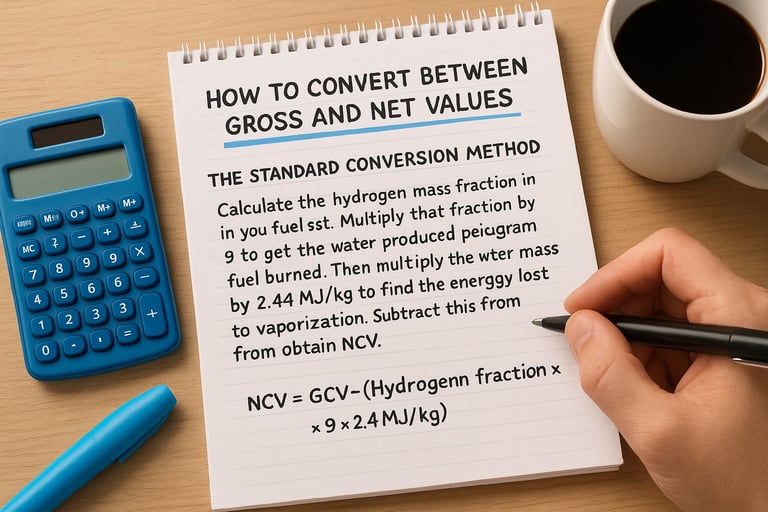
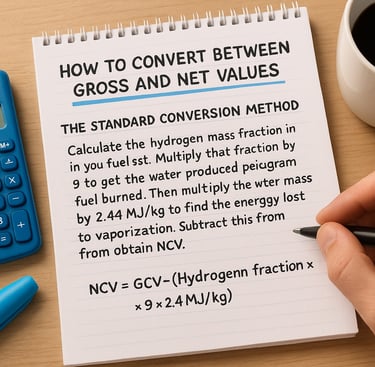
Calculate the hydrogen mass fraction in your fuel first. Multiply that fraction by 9 to get the water produced per kilogram of fuel burned. Then multiply the water mass by 2.44 MJ/kg to find the energy lost to vaporization. Subtract this from GCV to obtain NCV. The formula looks like this:
NCV = GCV - (Hydrogen fraction × 9 × 2.44 MJ/kg)
Natural gas contains about 25% hydrogen by mass, which produces roughly 2.25 kg of water per kilogram of fuel. That water represents about 5.5 MJ of lost heat energy. If your natural gas has a GCV of 55 MJ/kg, the NCV calculates to approximately 49.5 MJ/kg.
Using published conversion factors
Most fuel suppliers provide both values in their technical data sheets. You avoid calculation errors by using these published numbers directly. The conversion factor between GCV and NCV stays consistent for a given fuel type. For natural gas, divide GCV by approximately 1.11 to get NCV. For heating oil, divide by roughly 1.06. These factors account for typical composition ranges.
Published conversion factors eliminate calculation errors when precise fuel composition data is unavailable.
When you work with biogas streams, composition varies more than commercial fuels. You need actual methane content measurements and sulfur compound readings. Laboratory analysis gives you the exact hydrogen content needed for accurate conversions. Generic conversion factors introduce errors that compound through your entire design calculation.
Typical differences for common fuels
The percentage gap between GCV and NCV depends on hydrogen content. Fuels with more hydrogen produce more water vapor when burned, creating larger differences. Natural gas shows the biggest gap at roughly 10%, while heating oil and diesel typically range from 5 to 6%. These percentages stay consistent across different supply sources because fuel specifications standardize composition ranges.
Natural gas and methane
Pure methane has a GCV of approximately 55.5 MJ/kg and an NCV of 50.0 MJ/kg, creating a 10% difference. Your pipeline gas supply varies slightly based on region but generally falls between 52 and 56 MJ/kg for GCV. The gross calorific value vs net calorific value gap stays proportional across this range. When you calculate energy content for billing purposes, gas companies typically use 38 to 47 MJ/Nm³ for NCV depending on local composition. The higher the methane content, the closer you get to the pure methane ratio.
Natural gas consistently shows the largest GCV to NCV difference among common fuels due to its high hydrogen content.
Liquid fuels and solid biomass
Heating oil and diesel fuel both show GCV around 45.4 MJ/kg with NCV near 42.6 MJ/kg, a difference of roughly 6%. Wood pellets range from 17 to 20 MJ/kg for GCV and 16 to 18 MJ/kg for NCV. Moisture content affects these numbers significantly. Wet biomass loses more energy to water evaporation than the hydrogen combustion alone. You need to account for both fuel moisture and combustion water when working with solid fuels.
Using gross and net values in biogas projects
Your biogas equipment operates based on net calorific value because the water vapor exits with exhaust gases. When you specify a BioTreater system or similar processing unit, manufacturers rate capacity in NCV terms. The raw biogas entering your system typically contains 55 to 65% methane with a GCV around 22 to 24 MJ/Nm³ and NCV around 20 to 22 MJ/Nm³. After processing to pipeline quality, you get 95 to 99% methane with substantially higher energy content per cubic meter. Understanding gross calorific value vs net calorific value helps you calculate actual output correctly.
Equipment sizing and performance guarantees
Performance guarantees reference net values because that represents usable energy. When you guarantee 99.5% biomethane recovery, you calculate against NCV input and output. The heat balance for your entire system uses NCV to match actual operating conditions. If you plan to recover waste heat from exhaust gases, you might approach GCV performance by condensing water vapor. Most systems do not condense, so NCV remains the relevant metric.
Equipment manufacturers rate capacity using net calorific value to reflect actual operating performance without condensation.
Carbon credit calculations
Carbon accounting requires net values for accurate offset calculations. You measure emissions based on actual energy delivered, not theoretical maximum. Your carbon credit revenue depends on demonstrating real displacement of fossil fuels, which means using NCV comparisons.
Avoiding common errors with GCV and NCV data
The most frequent mistakes happen when you mix data sources that use different reference conditions or unit conventions. Lab reports might list values in MJ/kg while supplier specs use MJ/Nm³. You need to verify whether the cubic meter refers to standard conditions (273 K, 1 bar) or normal conditions (273 K, 1.01325 bar). Temperature and pressure differences change volumetric energy density by several percent. Converting between mass and volume basis requires knowing actual gas density under your operating conditions.
Unit conversion mistakes
Double-check which basis your numbers use before plugging them into calculations. Some regions report calorific values at 15°C reference temperature while others use 0°C or 25°C. The gross calorific value vs net calorific value distinction compounds when you also convert between different temperature bases. Always confirm whether values are per kilogram, per normal cubic meter, or per standard cubic meter before comparing fuels or sizing equipment.
Mixing unit conventions and reference conditions creates calculation errors that cascade through entire project designs.
Key takeaways
You convert between GCV and NCV by subtracting the latent heat of water vapor produced during combustion. The percentage difference ranges from 5 to 6% for liquid fuels and around 10% for natural gas. Your project calculations need the correct value to avoid sizing errors and inflated efficiency claims. Always verify which reference condition your data uses because mixing GCV and NCV creates compounding mistakes through every downstream calculation.
Equipment manufacturers rate capacity using net calorific value because that reflects actual performance without condensation. When you size biogas processing systems, guarantee performance metrics, or calculate carbon credits, you work with NCV numbers. Understanding gross calorific value vs net calorific value helps you compare fuel options accurately and design systems that meet real-world performance targets.
Explore 99pt5's BioTreater biogas processing solutions for guaranteed 99.5% biomethane recovery with industry-leading efficiency and the lowest operating costs.