Higher Heating Value vs Lower Heating Value: Why It Matters
Understand higher heating value vs lower heating value. Learn why this 7-11% difference impacts biogas project efficiency, equipment, & finances.
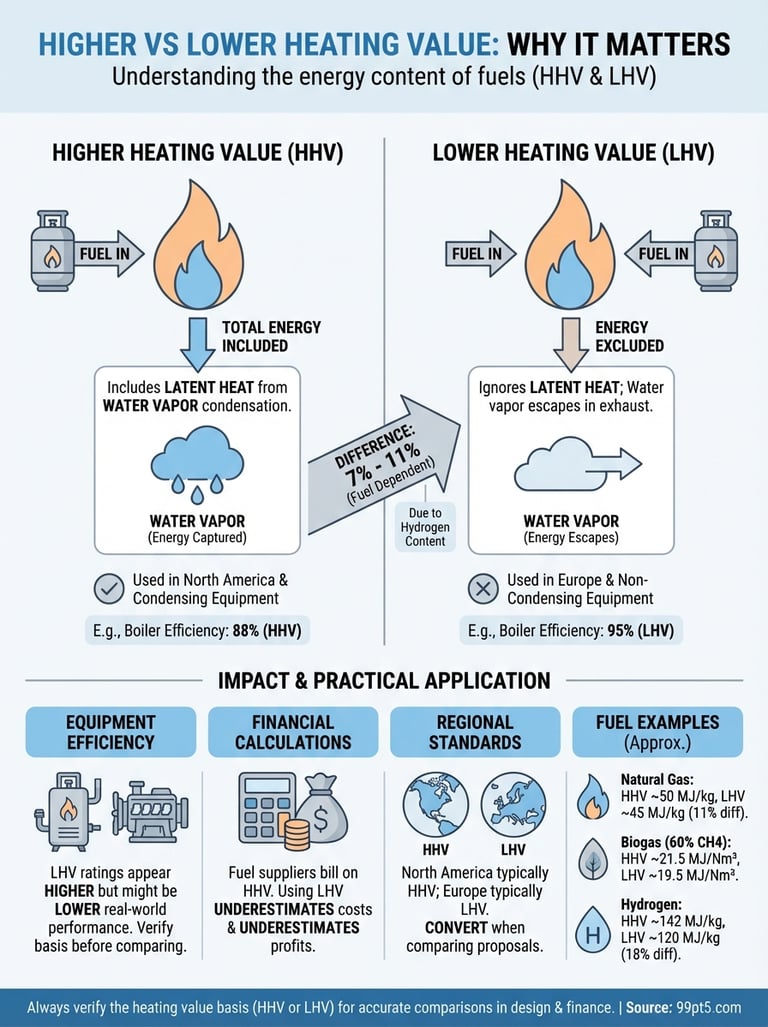
When you burn fuel, water vapor forms and carries away energy. Higher heating value accounts for all that energy by assuming the water vapor condenses back to liquid. Lower heating value ignores it because the vapor escapes with the exhaust. That difference typically ranges from 7% to 11% depending on the fuel.
This article breaks down what HHV and LHV mean for your biogas projects. You'll learn why the distinction matters when you calculate efficiency, compare equipment specifications, or evaluate fuel costs. We cover practical examples for natural gas, biogas, and hydrogen. You'll see how to convert between the two values and which one to use for specific applications. By the end, you'll know exactly when to apply HHV versus LHV in your system design and financial analysis.
Why higher and lower heating values matter
You need to know which heating value your equipment supplier, fuel vendor, and efficiency calculator use. Different regions and industries prefer different standards, creating confusion when you compare specifications. North American manufacturers typically quote efficiency based on HHV, while European companies often use LHV. This means a boiler rated at 90% efficiency on an LHV basis might only achieve 82% efficiency when measured against HHV.
Impact on equipment selection
Your equipment purchase decisions depend on accurate efficiency comparisons. When you evaluate two boilers, one rated at 88% HHV and another at 95% LHV, you cannot directly compare these numbers. The LHV rating appears higher but may actually represent lower real-world performance. You must convert both ratings to the same basis before making your selection.
Converting between HHV and LHV prevents costly mistakes when you compare competing equipment proposals.
Financial calculations require the right basis
Fuel cost analysis demands the correct heating value. Your fuel supplier bills you based on HHV energy content, so you must use HHV when calculating operating costs. If you mistakenly use LHV in your financial model, you will underestimate fuel consumption by 7% to 11%, throwing off your entire project budget and return on investment projections.
How to interpret HHV and LHV in practice
You encounter HHV and LHV values on specification sheets, fuel invoices, and efficiency ratings. The first step is identifying which value the document uses. Look for explicit labels like "HHV basis" or "LHV basis" near efficiency percentages or energy content figures. If the document doesn't specify, assume HHV for North American sources and LHV for European publications. When you compare higher heating value vs lower heating value across different vendors, always confirm the basis before making decisions.
Reading specification sheets
Equipment manufacturers list energy consumption, output capacity, and efficiency using either heating value basis. An 85% efficient engine on HHV basis converts to roughly 94% efficient on LHV basis for natural gas. You need to identify which standard applies before comparing options. Check the fine print at the bottom of specification sheets or in the technical appendix where manufacturers typically disclose their calculation method.
Always verify the heating value basis before comparing equipment from different manufacturers.
Converting between values
The conversion factor depends on fuel composition, specifically hydrogen content. For natural gas, divide HHV by 1.11 to get LHV. For biogas with 60% methane, use a factor between 1.08 and 1.10. You can calculate the precise conversion using fuel composition data and the water vapor heat of vaporization, but standard factors work well for preliminary analysis. When accuracy matters, request both HHV and LHV values directly from your fuel supplier or laboratory test results.
Comparing HHV and LHV for common fuels
You see the biggest differences between HHV and LHV in hydrogen-rich fuels. Natural gas shows an 11% difference between the two values, while diesel fuel varies by only 7%. This happens because hydrogen produces more water vapor during combustion, which carries away more latent heat. Understanding these differences helps you evaluate fuel quality and calculate accurate energy balances for your system.
Natural gas and biogas values
Natural gas delivers 50 MJ/kg on an HHV basis and 45 MJ/kg on an LHV basis. Your biogas composition directly affects the higher heating value vs lower heating value gap. Raw biogas with 60% methane content shows 21.5 MJ/Nm³ HHV versus 19.5 MJ/Nm³ LHV.
After upgrading to 98% methane, you reach 35.8 MJ/Nm³ HHV and 32.3 MJ/Nm³ LHV. These numbers matter when you calculate project economics and compare fuel quality between different digesters. Raw biogas values vary significantly based on feedstock composition and digester conditions, so you need to test your specific gas stream rather than rely on generic values.
Raw biogas heating values depend heavily on methane content, CO2 levels, and trace contaminants in your feedstock.
Hydrogen fuel characteristics
Hydrogen shows the largest HHV to LHV gap of any common fuel at roughly 18%. This fuel produces 142 MJ/kg HHV but only 120 MJ/kg LHV. Pure hydrogen creates more water vapor per unit of energy than any hydrocarbon, making the heating value choice critical for hydrogen blending projects or fuel cell applications.
Using HHV and LHV in efficiency calculations
Your efficiency calculations change dramatically depending on which heating value you choose as the baseline. Thermal efficiency equals useful energy output divided by total energy input, but this simple formula hides a critical choice. When you use HHV as your denominator, you include energy that escapes as water vapor, resulting in lower efficiency percentages. Switching to LHV as your baseline increases the calculated efficiency by the same percentage difference between the two heating values.
Boiler efficiency ratings
Boiler manufacturers measure efficiency by dividing heat transferred to water or steam by fuel energy consumed. A condensing boiler recovers heat from water vapor in the exhaust, so you should rate it using HHV because it actually captures that latent heat energy. Your non-condensing boiler cannot recover this energy, making LHV the more honest representation of available heat. The choice between higher heating value vs lower heating value affects how you compare competing boiler proposals and calculate payback periods for efficiency upgrades.
Use HHV for condensing equipment and LHV for non-condensing systems to reflect actual energy recovery potential.
Engine and generator calculations
Gas engines and combined heat and power systems require careful attention to heating value selection. You calculate electrical efficiency by dividing generator output by fuel energy input. Most engine manufacturers quote efficiency on an LHV basis because exhaust temperatures stay too high for water vapor condensation. When you compare a 42% efficient engine (LHV) to a 38% efficient turbine (HHV), you must convert both to the same basis. The engine actually delivers slightly less efficiency than it appears when you recalculate using HHV.
HHV and LHV considerations for biogas projects
Biogas upgrading projects require precise heating value specifications from the start. Your equipment suppliers, financial models, and performance guarantees all depend on using consistent heating value standards. Most biogas upgrading systems in North America operate based on HHV calculations, while European systems typically use LHV. This difference becomes critical when you import technology or compare international proposals. The choice between higher heating value vs lower heating value affects every calculation from digester sizing to revenue projections.
Equipment vendor specifications
Your biogas upgrading equipment vendor must clearly state whether performance guarantees use HHV or LHV as the basis. A 99.5% methane recovery guarantee means different things depending on the heating value standard. You need this clarity before signing purchase agreements. Request that vendors provide both HHV and LHV specifications for your specific biogas composition, including methane content, CO2 levels, and expected contaminants.
Verify that your vendor's performance guarantees match the heating value basis used in your financial model.
Financial modeling accuracy
Your project's financial viability depends on matching heating value standards across all calculations. Revenue from biomethane sales gets calculated using the energy content your gas utility measures, typically HHV in North America. When you build financial models using LHV figures, you underestimate actual fuel costs and overestimate profits by 8% to 11%. This error compounds across multi-year projections, potentially making an economically viable project appear unworkable or vice versa.
Key points to remember
Understanding higher heating value vs lower heating value prevents costly mistakes in your biogas projects. HHV includes water vapor energy while LHV excludes it, creating a 7% to 11% difference depending on fuel type. Always verify which basis your vendors, fuel suppliers, and financial models use. North American systems typically use HHV while European equipment uses LHV, so you must convert values when evaluating international proposals. Match your efficiency calculations and revenue projections to the same standard. 99pt5's BioTreater system delivers guaranteed 99.5% biomethane recovery on an HHV basis, ensuring performance without confusion.