Honeywell Condition Monitoring: Vibration, CBM, Deployment
Unlock 20-30% maintenance savings using Honeywell condition monitoring. Learn to deploy, select, and troubleshoot vibration-based CBM for critical equipment.
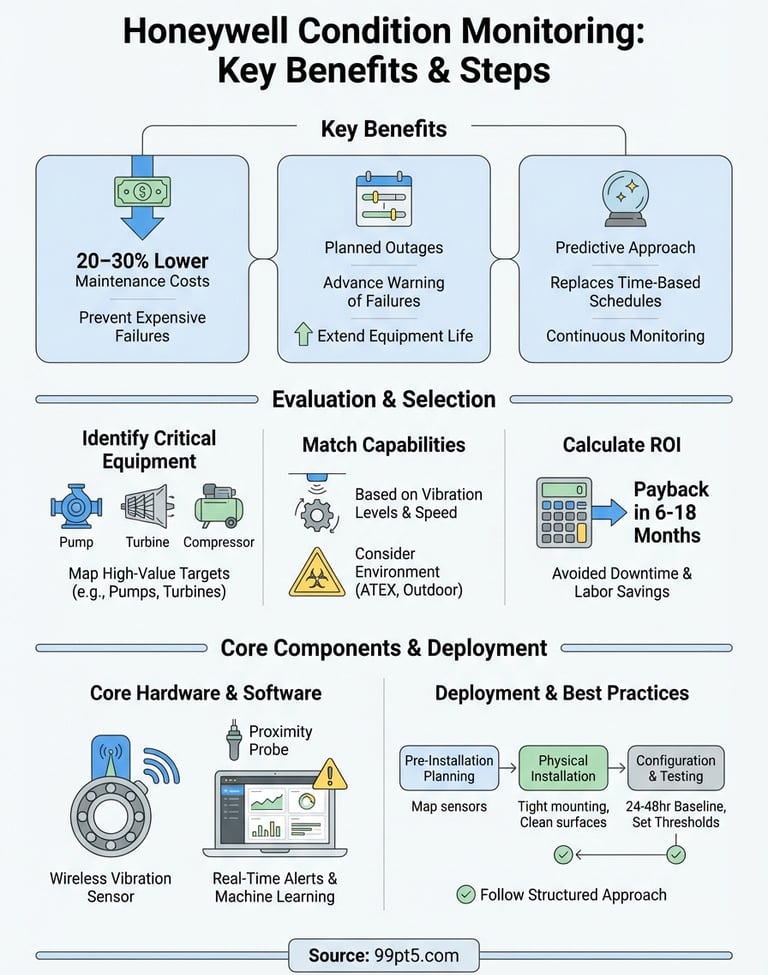
Honeywell condition monitoring tracks the health of your rotating equipment using vibration sensors and real time data analysis. The system detects bearing wear, misalignment, imbalance, and other mechanical faults before they cause downtime. You get alerts when problems develop so you can schedule maintenance during planned outages instead of dealing with emergency shutdowns.
This guide walks you through everything you need to know about Honeywell's vibration based condition monitoring and condition based maintenance (CBM) systems. You'll see why these solutions matter for your operations, how to evaluate and select the right configuration, what deployment looks like from start to finish, and common issues to avoid. Whether you're installing your first monitoring system or upgrading an existing setup, you'll find practical steps for integration and troubleshooting that help you maximize uptime and reduce maintenance costs.
Why Honeywell condition monitoring matters
Unplanned downtime costs you money in lost production, emergency repairs, and rushed parts orders. Honeywell condition monitoring gives you advance warning of equipment failures so you can schedule maintenance during planned outages instead of scrambling to fix problems at 2 AM. You'll cut maintenance costs by 20-30% and extend equipment life by catching issues early.
The system tracks vibration patterns that signal developing problems like bearing wear, shaft misalignment, or rotor imbalance. You get real time alerts when readings exceed normal thresholds so your team can investigate before a minor issue becomes a major failure. This predictive approach replaces time-based maintenance schedules that waste resources on equipment that's still running fine or miss problems that develop between scheduled inspections.
Catching a failing bearing costs $500 in parts and scheduled downtime, while an unexpected failure can cost $50,000 in emergency repairs, production losses, and secondary damage to connected equipment.
Your operations stay online longer and run more efficiently with continuous monitoring instead of periodic manual checks.
How to evaluate and select Honeywell condition monitoring
Start by mapping your critical rotating equipment and identifying which failures would cause the most expensive downtime. Your high-value targets include compressors, pumps, turbines, motors, and gearboxes that support production lines or safety systems. You need continuous monitoring for equipment that runs 24/7 and costs over $10,000 per hour when offline.
Match system capabilities to your equipment profile
Look at your vibration levels and operating speeds to determine sensor requirements. Equipment spinning under 600 RPM needs velocity sensors, while high-speed machinery above 3,600 RPM requires accelerometers. You'll want proximity probes for shaft position monitoring on critical turbines and compressors where radial and axial movement matters for safety.
Consider your environmental conditions when selecting hardware. Hazardous area installations need ATEX or IECEx certified sensors, while outdoor equipment requires IP67 rated enclosures that handle moisture and temperature extremes.
Calculate ROI and payback period
Compare the total system cost against your annual unplanned downtime expenses. Include sensor hardware, data acquisition units, software licenses, installation labor, and training. Most facilities see payback in 6-18 months through avoided emergency repairs and extended equipment life.
A facility with $500,000 in annual unplanned downtime typically recovers a $150,000 Honeywell condition monitoring investment within four months by preventing just two major failures.
Factor in maintenance labor savings from switching predictive schedules that reduce unnecessary inspections and part replacements.
Honeywell vibration and CBM solutions at a glance
Honeywell offers integrated hardware and software packages that combine vibration sensors, data acquisition units, and analytics platforms into complete monitoring systems. You get factory-configured solutions that work together out of the box instead of piecing together components from multiple vendors.
Core hardware components
Wireless vibration sensors mount directly on bearing housings and transmit data without cable runs that complicate installations. The sensors measure acceleration, velocity, and displacement across multiple frequency ranges to detect specific fault patterns. You'll find options for both battery-powered units that last 5-10 years and wired accelerometers for critical equipment that needs continuous high-resolution monitoring.
Proximity probes track shaft position in turbomachinery where radial and axial movement indicates developing problems with bearings, seals, or rotor dynamics. These sensors integrate with the same data acquisition infrastructure as vibration monitors for unified analysis.
Software and analytics platform
Honeywell Forge APM processes vibration data from your sensors and compares readings against baseline patterns to identify anomalies. The system uses machine learning algorithms that improve fault detection accuracy as they analyze more data from your specific equipment.
Real-time dashboards show equipment health status across your facility, while automated alerts notify you when vibration levels exceed acceptable thresholds or trend toward failure conditions.
You access monitoring data through web browsers and mobile apps that let maintenance teams check equipment status from anywhere.
Deployment steps and integration best practices
Your deployment succeeds when you follow a structured approach that addresses planning, installation, and testing phases. You'll minimize disruptions to operations and ensure your Honeywell condition monitoring system delivers accurate data from day one by working through these critical stages methodically.
Pre-installation planning
Map your sensor locations on equipment drawings before ordering hardware so you get the right mounting configurations and cable lengths. You need to identify power sources near monitoring points and plan cable routes that avoid interference from electrical lines or heat sources. Schedule installations during planned maintenance windows when you can safely access equipment and verify mounting surfaces are clean and flat.
Physical installation process
Mount vibration sensors directly on bearing housings using threaded studs or magnetic bases that maintain solid contact with metal surfaces. You want sensors positioned where they'll capture the clearest vibration signals, typically on horizontal and vertical planes at each bearing location. Run signal cables in protective conduit away from power lines to prevent electrical noise contamination, and terminate connections at your data acquisition unit following the manufacturer's wiring diagrams.
Professional installation on a 20-machine facility typically takes 3-5 days with proper planning, but rushing through mounting and wiring can create false alarms that waste months of troubleshooting time.
System configuration and testing
Configure your baseline parameters by running equipment at normal operating conditions for 24-48 hours while the system learns typical vibration patterns. Set alarm thresholds at 10-15% above baseline readings to catch developing problems without triggering false alerts. Verify data accuracy by comparing sensor readings against handheld vibration meters at the same measurement points.
Common pitfalls and troubleshooting tips
You'll waste months chasing false alarms if you skip proper setup and maintenance procedures for your Honeywell condition monitoring system. Most problems stem from installation errors and configuration mistakes that create bad data instead of accurate equipment health information.
Poor sensor mounting creates unreliable data
Loose sensors generate erratic readings that trigger false alarms and hide real problems. You need tight mounting with clean, flat surfaces and properly torqued studs or strong magnetic bases that won't vibrate off during operation. Check your sensor connections every six months because thermal cycling and vibration gradually loosen mounts over time.
Incorrect alarm settings waste your team's time
Setting alarm thresholds too low floods maintenance teams with false alerts that get ignored, while thresholds set too high miss developing problems until failures occur. Start with manufacturer recommendations and adjust based on your equipment's actual operating patterns over 30 days of baseline data.
A facility that reduced false alarms from 47 per week to 3 per week by raising velocity thresholds just 15% above baseline caught every real fault while eliminating alert fatigue that caused technicians to ignore warnings.
Verify your frequency ranges match the rotating speeds of monitored equipment so the system detects relevant fault signatures instead of background noise.
Key takeaways
Honeywell condition monitoring reduces your maintenance costs by 20-30% and prevents expensive emergency failures through continuous vibration analysis of rotating equipment. You get advance warning when bearings, shafts, or rotors develop problems so you can schedule repairs during planned outages instead of dealing with unexpected downtime.
Success depends on proper sensor mounting, accurate baseline configuration, and appropriate alarm thresholds that catch real problems without generating false alerts. Your deployment follows a structured approach that includes equipment mapping, installation during maintenance windows, and 24-48 hours of baseline data collection before going live.
Whether you're monitoring compressors, pumps, or process equipment in BioGas facilities, condition-based maintenance systems like Honeywell's protect your investment in critical machinery. Check out 99pt5's BioGas processing solutions for equipment designed with petroleum industry reliability standards that benefit from continuous monitoring.