How To Remove H2S From Biogas: Methods And Best Practices
Discover how to remove H2S from biogas using activated carbon, chemical, and biological methods. Get practical guidance on system design & monitoring for clean, valuable biomethane.
H2S removal from biogas means eliminating hydrogen sulfide gas before you use or sell the biomethane. This corrosive compound forms naturally during anaerobic digestion when organic matter breaks down. Left unchecked, it damages equipment, creates safety hazards, and reduces the commercial value of your gas. The goal is simple: clean biogas that meets pipeline specifications and protects your investment.
This guide walks you through proven methods for removing H2S from biogas streams. You'll learn how to evaluate different technologies like activated carbon, chemical scrubbing, biological treatment, and iron-based systems. We'll cover the factors that determine which approach works best for your operation, including feedstock characteristics, target purity levels, and operating costs. You'll also find practical guidance on system design, monitoring protocols, and safety compliance. By the end, you'll understand how to select and implement an H2S removal strategy that delivers consistent results and maximizes your return.
Why H2S removal in biogas matters
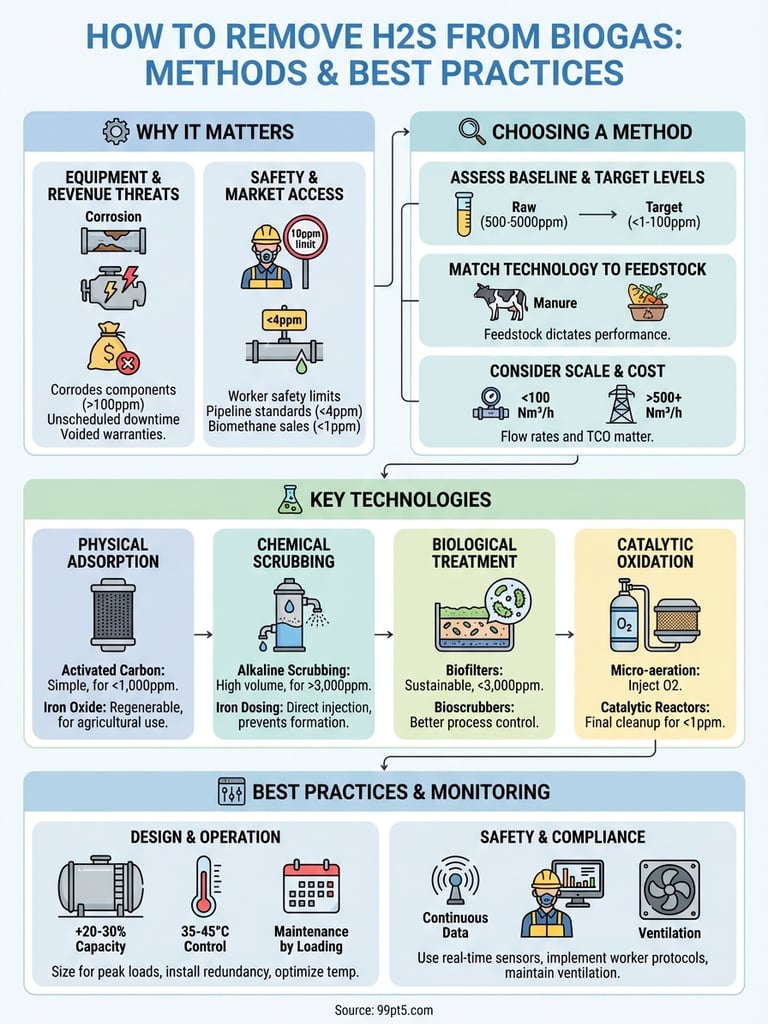
Understanding how to remove H2S from biogas directly impacts your bottom line and operational safety. Hydrogen sulfide concentrations above 100 parts per million (ppm) corrode metal components in your system, including pipes, storage tanks, and engine parts. This corrosion forces you to replace expensive equipment years before its expected lifespan ends. Maintenance costs escalate quickly when you ignore H2S levels, often consuming profits that would otherwise flow to your business.
Direct threats to equipment and revenue
Your cogeneration engines suffer the most damage from untreated biogas. Sulfur compounds form sulfuric acid during combustion, eating away at cylinder walls and exhaust systems. You'll face unscheduled downtime that stops gas production and halts revenue generation. Equipment warranties become void when manufacturers detect H2S damage during inspections.
Removing H2S protects your capital investment and maintains consistent cash flow from gas sales.
Safety and market access requirements
Worker safety regulations limit H2S exposure to 10 ppm for an eight-hour shift in most jurisdictions. Pipeline injection standards typically require concentrations below 4 ppm to prevent corrosion in transmission infrastructure. Market specifications for biomethane sales demand even stricter limits, often under 1 ppm. You cannot access premium markets or secure long-term contracts without reliable H2S control.
How to choose an H2S removal method
Your selection process starts with measuring baseline H2S levels in your raw biogas and identifying the target concentration you need to achieve. Different end uses require different purity standards. Pipeline injection might demand less than 4 ppm, while engine manufacturers often accept up to 100 ppm for shorter intervals. Cost per unit of H2S removed varies significantly between technologies, so you need accurate data to compare options fairly.
Assess your current H2S concentration and target levels
Raw biogas from protein-rich feedstocks like poultry manure typically contains 2,000 to 5,000 ppm of H2S, while agricultural waste generates 500 to 2,000 ppm. You must test your specific stream because concentration ranges determine which technologies work efficiently. High concentrations above 3,000 ppm favor chemical scrubbing or iron oxide systems that handle heavy loads without frequent media replacement. Lower concentrations under 1,000 ppm allow biological filters or activated carbon to operate economically for extended periods.
Target levels depend on your downstream equipment and market access requirements. Cogeneration engines tolerate 50 to 100 ppm for limited run times, but pipeline specifications enforce 4 ppm or less. Biomethane sales contracts often require concentrations below 1 ppm to meet renewable natural gas standards. Calculate the reduction percentage you need because removing 90% of H2S costs less than achieving 99.5% removal.
Match technology to feedstock and scale
Feedstock composition dictates which removal method delivers consistent performance. Manure-based systems benefit from iron dosing directly into the digester, while food waste operations often require two-stage removal with biological treatment followed by polishing. Flow rates under 100 Nm³/hour suit compact activated carbon units, but larger operations processing 500+ Nm³/hour justify the capital cost of chemical scrubbing towers or membrane systems.
Select technologies that align with your available space, maintenance capabilities, and operating budget rather than chasing the lowest initial purchase price.
Operating expenses include media replacement, chemical consumption, electricity, and labor for monitoring. Calculate total cost of ownership across three to five years when you evaluate how to remove H2S from biogas. Factor in disposal costs for spent materials because some byproducts require hazardous waste handling while others produce saleable sulfur or fertilizer products.
Overview of key H2S removal technologies
You can choose from four primary categories when you decide how to remove H2S from biogas: physical adsorption, chemical absorption, biological treatment, and catalytic oxidation. Each technology operates through different mechanisms and delivers distinct performance characteristics. Physical methods capture H2S molecules on solid surfaces, while chemical systems react with sulfur compounds to form new products. Biological approaches use microorganisms to convert H2S into elemental sulfur or sulfate, and catalytic methods oxidize H2S through controlled combustion. Your selection depends on inlet concentration, required purity, available space, and budget constraints.
Activated carbon and iron oxide systems
Activated carbon filters provide the simplest installation for low to moderate H2S concentrations under 1,000 ppm. You replace cartridges or vessels when breakthrough occurs, typically after processing 10 to 20 kilograms of H2S per kilogram of carbon. These systems require no power beyond gas pressure and operate silently without moving parts. Carbon saturation happens faster in humid conditions, so you need upstream water removal for maximum efficiency.
Iron oxide pellets offer regeneration capabilities that activated carbon cannot match. You expose saturated pellets to air, which converts iron sulfide back to iron oxide for reuse. Regeneration cycles extend media life to 18 months or longer in agricultural applications. However, pellet systems demand larger footprints and careful moisture control because wet conditions cause clumping and channeling that reduce contact efficiency.
Chemical scrubbing methods
Alkaline scrubbing with sodium hydroxide (NaOH) or sodium bicarbonate removes H2S through chemical reaction in packed towers. You spray solution countercurrent to rising biogas, achieving outlet concentrations below 10 ppm from inlet levels exceeding 5,000 ppm. These systems handle high volumes efficiently but generate spent caustic that requires disposal or regeneration. Operating costs depend on caustic prices, which fluctuate with global chemical markets.
Iron salt dosing into digesters prevents H2S formation at the source. You inject ferrous chloride or ferric chloride directly into slurry where it reacts with sulfides before gas evolution occurs. Dosing rates of 50 to 150 mg iron per liter of feedstock reduce gas-phase H2S by 80 to 95 percent. This preventative approach works best with protein-rich feedstocks but increases sludge production and disposal volumes.
Biological desulfurization
Biofilters pass biogas through beds of specialized bacteria that oxidize H2S into elemental sulfur and sulfate. You maintain optimal conditions with controlled moisture, nutrients, and temperature between 25 and 40 degrees Celsius. These systems deliver consistent performance for concentrations under 3,000 ppm with minimal chemical consumption. Biomass growth requires periodic harvesting to prevent bed clogging and maintain residence time.
Bioscrubbers separate absorption and biological oxidation into distinct stages. Your gas contacts water or weak caustic in a scrubber tower, then bacteria in a separate reactor oxidize dissolved sulfides. This configuration provides better process control than single-stage biofilters and handles concentration swings more effectively.
Biological methods produce saleable elemental sulfur as a byproduct, turning waste removal into revenue generation.
Oxygen injection and catalytic approaches
Micro-aeration introduces controlled oxygen volumes directly into digester headspace or gas lines. Sulfur-oxidizing bacteria consume oxygen and H2S simultaneously, converting sulfur to elemental form that deposits on surfaces or remains in slurry. You inject 2 to 6 percent oxygen by volume to achieve 70 to 90 percent H2S reduction without methane oxidation. Precision control prevents explosive mixtures and maintains anaerobic conditions in digesters.
Catalytic reactors remove residual oxygen after micro-aeration while polishing H2S to pipeline specifications. Catalyst beds containing precious metals facilitate complete H2S oxidation at elevated temperatures, delivering outlet concentrations below 1 ppm. These systems serve as final cleanup stages in multi-step processes targeting biomethane quality standards.
Design and operational best practices
Your system design determines how effectively you remove H2S over the equipment's operational life. Proper sizing prevents bottlenecks during peak production periods, while strategic placement of treatment units minimizes pressure drops and energy consumption. You need to account for seasonal variations in feedstock composition that create concentration spikes, not just average H2S levels measured during commissioning.
Size equipment for peak loads and future growth
Design capacity should exceed your current maximum flow rate by 20 to 30 percent to accommodate production increases and process upsets. You cannot achieve target removal efficiency when gas velocities through packed beds or filters exceed design specifications. Pressure drop calculations must include fouled conditions, not clean media performance, because real-world operation differs significantly from laboratory data.
Install redundant treatment trains when continuous operation matters for revenue generation. Backup systems allow maintenance without shutting down biogas production or flaring valuable product. Your capital investment in redundancy pays back through avoided downtime costs within two to three years for most commercial operations.
Optimize process parameters and maintenance schedules
Temperature control between 35 and 45 degrees Celsius maximizes biological activity in biofilters and prevents condensation that fouls chemical systems. You achieve better results when you pre-condition biogas humidity to 80 percent relative saturation rather than allowing water slugs to reach treatment units.
Regular testing of outlet concentrations prevents costly equipment damage from breakthrough events that traditional monitoring systems miss.
Maintenance intervals depend on actual H2S loading, not calendar schedules. Track cumulative sulfur removed to predict media replacement accurately and avoid premature changes that waste money or delayed changes that compromise quality.
Monitoring, safety and compliance
Your H2S removal system requires continuous measurement to verify performance and protect workers. Real-time sensors placed upstream and downstream of treatment units show you actual removal efficiency, not theoretical design values. You detect breakthrough events immediately when outlet concentrations rise above specifications, allowing corrective action before equipment damage occurs. Compliance documentation depends on accurate data logging that regulatory agencies can audit during facility inspections.
Track performance with continuous sensors
Fixed gas detectors at treatment units and enclosed spaces alert you when H2S concentrations exceed safe thresholds. You need sensors that withstand biogas humidity and corrosive conditions without frequent calibration failures. Data logging systems record concentration trends that reveal declining media performance or process upsets requiring investigation.
Installing redundant sensors at critical measurement points prevents false readings from stopping production or creating undetected safety hazards.
Implement workplace safety protocols
Personal monitors worn by maintenance staff provide individual protection during filter changes and confined space entry. Training programs must cover H2S health effects, emergency response procedures, and proper use of respiratory protection. Ventilation systems in treatment buildings maintain air quality below occupational exposure limits, typically 10 ppm for eight-hour shifts. Your safety protocols determine how effectively you protect workers while learning how to remove h2s from biogas in daily operations.
Bringing it all together
You now understand how to remove h2s from biogas through multiple proven technologies that protect your equipment and maximize revenue. Selection criteria include your current H2S concentration, target purity requirements, feedstock characteristics, and operating budget constraints. Physical adsorption works for lower concentrations under 1,000 ppm, while chemical scrubbing handles heavy loads above 3,000 ppm efficiently. Biological systems offer sustainable operation with saleable byproducts, and catalytic methods deliver pipeline-quality biomethane when you need concentrations below 1 ppm.
Your success depends on accurate monitoring, proper system sizing, and maintenance schedules based on actual sulfur loading rather than calendar intervals. Companies like 99pt5 deliver integrated biogas processing solutions that guarantee 99.5% methane recovery while removing contaminants to pipeline specifications. The right technology combination transforms corrosive raw biogas into valuable clean fuel that generates consistent returns for your operation.