What Is Process Safety? A Guide to Managing Major Hazards
Discover what is process safety and why it's vital for high-hazard industries. Learn how to manage major hazards and build a robust PSM system today.
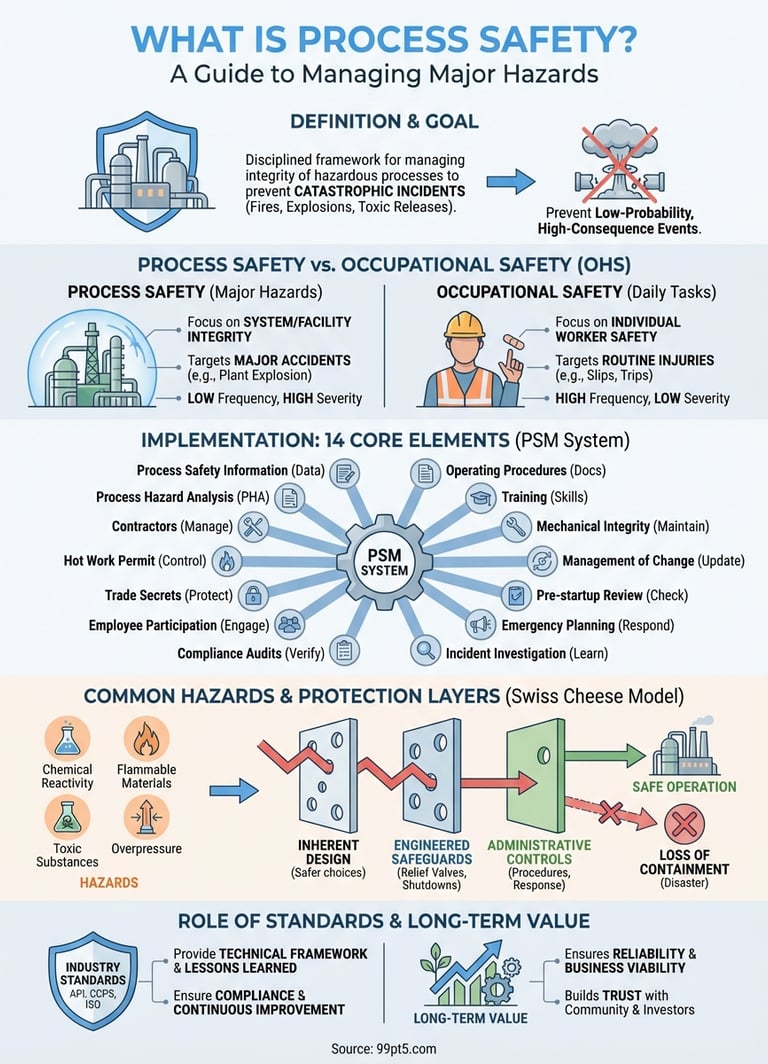
Process safety is a disciplined framework for managing the integrity of operating systems and processes that handle hazardous materials. It focuses on preventing catastrophic incidents like fires, explosions, and toxic releases that could harm workers, communities, and the environment. Unlike general workplace safety that addresses slips, trips, and minor injuries, process safety targets major hazards inherent in chemical processing, oil and gas operations, and other high-risk industrial activities. The goal is to prevent low-probability, high-consequence events through rigorous hazard identification, risk assessment, and multiple layers of protection.
This guide breaks down the fundamentals of process safety management. You'll learn why it matters for industries handling dangerous materials, how it differs from standard occupational safety programs, and what steps you need to implement an effective system. We'll also cover common hazards you face in high-risk operations, the protection layers that prevent disasters, and the industry standards that keep your operations compliant. Whether you're designing new processes or maintaining existing facilities, understanding these principles helps you protect people, assets, and your business from major accidents.
Why process safety is crucial for high-hazard industries
Process safety prevents the catastrophic failures that can destroy entire facilities, kill workers and nearby residents, and devastate communities. When you handle flammable liquids, toxic gases, or reactive chemicals at scale, a single breach can release energy equivalent to tons of explosives or create poison clouds spanning miles. Your operations likely involve pressurized vessels, high temperatures, and materials that react violently when mixed incorrectly. Understanding what is process safety means recognizing that your normal operating conditions sit just one barrier away from disaster.
The cost of process safety failures
Major incidents demonstrate why you cannot afford to ignore process safety principles. The 2005 BP Texas City refinery explosion killed 15 workers and injured 180 others when a hydrocarbon vapor cloud ignited during startup operations. The 2013 West Fertilizer plant explosion in Texas leveled nearby homes and killed 15 people after ammonium nitrate detonated. These events cost billions in settlements, cleanup, and lost production. Your facility faces similar risks if you store large quantities of hazardous materials or run complex chemical processes. Each incident traces back to failed safeguards like inadequate hazard analysis, poor maintenance, or ignored warning signs.
Process safety failures don't just harm people. They can erase your company's value overnight.
Financial and reputational stakes
Beyond human tragedy, process safety incidents destroy your business viability. You face regulatory fines reaching hundreds of millions, wrongful death lawsuits, and potential criminal charges against executives. Insurance premiums spike or coverage disappears entirely. Your facility may sit idle for months during investigations and repairs, with production losses compounding daily. Customers abandon contracts when they doubt your reliability. Top talent refuses to work at sites with poor safety records. Communities and regulators scrutinize every aspect of your operations. Investors flee when they see process safety management failures signal deeper organizational problems. The companies that survive major incidents spend decades rebuilding trust and often never regain their former market position.
How process safety differs from occupational health and safety
Process safety and occupational health and safety (OHS) protect workers, but they target fundamentally different hazards. OHS addresses daily workplace risks that affect individual employees like slips, falls, cuts, and repetitive strain injuries. These incidents happen frequently but typically harm one or a few people at a time. When you understand what is process safety, you recognize it focuses on major accident hazards that could kill dozens or hundreds of people simultaneously through fires, explosions, or toxic releases. Your OHS program prevents workers from falling off ladders. Your process safety program prevents the entire facility from exploding.
Focus on individual workers vs. major accidents
Occupational safety programs concentrate on protecting individual workers during routine tasks. You implement lockout/tagout procedures, require hard hats and safety glasses, and train employees on proper lifting techniques. These measures address hazards workers encounter every shift. The incidents you prevent happen frequently but usually result in minor to moderate injuries. Your safety metrics track lost-time injury rates and recordable incidents per million work hours.
Process safety targets the catastrophic events your facility could trigger. You analyze what happens if a reactor vessel ruptures or a storage tank leaks thousands of gallons of toxic chemicals. These scenarios may never occur during your plant's entire operating life, but a single failure can kill everyone on site and devastate the surrounding community.
Process safety prevents the disasters that make headlines. Occupational safety prevents the injuries that happen daily.
Different risk profiles and consequences
Risk assessment drives both disciplines but uses completely different scales. Your OHS programs evaluate high-frequency, low-consequence events. You expect some number of minor injuries each year despite your best efforts. Process safety deals with low-probability, high-consequence scenarios where acceptable frequency approaches zero. You cannot tolerate even one major release or explosion.
How to implement a process safety management system
Implementing an effective process safety management (PSM) system requires you to establish 14 core elements that work together to identify, evaluate, and control major hazards. Your system must address everything from process hazard analysis and operating procedures to mechanical integrity and emergency response. Start by assembling a team with expertise in your operations, engineering, maintenance, and safety disciplines. They will inventory all processes involving hazardous materials above threshold quantities and prioritize them based on risk. Understanding what is process safety means recognizing that your implementation approach must be systematic rather than reactive.
Building your foundational elements
Your first priority involves developing written process safety information for each covered process. You document the chemistry, maximum intended inventory, safe operating limits, and equipment specifications. This information feeds into process hazard analyses where teams systematically identify what can go wrong and evaluate existing safeguards. Methods like HAZOP (Hazard and Operability Study) or What-If analysis help you uncover scenarios others missed. Convert these findings into operating procedures that workers can actually follow and training programs that build competence.
Your process safety system only works if frontline workers understand and follow the safeguards you design.
Maintaining safety over time
Mechanical integrity programs ensure your equipment performs as designed through inspections, testing, and preventive maintenance. You establish management of change procedures so modifications don't introduce new hazards. Regular audits verify your system remains effective rather than becoming paper compliance exercises. Each element reinforces the others to prevent the barrier failures that lead to disasters.
Common process safety hazards and protection layers
Your facility faces several categories of major hazards that require multiple protection layers to prevent catastrophic releases. Chemical reactivity creates hazards when materials decompose or react unexpectedly, generating heat and pressure that can rupture containment. Flammable materials pose explosion risks when vapors reach ignition sources after leaking from equipment. You also handle toxic substances that can kill or injure people in extremely low concentrations if released to the atmosphere. Understanding what is process safety means recognizing these hazards exist simultaneously in most operations.
Major hazard categories
Overpressure scenarios represent one of your highest risks because vessels and piping systems operate near their design limits daily. Blocked discharge lines, runaway reactions, or external fires can push pressures beyond safe thresholds. Loss of containment events occur when corrosion, mechanical failure, or human error breaches barriers between hazardous materials and people. Your equipment ages and degrades, making ongoing integrity management critical.
Protection layers form independent barriers that each hazard must defeat before causing harm.
Layers of protection analysis
You implement multiple independent protection layers (IPLs) to prevent single failures from cascading into disasters. Process design provides your first layer through inherently safer choices like lower inventories and operating temperatures. Engineered safeguards include pressure relief valves, automatic shutdown systems, and containment structures. Your final layers involve administrative controls like procedures and emergency response capabilities that mitigate consequences when other barriers fail.
The role of industry standards in maintaining safety
Industry standards provide the technical framework that translates process safety principles into specific requirements you can implement and verify. Organizations like the American Petroleum Institute (API), the Center for Chemical Process Safety (CCPS), and the International Organization for Standardization (ISO) publish detailed guidance on equipment design, inspection intervals, and management practices. These standards represent decades of lessons learned from incidents across multiple industries. When you apply recognized standards, you benefit from collective industry experience rather than discovering hazards through your own failures. Understanding what is process safety includes recognizing that standards give you proven methods to achieve safety objectives consistently.
Standards for equipment and processes
API 510, 570, and 653 establish minimum inspection requirements for pressure vessels, piping systems, and storage tanks based on service conditions and degradation mechanisms. You follow ASME codes for pressure equipment design to ensure adequate safety factors against rupture. These specifications tell you exactly what wall thickness, materials of construction, and relief capacities your equipment needs. Standards also define acceptable practices for activities like hot work permits, confined space entry, and hazardous area classification.
Compliance and continuous improvement
Your facility demonstrates regulatory compliance by implementing recognized industry standards that meet or exceed minimum legal requirements. Auditors and inspectors evaluate your programs against these benchmarks. Beyond compliance, standards drive continuous improvement as industry bodies update guidance to reflect new hazards, technologies, and incident investigations. You stay current by reviewing standard revisions and assessing their applicability to your operations.
Ensuring long-term safety and reliability
Understanding what is process safety gives you the foundation to prevent catastrophic incidents throughout your facility's operating life. Your commitment to systematic hazard management must extend beyond initial startup into daily operations, routine maintenance, and eventual decommissioning. You achieve long-term reliability by sustaining all 14 PSM elements rather than letting programs degrade after audits or inspections pass. Regular management reviews ensure your safety systems adapt as processes change, equipment ages, and your workforce turns over. The organizations that maintain excellent process safety records treat it as a core business discipline rather than a compliance burden.
Industries handling hazardous materials at high pressures and temperatures face inherent process safety challenges. If you operate biogas processing equipment or similar systems involving flammable gases, you need designs built to rigorous petroleum industry standards. Companies like 99pt5 demonstrate how applying proven safety principles creates reliable, efficient operations that protect people while delivering superior performance. Your investment in process safety pays dividends through uninterrupted production, lower insurance costs, and the confidence that comes from knowing your operations won't harm workers or communities.