GHG Protocol Corporate Standard: Scopes 1-3 & How to Report
Apply the GHG Protocol Corporate Standard to calculate Scopes 1-3 emissions, set reduction targets, and report results with confidence.
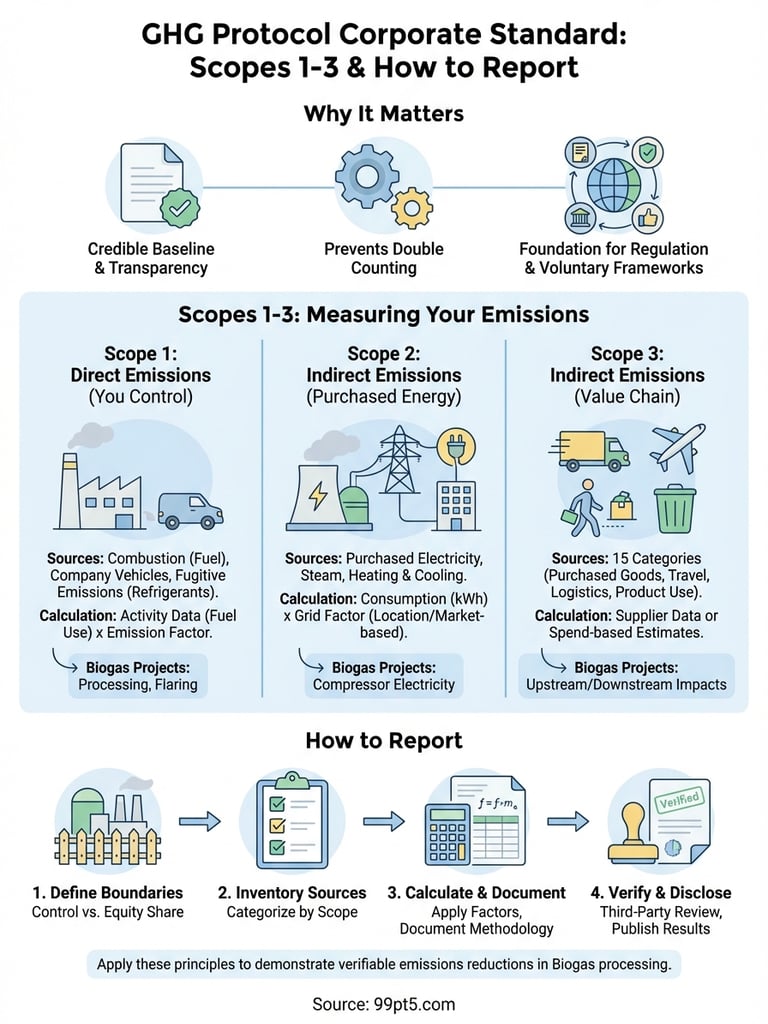
The GHG Protocol Corporate Standard is the most widely used framework for measuring and reporting greenhouse gas emissions at the company level. Published by the World Resources Institute and the World Business Council for Sustainable Development, this standard gives you a step-by-step method to calculate emissions across three scopes: direct emissions from your operations (Scope 1), indirect emissions from purchased energy (Scope 2), and all other indirect emissions in your value chain (Scope 3). Companies use this framework to build credible emissions inventories, set reduction targets, and report to stakeholders or regulatory bodies.
This guide walks you through the practical application of the standard, with particular focus on biogas and biomethane projects. You'll learn how to define your organizational boundaries, calculate emissions for each scope, report your results, and apply these principles to BioGas processing operations. Whether you're preparing for regulatory disclosure requirements or building a voluntary carbon inventory, this article gives you the information you need to implement the standard correctly and demonstrate verifiable emissions reductions.
Why the GHG Protocol Corporate Standard matters
You need a credible baseline to measure progress, and the GHG protocol corporate standard gives you exactly that. Investors, regulators, and customers increasingly demand verified emissions data, and this framework provides the consistency they expect. When you follow a globally recognized methodology, your emissions inventory becomes comparable with thousands of other companies worldwide, which strengthens your position in supply chains and procurement processes.
The standard matters because it prevents double counting and creates transparency in your climate reporting. You can identify the largest emission sources in your operations, prioritize reduction investments, and track improvements over time with confidence. For companies that design and install biogas systems, this framework helps you quantify the actual climate benefits you deliver to end-clients, turning environmental performance into a competitive advantage.
Accurate emissions accounting transforms sustainability from a compliance exercise into a strategic business tool.
Regulatory requirements keep expanding across jurisdictions, and the corporate standard forms the technical foundation for many disclosure schemes. Whether you're preparing for CSRD in Europe or voluntary frameworks like CDP, starting with this standard ensures you meet multiple reporting obligations simultaneously. Your ability to demonstrate genuine emissions reductions through documented methodologies also unlocks carbon credit opportunities and strengthens your market position in the growing biomethane sector.
How to apply the standard in your company
You start by defining your organizational boundary, which determines which operations and facilities you include in your emissions inventory. The ghg protocol corporate standard offers two approaches: the equity share method (where you account for emissions based on your ownership percentage) and the control approach (where you account for 100% of emissions from operations you control). Most companies choose the control approach because it aligns with financial reporting and simplifies data collection from facilities you manage directly.
Define your organizational boundary
Your boundary decision affects every calculation that follows, so you need to document your choice clearly and apply it consistently across reporting periods. Under the control approach, you select either financial control (ability to direct financial and operating policies) or operational control (authority to implement operating policies). Companies that design and install biogas systems typically use operational control for facilities they own and operate, while excluding client-owned installations unless contractual arrangements specify otherwise.
Choose a boundary approach that matches how you manage operations, not what makes your numbers look better.
Identify and categorize emission sources
Once you establish boundaries, you inventory all emission sources within those boundaries and assign them to the appropriate scope. Walk through your facilities and operations systematically, documenting fuel consumption, electricity use, refrigerant leaks, vehicle fleets, and purchased goods. For biogas processing operations, you capture emissions from compressors, catalytic reactors, heating systems, and fugitive releases during BioGas upgrading. Create a detailed source list with responsible departments, data collection methods, and emission factors you'll apply.
Your categorization determines reporting accuracy and identifies reduction opportunities. Manufacturing facilities need different source categories than service companies, so adapt your inventory structure to reflect actual operations rather than forcing your business into generic templates.
Explain scopes 1, 2, and 3 in practice
You calculate emissions differently for each scope, and the ghg protocol corporate standard provides specific guidance for every category. Understanding these distinctions helps you collect the right data from the right sources and apply appropriate emission factors to your activity data. For companies that build biogas processing equipment, each scope captures different aspects of your climate impact, from manufacturing operations to the performance of installed systems.
Scope 1: Direct emissions you control
Your Scope 1 inventory includes all emissions from sources you own or control directly. You calculate these by multiplying fuel consumption (natural gas, diesel, propane) by published emission factors for each fuel type. If you operate a fabrication facility that builds BioTreater systems, you account for emissions from welding equipment, heating systems, forklifts, and company vehicles used for installations. Fugitive emissions from refrigerants in air conditioning systems also fall under Scope 1.
Manufacturing operations generate measurable combustion emissions when you burn fuels for heat or power generation. Track monthly fuel deliveries, convert volumes to standard units, and apply the appropriate CO2e factor from recognized databases. Process emissions from chemical reactions during equipment testing or catalyst preparation also belong in this scope.
Scope 2: Purchased energy emissions
You account for indirect emissions from electricity, steam, or cooling you purchase from utility providers. Multiply your monthly kilowatt-hour consumption by the grid emission factor for your location, which reflects the carbon intensity of your local electricity supply. The standard requires you to report using both location-based factors (grid average) and market-based factors (supplier-specific) when you purchase renewable energy certificates or enter power purchase agreements.
Calculate Scope 2 separately from Scope 1 to avoid double-counting emissions that occur at power plants versus your facilities.
For biogas equipment manufacturers, electricity consumption during fabrication, testing, and assembly operations creates your largest Scope 2 impact. Office buildings, warehouses, and research facilities add additional purchased energy emissions to your inventory.
Scope 3: Value chain emissions
Your Scope 3 calculation captures 15 distinct categories of indirect emissions that occur upstream and downstream from your operations. Upstream categories include purchased materials (steel, compressors, catalysts), business travel, employee commuting, and transportation of goods to your facilities. Downstream categories cover product transportation, installation services, and the use phase of equipment you manufacture.
Companies that design biogas processing systems face significant Scope 3 emissions from raw material extraction, component manufacturing, and logistics. You estimate these using supplier-specific data when available, or spend-based calculations that apply emission factors to procurement dollars by product category.
Report your emissions under the standard
You compile your emissions inventory into a formal report that communicates results to stakeholders, meets regulatory requirements, and establishes baseline data for future improvements. The ghg protocol corporate standard specifies minimum reporting elements you include: organizational boundaries, reporting period, emission scopes covered, emission sources and activities, calculation methodologies, emission factors used, and total emissions by scope. Your report transforms raw data into actionable intelligence that drives business decisions and demonstrates accountability to investors, customers, and regulators.
Choose your reporting format
You select a reporting structure based on disclosure requirements and stakeholder needs. Many companies publish standalone sustainability reports following frameworks like GRI or TCFD, while others submit data through CDP questionnaires or regulatory platforms. Your format choice affects how you present scope breakdowns, temporal comparisons, and intensity metrics (emissions per unit of revenue or production). Standard formats streamline the review process and make your results comparable with industry peers.
Document every assumption and data quality limitation so reviewers understand the reliability of your numbers.
Regulatory submissions often require specific templates with predefined data fields, while voluntary reports allow more flexibility in presentation. Consider how you structure information for different audiences: executives need high-level summaries with business implications, while technical reviewers require detailed methodology appendices with calculation worksheets and emission factor sources.
Document methodology and data sources
You maintain comprehensive records of every calculation step, data source, and methodological choice. Your documentation includes emission factor databases used (EPA, IEA, supplier-specific data), measurement approaches for each source category, data quality assessments, and uncertainty estimates for key emission sources. This transparency enables third-party verification and ensures consistency across reporting periods when staff changes or operations expand.
Verify and disclose results
You strengthen credibility through independent verification before public disclosure. Third-party auditors review your inventory boundaries, calculation methods, data quality, and final results against standard requirements. After verification, you publish results through appropriate channels: annual sustainability reports, regulatory filings, investor communications, or public registries. Consistent disclosure builds trust with stakeholders and creates accountability for reduction commitments you make based on inventory results.
Use the standard in biogas and biomethane projects
You apply the ghg protocol corporate standard to biogas operations by treating processing facilities as distinct emission sources with unique characteristics. Your BioGas upgrading systems generate direct emissions during operation while simultaneously enabling significant emission reductions when biomethane displaces fossil natural gas. The standard helps you quantify both sides of this equation: operational emissions from processing equipment and avoided emissions from renewable gas production. This dual accounting demonstrates the net climate benefit your biogas projects deliver to end-clients.
Calculate emissions from biogas processing
Your Scope 1 inventory captures combustion emissions from auxiliary heaters, pilot flames in catalytic reactors, and any flare systems that burn excess gas during maintenance or upset conditions. Processing equipment like compressors and blowers typically run on electricity, creating Scope 2 emissions you calculate using grid factors for your facility location. Fugitive releases during pressure changes, valve maintenance, or storage tank breathing also belong in Scope 1 when you measure or estimate methane slip rates from your upgrading process.
Processing efficiency directly affects your emission footprint per unit of biomethane produced.
Account for biomethane benefits
You document avoided emissions when biomethane produced by your systems displaces conventional natural gas in transportation or heating applications. The standard allows you to report these benefits separately from your corporate inventory, showing clients the emission reduction value their investment delivers. Calculate displacement benefits by multiplying biomethane output by the emission factor difference between fossil gas and your renewable product, accounting for upstream extraction and processing emissions in both cases.
Next steps
You implement the ghg protocol corporate standard by starting with your organizational boundary definition and progressing systematically through scope calculations. Begin with Scope 1 emissions from direct operations, where data collection proves most straightforward, then expand to Scope 2 from purchased energy. Build your Scope 3 inventory gradually by prioritizing the largest impact categories first, using supplier-specific data where available and spend-based estimates for less significant sources.
Documentation quality determines your success with third-party verification and stakeholder confidence in your results. Create detailed calculation worksheets, maintain emission factor sources, and document every methodological choice you make during inventory development. Regular updates to your inventory help you track progress toward reduction targets and respond to evolving regulatory requirements across jurisdictions.
For companies that design biogas processing systems, accurate emissions accounting demonstrates the climate benefits your technology delivers. 99pt5's BioTreater™ systems achieve 99.5% methane recovery with guaranteed performance metrics, creating verifiable emission reductions you can document through the corporate standard framework.