How To Calculate Carbon Intensity: Formula, Units, Examples
Master how to calculate carbon intensity for BioGas operations. Get the formula, choose correct units, gather trusted data, & interpret results for project success.
You need to prove your BioMethane project is getting cleaner as it scales. Total emissions tell part of the story, but they go up when production increases. Your clients want to see efficiency gains. Regulators demand proof. Carbon credits depend on accurate numbers. This is where carbon intensity becomes essential.
Carbon intensity measures emissions per unit of output. It's calculated by dividing total greenhouse gas emissions by a specific activity metric like megawatt hours produced, tonnes of product manufactured, or cubic meters of gas processed. The formula is simple. Getting it right requires choosing the correct units and collecting reliable data.
This guide shows you exactly how to calculate carbon intensity for your BioGas or BioMethane operations. You'll learn which denominator to use for your specific process, where to source emissions data that auditors will accept, and how to interpret results that matter to stakeholders. We'll walk through the four essential steps with practical examples from the renewable gas sector.
Why carbon intensity matters for your projects
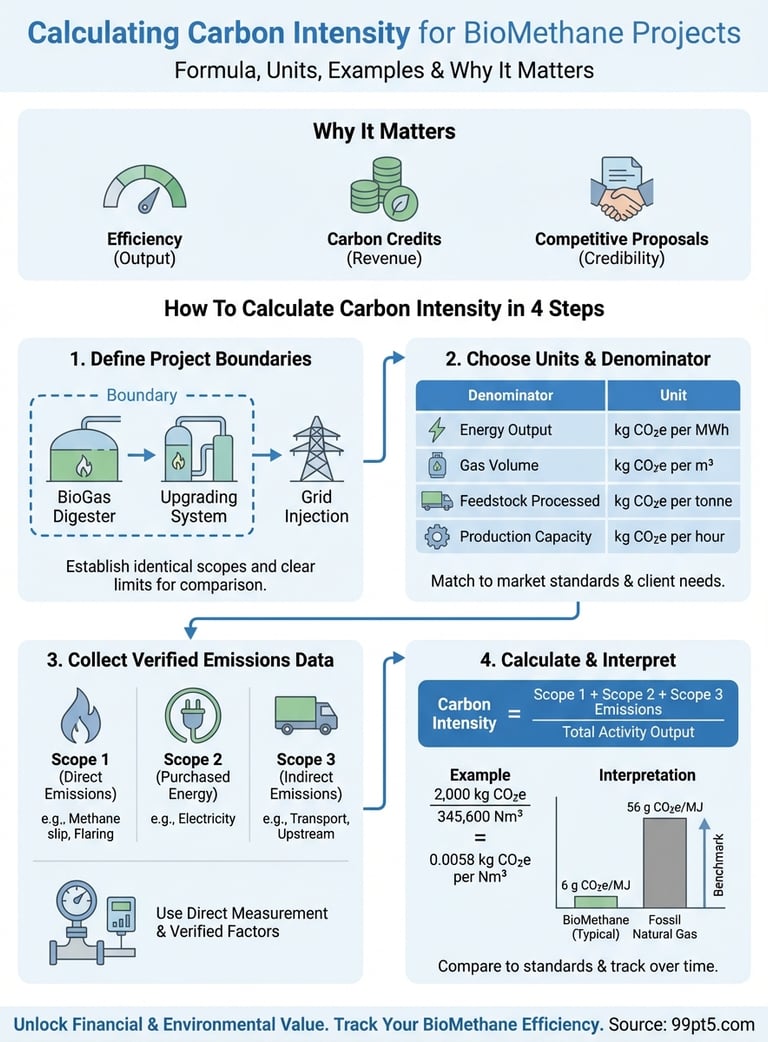
Your clients judge BioMethane systems by efficiency per unit of output, not just total emissions. When you install a system that processes 500 cubic meters per hour, stakeholders expect cleaner gas production as volumes increase. Carbon intensity gives you the metric that proves your technology delivers on this expectation. It shows emissions per megawatt hour of energy produced or per cubic meter of BioMethane delivered, which matters more than raw tonnage to end clients.
Client reporting and carbon credit revenue
Project owners need carbon intensity data to secure renewable fuel credits and access carbon markets. The lower your system's intensity score, the more valuable the credits become. Financial models for farm digesters and industrial waste facilities depend on accurate intensity calculations to forecast revenue from environmental attributes. When you know how to calculate carbon intensity correctly, you give clients the documentation they need for certification bodies and credit registries.
Accurate carbon intensity calculations can be worth thousands in additional revenue per project through carbon credit markets.
Competitive differentiation in proposals
Bidding on large BioMethane contracts requires performance guarantees backed by data. Generic efficiency claims don't win projects. When you present carbon intensity targets with clear calculation methods, you demonstrate technical credibility. Your proposals stand out when they include specific intensity metrics like kilograms CO2e per cubic meter of upgraded gas, calculated using standardized denominators that auditors and regulators accept. This level of precision separates professional system integrators from competitors who only discuss total emissions reductions.
Step 1. Decide what you want to compare
Before you can calculate carbon intensity, you need to define exactly what you're measuring. Are you comparing different BioGas upgrading technologies? Tracking performance improvements across quarters? Benchmarking your system against industry standards? The comparison you choose determines which emissions sources you include and which activity metrics make sense. A farm digester operator comparing seasonal variations will use different boundaries than a system integrator evaluating equipment options for a new installation.
Compare similar processes or equipment types
You get meaningful results when you compare identical scopes. If you're evaluating two BioMethane upgrading systems, both calculations must include the same process stages. One measurement that covers only the upgrading unit while another includes digester operations and compression creates false comparisons. Your carbon intensity calculations should encompass the same equipment boundaries, process inputs, and operational phases. This consistency lets you identify which technology actually delivers lower emissions per unit of output.
Define clear project boundaries
Establish where your measurement starts and stops before collecting any data. For a complete BioGas to BioMethane system, you might measure from feedstock reception through grid injection. Another valid boundary starts at raw BioGas inlet and ends at purified BioMethane outlet, excluding the digester itself. Document your boundary decision in writing so auditors and clients understand exactly what your intensity figures represent. When you learn how to calculate carbon intensity with consistent boundaries, you create data that stakeholders can trust and regulators will accept.
Clear boundaries prevent disputes over whether your carbon intensity calculations include upstream or downstream processes.
Step 2. Choose units and a clear denominator
The denominator you select transforms raw emissions data into meaningful carbon intensity figures. Your choice determines whether stakeholders can understand and act on your results. When you learn how to calculate carbon intensity, the numerator stays consistent (total CO2e emissions), but the denominator changes based on what you're measuring. A power generator uses megawatt hours. A BioMethane producer might use cubic meters of purified gas. The wrong denominator makes your intensity score meaningless to the people who need it.
Common denominators for BioMethane systems
Select the denominator that matches your system's primary output. BioGas upgrading projects typically measure intensity against energy content or volume produced. The table below shows standard options:
Denominator Unit Best for Energy output kg CO2e per MWh Grid injection projects, power generation comparison Gas volume kg CO2e per m³ Process efficiency tracking, equipment benchmarking Feedstock processed kg CO2e per tonne Waste treatment facilities, agricultural operations Production capacity kg CO2e per hour Equipment sizing decisions, scaled operations
Your equipment specifications should drive this choice. If your BioTreater system processes 500 Nm³/hour and delivers 99.5% BioMethane recovery, calculate intensity per cubic meter of output gas.
The denominator you choose should align with how your clients measure project success and how regulators evaluate renewable fuel credits.
Match your denominator to stakeholder expectations
Regulatory bodies and carbon credit registries require specific intensity units for certification. European renewable fuel standards typically demand grams CO2e per megajoule of energy. North American programs might request kilograms per million BTU. Check the requirements of your target markets before finalizing calculations. Using the wrong units forces you to recalculate everything when you submit for credits or certifications. Financial models depend on these figures, so alignment with market standards prevents costly revisions during the approval process.
Step 3. Collect emissions data you can trust
Your carbon intensity calculation depends entirely on emissions data quality. Unreliable numbers produce meaningless intensity scores that stakeholders reject. When you learn how to calculate carbon intensity, the collection phase determines whether your results hold up to auditor scrutiny. Start with direct measurements from your actual equipment rather than generic industry averages. Carbon credit applications and regulatory filings require documented data trails that prove each emission source was measured, not estimated.
Identify your emission sources by scope
List every source that falls within your project boundaries. For a BioGas upgrading system, Scope 1 emissions include combustion in boilers or flares, methane slip from the upgrading process, and fugitive emissions from equipment leaks. Scope 2 covers purchased electricity for compressors, pumps, and control systems. Scope 3 typically includes upstream feedstock transportation and downstream distribution, though many calculations exclude this for simplicity. Write down each source with its location in your process flow. This inventory prevents you from missing emission sources that auditors will question later.
Missing even small emission sources during data collection can invalidate your entire carbon intensity calculation.
Use measurement equipment and verified factors
Install flow meters and analyzers that continuously track BioGas composition and volumes at key process points. Modern upgrading systems should measure methane content at inlet and outlet, capture slip rates, and log energy consumption for all major equipment. When direct measurement isn't possible, use emission factors from recognized databases. The EPA publishes factors for natural gas combustion. The IPCC provides factors for methane slip. Document which factors you used and where they came from. Equipment suppliers often provide verified performance data for their systems that you can reference in your calculations.
Step 4. Calculate and interpret carbon intensity
Now you have your boundaries defined, your denominator selected, and your emissions data collected. The actual calculation is straightforward division, but the interpretation requires context. When you learn how to calculate carbon intensity, the math takes minutes while understanding what the results mean takes experience. Your final intensity score needs to make sense to financial analysts reviewing project returns, regulators evaluating renewable fuel applications, and clients comparing equipment options.
Apply the carbon intensity formula
Divide total emissions by your chosen denominator to get your carbon intensity score. The formula works the same regardless of your units. Here's the calculation template for a BioMethane upgrading system:
Total CO2e emissions (kg) = Scope 1 + Scope 2 + Scope 3 (if included) Total activity output = Volume, energy, or feedstock processed Carbon Intensity = Total CO2e emissions ÷ Total activity output
Example calculation for a BioTreater system processing 500 Nm³/hour of raw BioGas over one month:
Scope 1 emissions: 1,200 kg CO2e (methane slip, flaring) Scope 2 emissions: 800 kg CO2e (electricity for compression) Total emissions: 2,000 kg CO2e Total BioMethane output: 345,600 Nm³ (500 Nm³/h × 24h × 30 days × 0.96 uptime) Carbon Intensity = 2,000 ÷ 345,600 = 0.0058 kg CO2e per Nm³
Converting your carbon intensity result into the units your market requires should happen immediately after calculation, not during the approval process.
Interpret your results against benchmarks
Compare your calculated intensity to industry standards and regulatory thresholds. BioMethane upgrading systems typically achieve 10-30 kg CO2e per MWh when you include all scopes. Systems claiming lower scores either exclude significant emission sources or use favorable boundary definitions. Your 0.0058 kg per Nm³ from the example converts to roughly 6 grams CO2e per megajoule of energy content, which positions well below fossil natural gas at 56 grams per megajoule. Track your intensity over time to spot efficiency degradation. A rising intensity score signals equipment problems, methane slip increases, or process inefficiencies that reduce output while maintaining similar emissions.
Make carbon intensity work for you
You now know how to calculate carbon intensity with formulas, units, and data collection methods that meet regulatory standards. The four steps give you repeatable calculations that stakeholders trust: define your comparison boundaries, select the right denominator for your output, collect verified emissions data from actual measurements, and apply the formula with proper interpretation. Every project benefit depends on getting these calculations right, from carbon credit revenue to competitive proposals that win contracts.
Your BioMethane systems deliver measurable results when you can prove efficiency gains through carbon intensity tracking. The calculations you've learned here apply directly to BioGas upgrading equipment where guaranteed performance matters. Systems designed for 99.5% BioMethane recovery need intensity calculations that demonstrate this efficiency to clients and regulators. The BioTreater system from 99pt5 produces documented intensity improvements through integrated monitoring and precise contaminant removal that reduces emissions per cubic meter of output. Start tracking your carbon intensity today to unlock the financial and environmental value your projects generate.