Predictive Maintenance vs Condition Based Maintenance 101
Compare predictive maintenance vs condition based maintenance. Discover how each prevents downtime, their costs, ROI, and which is right for your facility.
Your industrial equipment starts showing warning signs. Should you wait until sensors trigger an alert or predict the problem weeks ahead? That decision defines whether you use condition based maintenance or predictive maintenance.
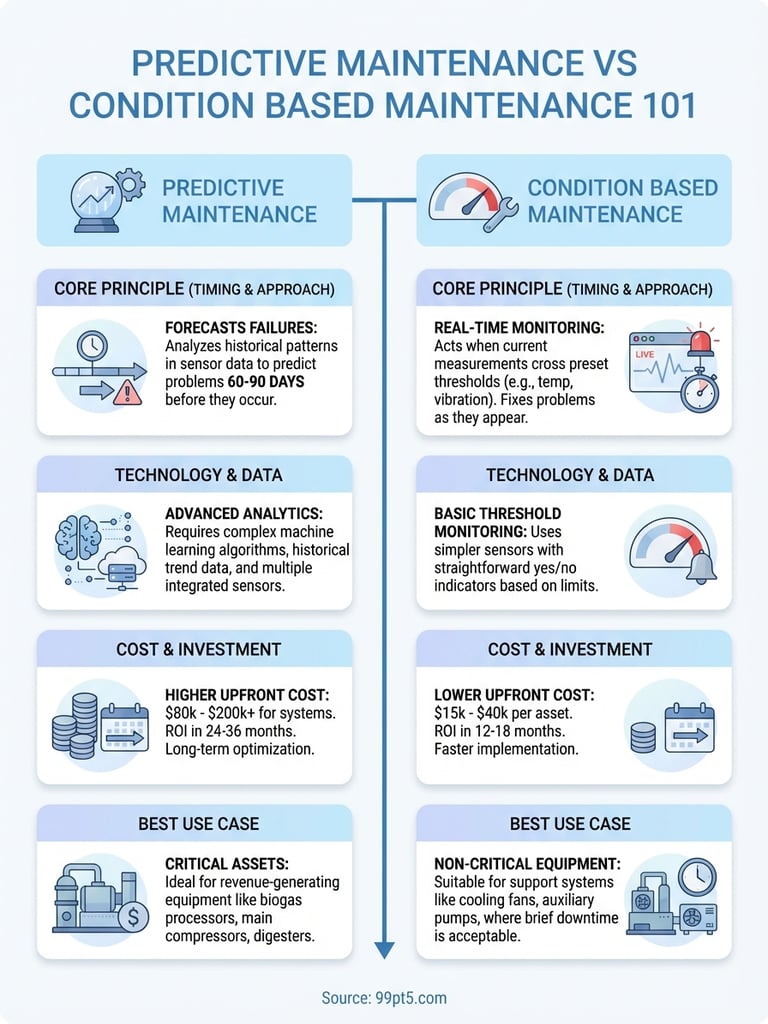
Condition based maintenance monitors equipment in real time and acts when measurements cross preset thresholds. Think of it as fixing problems the moment they appear. Predictive maintenance takes a different approach. It analyzes patterns in sensor data to forecast failures 60 to 90 days before they happen. Both strategies prevent unexpected breakdowns but they work on completely different timelines and require different investments.
This guide breaks down how each method works, when to use them, and what they cost to implement. You will learn the technical differences between the two approaches, see real examples from biogas and industrial plants, and get practical criteria for choosing the right strategy for your operation. By the end you will know which maintenance approach delivers the best return for your specific equipment and business goals.
Why predictive and condition based maintenance matter
Unplanned downtime costs industrial facilities between $10,000 to $250,000 per hour depending on the operation. When your biogas processing equipment fails unexpectedly, you lose production revenue, face emergency repair costs, and potentially breach contracts with clients. Both condition based and predictive maintenance strategies cut these risks by catching problems before catastrophic failures occur.
Business impact beyond downtime prevention
The predictive maintenance vs condition based maintenance choice directly affects your bottom line and client satisfaction. Reactive maintenance costs three to four times more than planned maintenance because you pay premium prices for emergency parts and overtime labor. Your clients expect guaranteed uptime, especially when their operations depend on continuous biogas processing. Implementing proactive maintenance strategies helps you deliver on those promises while protecting your profit margins.
Modern maintenance strategies reduce total maintenance costs by 25% to 30% compared to reactive approaches.
Equipment reliability builds your reputation. Facilities using proactive maintenance report fewer warranty claims, stronger client relationships, and easier contract renewals. You position your company as a premium provider when your systems run consistently without unexpected shutdowns.
How to choose predictive vs condition based maintenance
Your equipment criticality and operational constraints determine which maintenance strategy fits your facility. The predictive maintenance vs condition based maintenance decision depends on three core factors: the cost of failure, your available budget, and the technical complexity you can manage. You need a framework that matches your maintenance approach to each asset's importance in your operation.
Match strategy to equipment criticality
Start by identifying which equipment failures cause the most damage to your business. Critical assets that shut down production or create safety hazards deserve predictive maintenance because the 60 to 90 day advance warning lets you plan repairs without disrupting operations. Your biogas processing equipment, main compressors, and digesters fall into this category because unexpected failures cost you thousands per hour in lost production.
Non-critical equipment works fine with condition based maintenance. Support systems like cooling fans, auxiliary pumps, and monitoring instruments can trigger alerts when sensors detect problems. You fix them quickly without needing long-range predictions because brief downtime does not threaten your core operations.
Evaluate your resources and infrastructure
Predictive maintenance requires higher upfront investment in advanced sensors, data analytics software, and staff training. You need personnel who understand machine learning algorithms and can interpret trend data. Budget $50,000 to $150,000 for a comprehensive predictive system depending on your facility size.
Condition based maintenance costs 40% to 60% less to implement but provides shorter warning times before failures occur.
Choose condition based maintenance when you operate smaller facilities or have limited technical staff. This approach uses simpler threshold monitoring that maintenance teams grasp quickly. You install sensors that trigger alerts when vibration, temperature, or pressure crosses preset limits. The technology costs less and you start seeing benefits within weeks instead of months.
Key differences between predictive and condition based
The predictive maintenance vs condition based maintenance debate centers on timing and data interpretation methods. Condition based systems react to current measurements while predictive systems forecast future problems. Understanding these technical distinctions helps you select the approach that matches your operational requirements and technical capabilities.
Timing and data analysis approach
Condition based maintenance triggers work orders when sensor readings cross threshold limits in real time. Your team receives alerts the moment vibration exceeds 0.5 IPS-Peak or bearing temperature rises above 180°F. You respond within hours or days because the problem already exists and needs immediate attention.
Predictive maintenance analyzes historical data patterns and trends to calculate when failures will occur. The system collects months of temperature, vibration, and performance data, then uses algorithms to predict bearing degradation 60 to 90 days before failure. You schedule maintenance during planned downtime periods because you know the failure date in advance.
Predictive systems provide 8 to 12 times more advance warning than condition based monitoring for the same equipment failures.
Technology and measurement requirements
Condition based setups use basic threshold monitoring with straightforward sensor installations. You set alert levels based on manufacturer specifications or industry standards like ISO 10816. When measurements exceed limits, the system sends notifications. Your maintenance team acts on clear yes/no indicators without complex data analysis.
Predictive systems require advanced analytics software and multiple integrated sensors per asset. You capture continuous data streams for vibration spectrum analysis, thermal imaging patterns, and ultrasonic measurements. The system processes thousands of data points through machine learning models to identify degradation patterns invisible to threshold monitoring. Your staff needs training in data interpretation and predictive analytics tools to extract actionable insights from the complex datasets.
Costs, risks, ROI and implementation effort
Your maintenance budget determines which strategy you can implement today and which capabilities you can add later. The predictive maintenance vs condition based maintenance choice involves different cost structures and timeline expectations for seeing returns on your investment. You need clear numbers to justify equipment upgrades and staffing changes to stakeholders.
Initial investment breakdown
Condition based maintenance requires $15,000 to $40,000 per critical asset for sensor installation, monitoring software, and basic training. You purchase vibration sensors ($200 to $800 each), temperature monitors ($100 to $300), and pressure transducers ($150 to $500). The monitoring software costs $5,000 to $15,000 annually for cloud-based platforms that handle data collection and alert management.
Predictive maintenance demands $80,000 to $200,000 for comprehensive systems covering multiple assets. Your investment includes advanced sensor arrays, machine learning analytics platforms ($30,000 to $80,000 annually), and specialized training for technical staff. Implementation takes 6 to 12 months because you need historical data before the algorithms generate accurate predictions.
Companies using condition based maintenance see ROI within 12 to 18 months while predictive systems typically break even after 24 to 36 months.
Risk assessment and ROI timeline
Condition based systems carry lower implementation risk because the technology proves itself quickly. You install sensors, set thresholds, and start receiving actionable alerts within weeks. The main risk involves setting incorrect threshold levels that trigger too many false alarms or miss developing problems.
Predictive maintenance presents higher technical risk during the learning phase. Your algorithms need accurate training data and expertise to tune properly. Poor data quality or insufficient historical records produce unreliable predictions that waste maintenance resources. Budget an additional 20% to 30% for system refinement and staff training beyond initial costs.
ROI from both approaches compounds over time. Your maintenance costs drop 25% to 40% as you eliminate emergency repairs and extend equipment life. Predictive systems eventually deliver superior returns because they optimize parts inventory, reduce spare equipment needs, and minimize production disruptions through precise scheduling.
Examples in biogas and industrial plants
Your maintenance strategy choice becomes clearer when you see how both approaches work in actual facilities. The predictive maintenance vs condition based maintenance decision plays out differently depending on whether you run a compact biogas operation or a large industrial processing plant. These real-world applications show which strategy delivers better results for specific equipment types and operational scales.
Biogas processing facility case
A medium-sized biogas processing facility in Northern Europe installed condition based monitoring on its BioGas purification system. The operators set threshold alerts for compressor vibration at 0.5 IPS-Peak and bearing temperature at 175°F. When vibration spiked to 0.6 IPS-Peak during operations, the system triggered an immediate alert. Your maintenance team responded within 4 hours, discovered loose mounting bolts, and prevented a $40,000 compressor failure. The fix cost $800 in labor and materials.
Condition based monitoring works best for biogas equipment when downtime windows of 4 to 8 hours meet your production requirements.
The same facility later upgraded critical CO2 capture equipment to predictive maintenance. Sensors tracked pressure differentials, flow rates, and thermal patterns across the separation unit. After collecting 90 days of baseline data, the predictive system forecasted membrane degradation 75 days before failure. This advance warning let operators order replacement membranes, schedule maintenance during a planned shutdown, and avoid $125,000 in lost production.
Large industrial plant application
An industrial waste treatment facility processing 2,500 Nm3/hour of biogas uses both strategies on different equipment classes. Critical digesters and main boosters operate under predictive maintenance with continuous analytics monitoring 47 parameters. Support equipment like cooling fans and auxiliary pumps run condition based monitoring because brief downtime does not threaten core operations. This hybrid approach cuts total maintenance costs by 34% while maintaining 99.2% uptime on revenue-generating systems.
Bringing it all together
The predictive maintenance vs condition based maintenance decision shapes your maintenance costs, equipment reliability, and operational efficiency for years to come. Condition based monitoring delivers fast ROI and works well for non-critical equipment where 4 to 8 hour response times meet your needs. Predictive maintenance costs more upfront but provides the 60 to 90 day advance warnings that protect critical assets like your biogas processing systems from costly failures.
Your best strategy often combines both approaches. Critical revenue-generating equipment deserves predictive analytics while support systems run condition based monitoring. This hybrid model balances investment costs against operational risks.
Discover how 99pt5's BioTreater™ system integrates advanced monitoring capabilities that support both maintenance strategies while guaranteeing 99.5% BioMethane recovery and industry-leading operational efficiency.