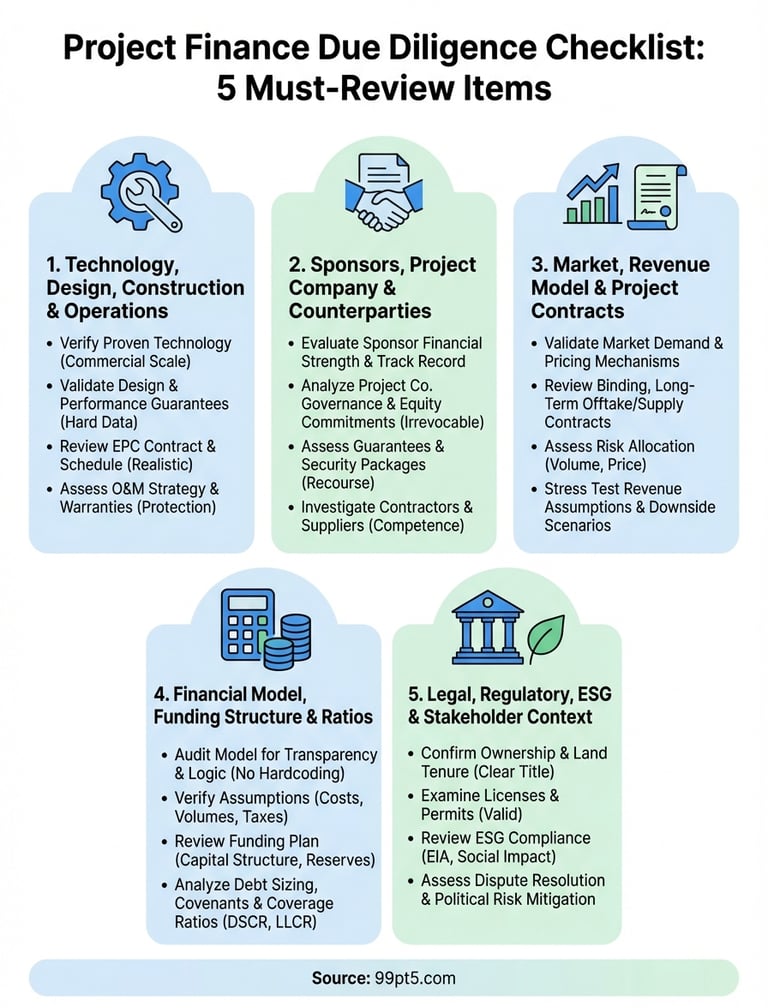
Project Finance Due Diligence Checklist: 5 Must-Review Items
Review the 5 critical categories every project finance due diligence checklist must address to secure lender confidence and reach financial close.
Securing financing for a capital-intensive infrastructure or energy project hinges on lenders' confidence that every material risk has been identified and addressed. Yet too many project finance transactions stumble because critical items slip through the cracks during due diligence. When you're evaluating a multimillion-dollar BioGas-to-BioMethane facility or similar infrastructure investment, a missing technical report, an unclear contract clause, or an unvetted sponsor can turn a promising deal into a non-starter. Lenders need certainty that the project finance due diligence checklist they follow is comprehensive, structured, and leaves no stone unturned.
This article breaks down five essential categories you must review before committing capital to any project financing arrangement. From technology maturity and construction risk to financial model integrity and regulatory compliance, we cover the critical documents, questions, and red flags that separate bankable projects from those that never reach financial close. Use this framework to ensure your due diligence process captures every element that matters to lenders, investors, and project success.
1. Technology, design, construction and operations
Technical failures account for a disproportionate share of project finance defaults, yet this category often receives superficial review during due diligence. You must verify that the technology is proven, the design meets performance targets, and the construction and operations plans are realistic and fully funded. Lenders depend on independent technical advisors to validate every claim the sponsor makes about process efficiency, capacity factors, and reliability. When evaluating a BioGas processing facility or similar infrastructure asset, your technical due diligence must go beyond glossy brochures and PowerPoint projections to hard data, reference projects, and contractual guarantees.
Technology maturity and track record
You need to confirm that the core technology has been deployed successfully at commercial scale in similar operating environments. Ask for performance data from at least three reference installations operating for a minimum of 12 months under comparable feedstock and climatic conditions. Verify that equipment suppliers can demonstrate uptime, recovery rates, and energy consumption that match the project's financial model assumptions.
Process design, capacity and efficiency targets
Review the process flow diagrams, heat and mass balances, and equipment datasheets to ensure the design is fit for purpose. You should verify that the guaranteed output specifications (such as 99.5% BioMethane recovery or specific CO2 purity levels) are backed by independent engineering studies and align with technology supplier warranties.
Construction scope, EPC arrangements and schedule
Examine the engineering, procurement, and construction (EPC) contract to understand risk allocation, liquidated damages for delay, and performance guarantees at completion. You must confirm that the construction schedule includes realistic timelines, contingency buffers, and clear milestones tied to drawdown conditions. Verify that all long-lead equipment is on order and that site readiness will not delay mobilization.
"Lenders lose sleep over construction risk because delays erode returns and tested contractors are your best insurance."
Operations, maintenance and performance guarantees
Assess the operations and maintenance (O&M) strategy, including whether the sponsor will self-perform or hire a third-party operator with relevant experience. You should verify that warranty periods, performance guarantees, and penalty regimes are sufficient to protect lenders through the critical early years of operation.
Technical documents, data and site information to collect
Your project finance due diligence checklist must capture all engineering studies, environmental impact assessments, geotechnical reports, and site surveys. Collect equipment supplier proposals, technology licensing agreements, and independent technical advisor reports to build a complete picture of technical viability.
2. Sponsors, project company and counterparties
The people and entities behind a project can determine its success or failure just as much as the underlying technology or market. You must evaluate whether the sponsor has the financial strength, technical capability, and strategic commitment to see the project through construction delays, cost overruns, and operational challenges. Your project finance due diligence checklist should scrutinize not only the sponsor's balance sheet but also the project company's governance, the quality of key counterparties, and the alignment of interests across all parties. Lenders who skip this step often discover too late that a sponsor lacks the resources to inject equity when needed or that critical contractors cannot deliver on their promises.
Sponsor background, financial strength and strategy
You need to verify the sponsor's track record in developing and operating similar projects, including any history of defaults, disputes, or reputational issues. Review audited financial statements for the past three years to confirm that the sponsor has sufficient liquidity and net worth to meet equity commitments and cost overrun obligations.
Project company structure, governance and equity commitments
Examine the shareholders' agreement, articles of association, and board composition to understand decision-making processes and minority shareholder protections. You must confirm that equity contributions are irrevocable, fully funded, and subordinated to senior debt, with clear mechanisms to prevent dilution or changes of control without lender consent.
Support undertakings, guarantees and security packages
Assess whether the sponsor has provided completion guarantees, cost overrun support, and working capital facilities that give lenders meaningful recourse if the project underperforms. You should verify that security packages include pledges over project assets, bank accounts, contracts, and shares, with perfection completed in all relevant jurisdictions.
"A sponsor guarantee is only as good as the sponsor's ability and willingness to honor it when the project is in distress."
Assessment of key contractors, suppliers and offtakers
Investigate the financial stability, technical competence, and contractual track record of the EPC contractor, equipment suppliers, and any offtake counterparties. Verify that these parties carry adequate insurance, have posted performance bonds, and can demonstrate successful delivery on comparable projects.
Alignment of incentives and risk sharing among parties
Evaluate whether the risk allocation framework properly incentivizes each party to perform its obligations and whether the sponsor retains enough skin in the game to avoid moral hazard.
3. Market, revenue model and project contracts
The revenue foundation of any project finance structure depends on your ability to prove that the project can generate sufficient cash flows to service debt under a wide range of market conditions. You need to verify that demand for the project's output is real, pricing mechanisms protect against volatility, and contractual arrangements shift appropriate risk to creditworthy counterparties. Your project finance due diligence checklist must dissect the market dynamics, revenue structure, and contract framework to ensure lenders are not exposed to merchant risk or unsupported demand assumptions. Projects fail when sponsors overestimate market adoption, underestimate competition, or lock in unfavorable contract terms that erode margins when inputs become expensive.
Market demand, competition and policy drivers
You must validate that the market for the project's output (such as BioMethane, electricity, or clean water) has sufficient depth and growth trajectory to absorb production over the debt tenor. Analyze competitor capacity additions, substitution threats, and regulatory incentives to understand whether the project can maintain its revenue assumptions in a changing landscape.
Revenue streams, pricing mechanisms and indexation
Examine how the project will earn revenue, whether through fixed-price contracts, indexed formulas, or merchant sales, and verify that pricing mechanisms offer adequate protection against inflation and input cost escalation. You should confirm that revenue escalation clauses are tied to credible indices and that any merchant exposure is stress-tested and capped.
Offtake, feedstock and service contracts
Review the offtake agreements, feedstock supply contracts, and service agreements that underpin the revenue model to ensure they are binding, long-term, and enforceable. Verify that counterparties are creditworthy, that payment terms align with debt service schedules, and that force majeure provisions do not create unacceptable revenue gaps.
Allocation of volume, price and performance risk
Assess which party bears the risk of volume shortfalls, price movements, and performance degradation, and verify that the sponsor or creditworthy counterparties have assumed these risks through take-or-pay clauses, price collars, or performance guarantees.
"Lenders finance contracts, not markets, so your revenue certainty depends on the strength of your offtake and supply agreements."
Stress testing revenue assumptions and downside scenarios
Demand that the sponsor provide sensitivity analyses and downside cases showing how the project performs if volumes fall, prices compress, or key contracts are terminated early.
4. Financial model, funding structure and ratios
The financial model is the analytical engine that lenders use to evaluate whether a project can generate sufficient cash flows to repay debt under various scenarios. You need to verify that the model is transparent, logically structured, and robust enough to withstand scrutiny from multiple lenders, technical advisors, and rating agencies. Your project finance due diligence checklist must include a comprehensive review of model architecture, assumptions, funding structure, and covenant calculations to ensure the numbers stack up. Models that contain circular references, hardcoded values, or unsupported assumptions will kill a financing before you reach financial close.
Model architecture, audit trail and version control
You must confirm that the financial model follows best practices for structure, with clear separation of inputs, calculations, and outputs across dedicated worksheets. Verify that every assumption can be traced back to supporting documentation and that version control protocols prevent unauthorized changes during the financing process.
Key assumptions for costs, volumes, taxes and inflation
Examine the capital expenditure budget, operating cost estimates, production volumes, and tax calculations to ensure they are realistic and supported by third-party engineering, market studies, and tax opinions. You should verify that inflation rates, escalation factors, and foreign exchange assumptions align with credible macroeconomic forecasts and historical data.
Capital structure, sources and uses of funds
Review the funding plan to confirm that equity commitments, senior debt, subordinated facilities, and any grant funding are sufficient to cover all project costs plus contingencies. Verify that the sources and uses statement reconciles and that each funding source has committed terms or binding agreements in place.
Debt sizing, covenants, reserves and repayment profile
Assess whether the debt quantum, amortization schedule, and covenant package are appropriate given the project's risk profile and cash flow generation capacity. You must verify that debt service reserve accounts, maintenance reserves, and other restricted accounts are sized correctly and funded according to the financing documents.
Coverage ratios, returns and sensitivity analysis outputs
Examine the debt service coverage ratios (DSCR), loan life coverage ratios (LLCR), and equity returns across the base case and stress scenarios to ensure the project meets minimum lender thresholds.
"Lenders live and die by coverage ratios, so every decimal point in your DSCR calculation must be defensible and conservative."
5. Legal, regulatory, ESG and stakeholder context
The legal and regulatory framework surrounding a project can create hidden liabilities that derail financing if you overlook permits, land rights, or environmental compliance. You must verify that the project company holds clear title to assets, operates under valid licenses, and meets all environmental, social, and governance (ESG) standards that lenders now demand. Your project finance due diligence checklist should capture every regulatory approval, stakeholder agreement, and dispute resolution mechanism that could affect the project's ability to operate and generate revenue. Projects that fail to secure community consent or that operate under unclear land tenure arrangements face costly delays, regulatory shutdowns, and reputational damage that makes refinancing impossible.
Ownership structure, land tenure and asset rights
You need to confirm that the project company has clear legal ownership or long-term lease rights to the project site and can transfer these rights as security to lenders. Verify that all land titles are free from encumbrances, third-party claims, and indigenous land rights issues that could disrupt operations.
Licenses, permits and sector regulation
Examine whether the project holds all construction, operating, and environmental permits required by national and local authorities, with validity periods that cover the full debt tenor. You must verify that sector-specific regulations governing BioGas processing, grid connection, or waste handling are understood and complied with.
Environmental impact, emissions and climate considerations
Review the environmental impact assessment (EIA), emissions monitoring plans, and climate risk assessments to ensure the project meets current standards and can adapt to future regulatory tightening. Verify that carbon credits, renewable energy certificates, and any climate finance are properly accounted for.
Social impact, labor, community and health and safety
Assess the social impact assessment, community engagement records, and labor management plans to confirm that the project has secured local support and meets international labor standards.
Dispute resolution, enforcement and political risk mitigation
Examine the governing law clauses, arbitration agreements, and political risk insurance to ensure lenders have enforceable remedies if disputes arise or governments change policy.
"Legal certainty is the foundation of project finance, and no amount of financial engineering can substitute for clear permits and enforceable contracts."
Key takeaways
A comprehensive project finance due diligence checklist must address five critical dimensions: technology maturity and construction risk, sponsor strength and counterparty quality, market fundamentals and contract structure, financial model integrity and debt sizing, plus legal compliance and ESG standards. You cannot afford to skip any category or rely on superficial reviews when lenders demand certainty before committing capital to infrastructure projects.
Your due diligence process should verify that every technical claim is backed by reference projects, that sponsors have the financial capacity to weather difficulties, and that revenue contracts shift appropriate risk to creditworthy parties. Financial models must be transparent and stress-tested, while regulatory approvals and stakeholder support must be secured before construction begins.
When evaluating BioGas-to-BioMethane facilities or similar energy infrastructure, partnering with technology providers who offer guaranteed performance metrics and proven track records reduces technical risk substantially. Projects built on petroleum-industry-grade engineering standards pass lender scrutiny faster and deliver more predictable returns. Explore 99pt5's BioTreater™ system to see how 99.5% recovery guarantees can strengthen your project's bankability.