The Importance of OpEx: Definition, KPIs, and CapEx vs OpEx
Understand the importance of OpEx for profitability. Get practical tips to manage operating expenses, track key KPIs, and balance CapEx.
Operating expenses (OpEx) are the recurring costs you pay to run your business day to day. These expenses cover everything from salaries and rent to utilities and maintenance. Unlike capital expenditures that buy long-term assets, OpEx keeps your operations moving forward right now. Every invoice you pay for supplies, every utility bill, every service contract adds up to your total OpEx. For companies in capital-intensive industries like BioGas processing, understanding and controlling these ongoing costs directly determines whether projects generate strong returns or struggle to break even.
This article breaks down why OpEx matters for your bottom line and shows you practical ways to manage it. You'll learn which key performance indicators reveal the health of your operating expenses, how to balance OpEx against capital spending, and what metrics successful companies track to maintain profitability. Whether you're evaluating new equipment for a BioMethane project or optimizing an existing facility, the strategies here will help you make smarter decisions about where your operational dollars go.
Why OpEx matters for business performance
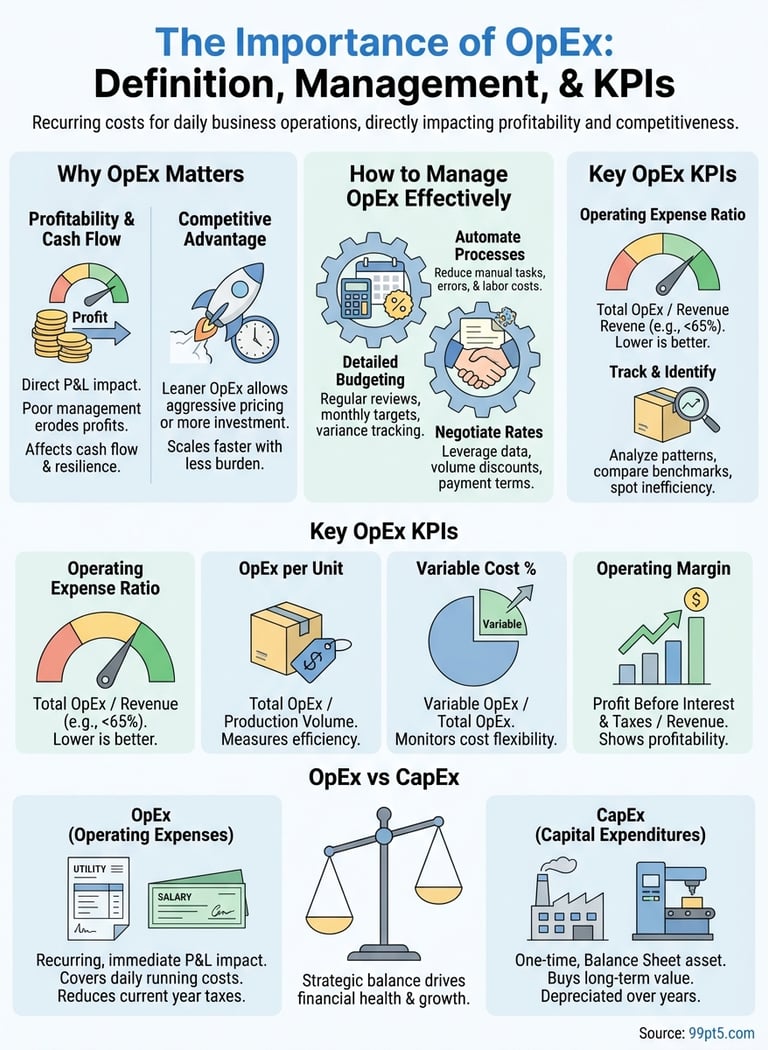
Your operating expenses directly shape your profit margins and competitive position in the market. When you control OpEx effectively, you free up capital for growth investments while maintaining healthy cash flow. Companies that track these costs closely can respond faster to market changes and price their products more accurately. The importance of OpEx becomes especially clear when you compare two similar businesses: the one with lower operating costs can either undercut competitors on price or enjoy higher margins on every sale. Poor expense management erodes profitability even when revenue grows, while disciplined OpEx control builds financial resilience that carries you through economic downturns.
Direct impact on profitability and cash flow
Every dollar you spend on operating expenses reduces your net income by the same amount. Unlike capital expenditures that you depreciate over years, OpEx hits your profit and loss statement immediately. This means poor OpEx management can turn a profitable project into a money-losing operation overnight. For example, a BioMethane facility with 10% higher operating costs than competitors might generate strong revenue but struggle to meet investor return expectations. Your cash flow suffers when operating expenses exceed projections because you need working capital to cover the gap between when you pay suppliers and when customers pay you. Tax implications matter too: while you can deduct operating expenses in the year you incur them, high OpEx still means less money available for reinvestment or distribution.
Lower operating expenses mean you need less revenue to reach profitability, reducing your break-even point and improving financial resilience.
Competitive advantage through operational efficiency
You gain a significant edge when your OpEx runs leaner than industry averages. Lower operating costs let you price aggressively during market downturns while maintaining margins, or invest more in quality and service when markets strengthen. Companies with efficient operations can scale faster because each new customer or project carries less overhead burden. This advantage compounds over time: the cash you save on operating expenses becomes available for technology upgrades, market expansion, or building reserves for economic uncertainty.
How to manage OpEx effectively
Managing your operating expenses requires a systematic approach that combines careful planning, ongoing monitoring, and strategic decision-making. You cannot control what you do not measure, so detailed expense tracking forms the foundation of effective OpEx management. Start by categorizing every operational cost, from fixed expenses like rent and insurance to variable costs such as materials and utilities. The importance of OpEx management becomes clear when you realize that small percentage improvements in multiple expense categories compound into substantial annual savings. Regular reviews help you spot trends early, negotiate better terms with vendors, and allocate resources to your highest-return activities.
Build a detailed OpEx budget with regular reviews
Your OpEx budget should break down every operational cost category with monthly and quarterly targets that reflect both historical patterns and future plans. Fixed costs like facility leases and insurance premiums stay constant, but variable expenses require careful forecasting based on production volumes, market conditions, and seasonal factors. Review your budget against actual spending every month to catch variances early. When a cost category exceeds budget by more than 5%, investigate immediately to determine whether you face a temporary spike or a structural issue that requires corrective action. Annual budget reviews let you renegotiate contracts, eliminate outdated expenses, and reallocate funds to areas that drive better results.
Detailed budgeting transforms OpEx management from reactive firefighting into proactive cost control that protects your margins.
Negotiate better rates with suppliers and vendors
You gain leverage when you approach supplier negotiations with accurate usage data and competitive alternatives. Review your largest expense categories annually and request quotes from at least three vendors for each significant service or supply contract. Long-term agreements often unlock volume discounts that reduce per-unit costs by 10-15% compared to monthly purchasing. Payment terms matter too: early payment discounts of 2% for paying within 10 days instead of 30 days effectively earn you a 36% annual return on those funds. Consolidating purchases with fewer suppliers strengthens your negotiating position and can reduce administrative overhead.
Automate processes to reduce labor costs
Process automation cuts repetitive manual tasks that consume staff time without adding strategic value. Automated systems for invoice processing, inventory management, and routine reporting reduce errors while freeing your team to focus on revenue-generating activities. Equipment with remote monitoring capabilities lets you track performance and predict maintenance needs before failures occur, reducing both downtime and emergency repair costs. The initial investment in automation typically pays for itself within 12-24 months through lower labor requirements and improved operational consistency.
Track spending patterns and identify waste
Regular expense analysis reveals spending patterns that indicate opportunities for improvement or signals of operational problems. Compare your operating costs per unit of output against industry benchmarks to identify categories where you spend significantly more than competitors. Look for expenses that increase without corresponding revenue growth, suggesting inefficiency or waste. Energy consumption, material waste rates, and overtime hours often hide substantial savings opportunities that become visible only through systematic tracking and analysis.
Key OpEx KPIs and metrics to monitor
You need specific metrics to understand whether your operating expenses support or undermine your business goals. Tracking the right KPIs transforms raw spending data into actionable insights that guide decisions about pricing, staffing, and resource allocation. The importance of OpEx monitoring lies in its ability to reveal problems before they damage your financial performance: a gradual upward trend in several expense categories might signal operational drift that requires immediate correction. Different metrics serve different purposes, so you should establish a dashboard that combines efficiency measures, profitability indicators, and trend analyses into a complete picture of your operational health.
Operating expense ratio
Your operating expense ratio divides total OpEx by revenue, showing what percentage of each sales dollar goes to cover operational costs. A ratio of 0.65 means you spend $0.65 on operating expenses for every dollar of revenue. Lower ratios indicate better efficiency, though acceptable ranges vary by industry: service businesses often run higher ratios than manufacturing operations. Track this metric monthly and compare it against your own historical performance and industry benchmarks. When your ratio increases without strategic justification, you either face rising costs that demand attention or declining revenue that signals market challenges.
OpEx per unit of output
Dividing total operating expenses by production volume gives you a per-unit cost that reveals operational efficiency trends. For a BioMethane facility processing 1,000 Nm³/hour, you might track OpEx per cubic meter of purified gas produced. This metric isolates cost efficiency from revenue fluctuations: if your per-unit OpEx increases while production stays constant, you face genuine operational problems rather than simple volume effects. Calculate this metric across different time periods to identify seasonal patterns and measure the impact of process improvements or equipment upgrades.
Tracking OpEx per unit of output lets you measure operational efficiency independently of market conditions or pricing changes.
Variable cost percentage
Your variable costs should move predictably with production volume, but unexpected deviations reveal problems. Calculate variable costs as a percentage of total OpEx and track how this percentage changes with production levels. A facility that normally runs 40% variable costs but suddenly jumps to 50% might have maintenance issues, material waste, or inefficient scheduling. This metric helps you distinguish between cost increases you can control through better operations and fixed cost burdens that require strategic decisions.
Operating margin
Operating margin measures profit before interest and taxes as a percentage of revenue, directly showing how operational efficiency translates to profitability. Strong operating margins create financial flexibility for growth investments and economic downturns. Compare your margin against competitors and track quarterly trends to assess whether your OpEx management delivers improving results. Declining margins despite stable revenue signal that operating costs are growing faster than sales, demanding immediate investigation and corrective action.
OpEx vs CapEx and how they work together
You face fundamentally different decisions when choosing between operating expenses and capital expenditures for your business investments. OpEx covers recurring costs that keep operations running, while CapEx involves purchasing assets that provide value over multiple years. Understanding this distinction helps you make smarter financial decisions about equipment purchases, facility improvements, and technology investments. The importance of OpEx becomes clearer when you see how it interacts with capital spending: your choice between buying or leasing equipment, building or renting facilities, and owning or subscribing to software directly impacts your financial statements, tax obligations, and cash flow patterns.
Understanding the key differences
Operating expenses hit your profit and loss statement immediately and reduce your taxable income in the current year. Capital expenditures appear on your balance sheet as assets that you depreciate over their useful life, spreading the tax benefit across multiple years. This accounting treatment creates different financial profiles: high OpEx businesses show lower profits but require less upfront capital, while CapEx-intensive operations report higher initial profits but need substantial investment before generating revenue. Your choice affects how investors and lenders evaluate your business, with OpEx models often appearing less capital-intensive but potentially more expensive over time.
Strategic OpEx and CapEx decisions shape your financial flexibility, tax position, and ability to scale operations efficiently.
Strategic balance between operating and capital spending
You need both operating expenses and capital investments to build a successful business, and the right mix depends on your growth stage, market conditions, and competitive position. Newer companies often favor OpEx through leasing and service contracts to preserve cash and maintain flexibility. Established businesses with strong cash flow typically shift toward CapEx to reduce long-term costs and build owned assets. For BioMethane facilities, equipment with lower operating expenses justifies higher upfront capital investment because reduced OpEx compounds into substantial savings over a 15-20 year operational life. Calculate the total cost of ownership across both OpEx and CapEx to make decisions that optimize your long-term financial performance rather than simply minimizing immediate costs.
Key takeaways on OpEx
The importance of OpEx extends far beyond simple accounting categories to shape every aspect of your business performance. Effective management of operating expenses directly improves your profit margins, strengthens cash flow, and creates competitive advantages that compound over years. You gain control through detailed budgeting, supplier negotiations, process automation, and systematic tracking of key metrics like operating expense ratios and per-unit costs. Strategic decisions about balancing OpEx against capital expenditures determine your financial flexibility and long-term return on investment, particularly for capital-intensive operations where daily operating costs accumulate into substantial lifetime expenses.
Your choice of equipment and systems dramatically impacts ongoing operational costs. For BioMethane facilities, equipment designed for lowest operating expenses delivers superior returns by reducing the daily costs that determine project profitability. The BioTreater system from 99pt5 demonstrates this principle by guaranteeing both 99.5% BioMethane recovery and industry-leading operational efficiency, turning smart OpEx management into measurable financial advantages.