SCADA vs DCS: Definitions, Differences, Costs, and Uses
Compare SCADA vs DCS control systems: real cost differences, architecture trade-offs, and how to choose the right one for your plant.
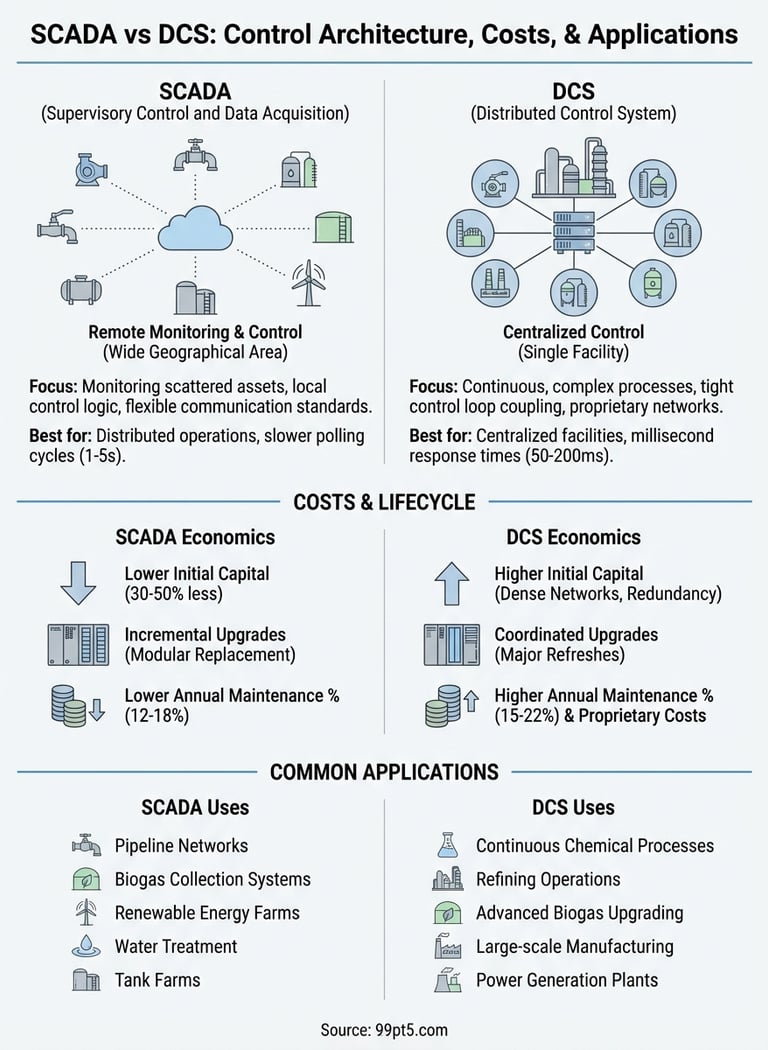
The SCADA vs DCS debate matters because choosing the wrong control architecture can cost you millions in equipment, engineering time, and lost operational efficiency. SCADA (Supervisory Control and Data Acquisition) focuses on monitoring and controlling equipment spread across large geographical areas, while DCS (Distributed Control System) handles complex, continuous processes within a single facility. Both systems collect data, control equipment, and help operators make decisions. But they approach these tasks differently, and that difference shapes everything from your initial investment to your daily operating costs.
This guide breaks down what separates SCADA from DCS in practical terms. You will learn how each system handles control logic, where companies typically deploy them, what they cost over their lifecycle, and which technical characteristics matter most when you are selecting one for your biogas processing plant or other industrial operation. We focus on real cost drivers and performance guarantees that affect your bottom line, not vague industry generalities.
Why SCADA vs DCS decisions matter for modern plants
Your control system choice determines upfront capital costs, engineering complexity, and operational flexibility for the next 15 to 25 years. Plants that select the wrong architecture often spend two to three times more on modifications, additional hardware, and unplanned downtime compared to facilities that matched their control strategy to their process requirements from day one. The SCADA vs DCS decision affects everything from how many engineers you need on staff to how quickly you can respond to process upsets.
Capital investment differences
SCADA implementations typically cost 30 to 50 percent less upfront than DCS installations for geographically distributed operations. You purchase individual RTUs or PLCs at each remote site, then connect them through existing communication networks to a central monitoring station. DCS systems require dense controller networks with redundant processors, proprietary communication buses, and often matching equipment from a single vendor, which drives total project costs higher even for smaller facilities.
Operational consequences
Your control architecture shapes how operators interact with equipment during normal operations and emergencies. SCADA systems excel when you need to monitor scattered assets like pipelines, biogas collection networks, or multiple small digesters across different farm locations. DCS platforms deliver superior performance when you run continuous processes that demand tight coordination between dozens of control loops, like the precise oxygen control and catalytic reactions in advanced biogas upgrading equipment.
The wrong control system adds engineering costs, limits process optimization, and creates maintenance burdens that compound over decades of operation.
How to choose between SCADA and DCS
Your process requirements and physical layout should drive your control system selection, not vendor recommendations or what competitors installed. Start by mapping your control loop density, geographic distribution, and response time requirements across your entire operation. Plants with fewer than 50 control loops concentrated in one building often benefit from DCS integration, while operations monitoring 100-plus points across multiple sites typically achieve better economics with SCADA implementations.
Process characteristics drive your selection
Continuous processes that demand tight coupling between control loops favor DCS architectures. When temperature changes in your reactor must trigger coordinated adjustments to pressure, flow, and catalyst injection within seconds, you need the deterministic control that DCS platforms deliver through their integrated controller networks. Batch operations, discrete manufacturing, and monitoring applications where each piece of equipment operates independently work well with SCADA configurations using individual PLCs or RTUs.
Match your control architecture to your process dynamics, not to your familiarity with specific brands or platforms.
Geographic scope and site layout
SCADA systems excel when you operate distributed assets across different buildings, properties, or regions. You monitor a biogas collection network spanning 15 farm digesters across three counties more efficiently with RTUs at each site reporting to one central station than trying to wire everything into a single DCS controller room. Centralized facilities with all equipment within 300 meters of a control room gain more value from DCS installations because you avoid the communication infrastructure costs that SCADA implementations require.
Control complexity and response times
Your maximum acceptable response time between sensor input and control output determines which architecture works best. DCS platforms deliver 50 to 200 millisecond scan times through dedicated controller networks, which matters when you run catalytic reactions or manage boiler controls. SCADA systems typically operate on one to five second polling cycles, perfectly adequate for tank level monitoring, valve status checks, and most biogas processing applications. The scada vs dcs decision becomes clear when you quantify exactly how fast your process must react to changing conditions.
Key differences between SCADA and DCS
Understanding the technical distinctions between these control architectures helps you avoid expensive mismatches between your equipment and your operational needs. The scada vs dcs comparison boils down to five fundamental differences: where control logic executes, how systems communicate, what protocols they support, how operators interact with processes, and what happens when communication fails. These differences translate directly into cost structures, engineering requirements, and operational capabilities that persist throughout your equipment's service life.
Control architecture and processing location
SCADA systems execute control logic locally at each RTU or PLC, then report status information back to central monitoring stations. Your remote biogas collection point makes its own decisions about valve positions and alarm conditions based on local sensor inputs, which means operations continue even when network connections drop. DCS platforms concentrate control processing in centralized controller racks, with field devices serving primarily as input/output endpoints rather than intelligent decision makers. This centralized approach delivers tighter coordination between control loops but creates single points of failure that can shut down entire process units.
Local intelligence in SCADA systems keeps critical equipment operating during communication outages, while DCS implementations demand redundant communication paths to maintain availability.
Each architecture handles process coordination differently. DCS controllers share data through high-speed proprietary buses that update multiple loops within milliseconds, ideal for processes where reactor temperature directly affects catalyst injection timing. SCADA implementations coordinate between sites through polling cycles measured in seconds, which works perfectly well for tank farm monitoring or digestor networks where process time constants span minutes or hours rather than milliseconds.
Communication protocols and vendor flexibility
SCADA systems typically support open communication standards like Modbus, OPC, DNP3, and MQTT, which lets you integrate equipment from multiple vendors without middleware or protocol converters. You connect Allen Bradley PLCs, Siemens RTUs, and third-party sensors into one monitoring network using standard industrial protocols. DCS vendors historically locked customers into proprietary communication buses that only worked with matching equipment from the same manufacturer, though modern platforms increasingly offer open protocol support to compete with SCADA flexibility.
Protocol flexibility affects your long-term equipment costs and upgrade options. Plants with SCADA architectures replace aging controllers one at a time without touching other equipment, while DCS installations often require coordinated upgrades across entire controller families to maintain compatibility within proprietary networks.
Operator interface and data management
DCS platforms ship with integrated operator interfaces and pre-configured tag databases that reduce engineering time during initial installation. SCADA systems require you to purchase separate HMI software packages, build your tag structures from scratch or through imports, and configure data historians as independent components. This modular SCADA approach costs more during engineering but delivers superior flexibility when you need to replace specific components or scale operations beyond original design capacity.
Costs and lifecycle trade offs for SCADA and DCS
Your total ownership costs extend far beyond the purchase price of controllers and software licenses. The scada vs dcs comparison requires you to evaluate initial capital expenditure, annual maintenance contracts, engineering labor for modifications, spare parts inventory requirements, and the eventual cost of major system upgrades over 15 to 25 years of operation. Plants that focus only on upfront equipment costs often discover that ongoing expenses consume three to five times the original investment throughout the system's operational life.
Initial capital expenditure
SCADA implementations typically require $50,000 to $150,000 for systems monitoring 50 to 200 points across distributed sites, including RTUs, communication infrastructure, HMI software licenses, and basic engineering. DCS installations handling similar point counts within centralized facilities cost $200,000 to $500,000 because you purchase redundant controller pairs, proprietary I/O modules, integrated operator workstations, and extensive factory testing before shipment. Your engineering costs run higher with SCADA projects when you need to configure multiple independent PLCs and build tag databases from scratch, while DCS vendors deliver pre-integrated systems that reduce commissioning time.
Communication infrastructure drives significant cost differences between architectures. SCADA systems leverage existing cellular networks, fiber connections, or radio links that you may already operate, adding only the cost of RTU modems and data plans. DCS implementations require you to install dedicated controller networks with redundant paths, specialized cabling, and network switches rated for industrial environments, which adds $30,000 to $100,000 to project budgets even for modest installations.
Long-term maintenance and upgrades
Annual maintenance contracts consume 12 to 18 percent of your original SCADA investment compared to 15 to 22 percent for DCS systems, primarily because proprietary controller platforms command premium support pricing. Spare parts inventory requirements differ substantially as well. You stock individual PLC modules costing $500 to $2,000 each for SCADA systems, while DCS operations keep redundant controller pairs and specialized I/O cards worth $5,000 to $15,000 per critical unit to maintain uptime guarantees.
DCS vendors lock you into proprietary upgrade paths that can cost 40 to 60 percent of your original investment every 10 to 12 years, while SCADA systems let you replace components incrementally.
Major system upgrades hit your budget differently depending on architecture. SCADA installations let you modernize one site at a time, spreading costs over multiple budget cycles and maintaining operations at other locations. DCS platforms often require coordinated upgrades across entire controller families to maintain compatibility within proprietary networks, forcing you to budget $150,000 to $400,000 for comprehensive refreshes that temporarily take process units offline.
Common applications in energy and process plants
Your control system choice aligns with specific operational patterns that energy and process industries have refined over decades. The scada vs dcs decision follows predictable patterns based on process type, geographic distribution, and control loop density. Understanding where each architecture delivers maximum value helps you avoid expensive mismatches between your equipment capabilities and operational requirements.
SCADA deployments
Pipeline networks, biogas collection systems, and distributed renewable energy installations rely on SCADA architectures because equipment spans multiple sites across wide geographic areas. You monitor dozens of remote digesters, compressor stations, or solar farms from one central location while maintaining local control intelligence at each site. Water treatment facilities, power distribution networks, and tank farms also favor SCADA implementations where operators need visibility across scattered assets without requiring millisecond coordination between control loops.
DCS implementations
Continuous chemical processes, refining operations, and advanced biogas upgrading plants deploy DCS platforms to handle tight coupling between control loops. You achieve the precise coordination needed for catalytic reactions, distillation columns, and integrated processing trains where temperature, pressure, and flow adjustments must happen simultaneously across multiple process stages. Large-scale manufacturing facilities with centralized equipment layouts benefit from DCS integration despite higher capital costs.
Next steps
The scada vs dcs decision requires you to match your control architecture to your actual process requirements, geographic layout, and long-term operational goals. Start by documenting your control loop density, response time needs, and whether your equipment sits within one facility or spans multiple locations. This analysis reveals which architecture delivers better economics and operational performance for your specific application.
Your biogas upgrading equipment demands precise control over catalytic reactions, oxygen injection, and contaminant removal processes that directly affect methane recovery rates and emissions performance. Explore how 99pt5's BioTreater system integrates advanced process control with guaranteed 99.5% methane recovery and 99.5% CO2e reduction, delivering the lowest operating expenses in the industry through petroleum-grade engineering and fully automated operation.