What Are Voluntary vs Compliance Carbon Markets In Practice?
Learn the practical differences between voluntary vs compliance carbon markets. Discover how to identify which market applies to your BioMethane projects & maximize carbon credit revenue.
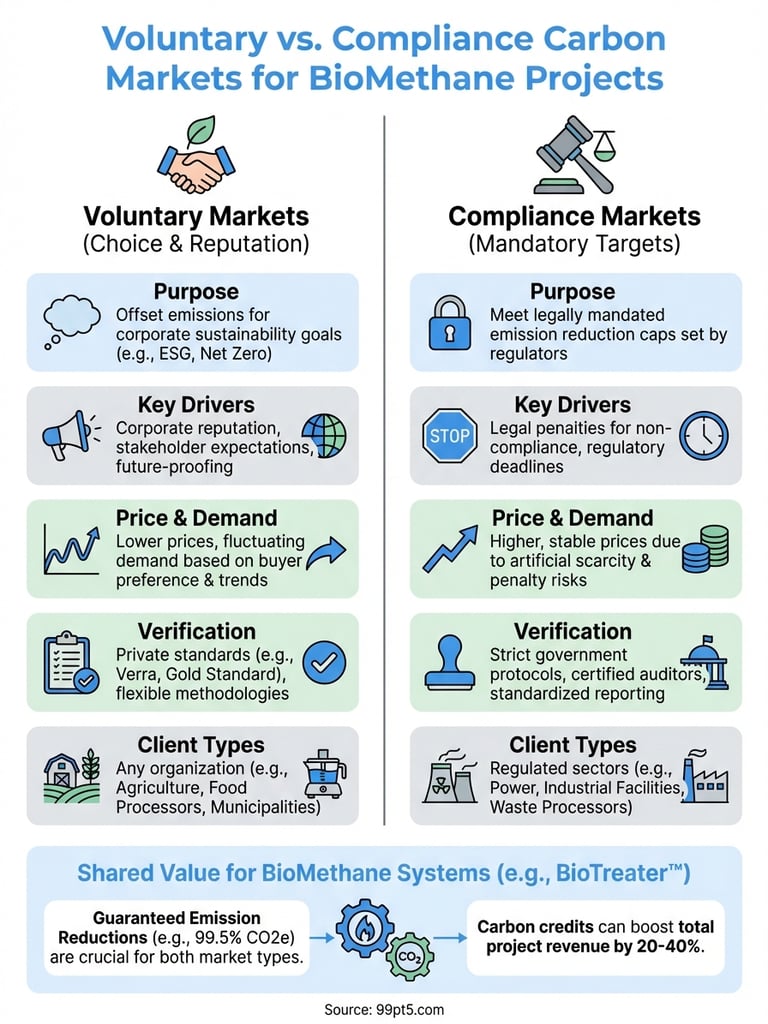
Carbon markets come in two forms. Compliance markets require specific industries to meet mandatory emission reduction targets set by regulators. Voluntary markets let businesses offset emissions by choice, buying credits to demonstrate environmental responsibility. The distinction matters because each operates under different rules, offers different benefits, and suits different business strategies.
If you design or install BioMethane systems, you need to know which market applies to your projects and how to maximize value from both. This article breaks down the practical differences between voluntary and compliance carbon markets. You'll learn how to identify which market governs your situation, understand the trade-offs each presents, and discover how to build a carbon strategy that turns BioGas processing into revenue while meeting regulatory requirements. We'll cover the mechanics of both markets, compare their pros and cons for project developers, and show you how to navigate carbon credits in the BioMethane sector.
Why carbon markets matter in practice
Carbon markets directly affect your bottom line when you develop BioMethane projects. Every tonne of CO2 equivalent you prevent or remove becomes a tradable asset, creating revenue streams beyond the gas you produce. Your project economics shift significantly based on whether you operate in a compliance market with mandated caps or a voluntary market where credits carry different values. Understanding the distinction between voluntary vs compliance carbon markets lets you price your systems accurately, forecast returns for clients, and identify which credits you can generate from specific installations.
Financial impact on BioMethane projects
The carbon credits your projects generate can represent 20 to 40 percent of total project revenue depending on market conditions and system efficiency. You capture value at multiple points: preventing methane emissions from organic waste, displacing fossil natural gas with renewable BioMethane, and potentially selling concentrated CO2 as a separate product. Compliance market credits typically command higher prices because buyers face legal penalties for non-compliance, while voluntary credits offer more flexibility but lower premiums. Your BioTreater™ systems that guarantee 99.5% CO2e emission reduction produce credits with measurable, verifiable performance data that buyers trust.
Projects with documented emission reductions and third-party verification secure premium prices in both market types.
Regulatory requirements you face
Compliance markets impose specific obligations on your end clients in regulated sectors. Power generators, industrial facilities, and waste processors in jurisdictions with emission trading schemes must surrender allowances equal to their emissions each year. When you install a BioMethane system that displaces fossil fuels, you help these clients reduce their compliance burden and avoid penalties. Your role extends beyond equipment supply to documenting the emission reductions your systems deliver. Voluntary markets let you serve clients outside regulated sectors who want to offset emissions for corporate sustainability goals, giving you broader market access but requiring different verification processes. Both paths need accurate monitoring, transparent reporting, and proof that your technology performs as guaranteed.
How to tell voluntary from compliance markets
You can identify which market governs your project by examining three factors: your client's regulatory obligations, the verification standards required, and the type of credits your system generates. The distinction between voluntary vs compliance carbon markets becomes clear when you assess whether your end client faces mandatory emission caps or chooses to offset voluntarily. Compliance markets operate under legal frameworks that penalize non-participation, while voluntary markets function on corporate choice and reputation goals.
Check your client's regulatory status
Your client operates in a compliance market if regulators mandate emission reduction targets for their sector. Power plants, refineries, cement manufacturers, and aviation companies in regions with emissions trading systems must participate by law. The European Union Emissions Trading System covers approximately 11,000 installations across member states, requiring each to surrender allowances matching annual emissions. You serve compliance market clients when you install BioMethane systems for facilities in California's Cap-and-Trade Program, the UK Emissions Trading Scheme, or similar regulatory frameworks. These clients face financial penalties for exceeding emission caps, making your guaranteed 99.5% CO2e reduction directly valuable to their compliance strategy.
Clients in voluntary markets choose to purchase carbon credits without legal requirement. Agricultural operations converting manure to BioMethane, food processors handling organic waste, and municipalities running wastewater treatment plants typically fall into this category unless specific regulations apply. These clients buy credits to meet corporate sustainability commitments, satisfy stakeholder expectations, or prepare for future regulations. Your role involves helping them demonstrate measurable environmental impact through documented emission reductions and transparent reporting.
Examine verification requirements
Compliance markets require government-approved verification protocols and registered auditors who follow strict regulatory standards. Your BioMethane system must meet specific technical requirements, undergo periodic inspections, and submit detailed emission reports to regulatory authorities. The verification process includes third-party audits, standardized methodologies for calculating reductions, and registry systems that track allowances.
Voluntary markets use private certification standards like Verra, Gold Standard, or the American Carbon Registry. You select the standard that best fits your project type, demonstrate additionality by proving your system creates reductions beyond business-as-usual scenarios, and engage independent verifiers who assess your documentation. The process offers more flexibility in methodology but demands equally rigorous proof of performance. Your BioTreater™ systems built to petroleum industry standards provide the measurable data both market types require, giving you access to whichever market serves your clients best.
Projects serving compliance markets generate allowances or offsets recognized by specific regulatory schemes, while voluntary projects create credits verified under private standards.
Key differences between the two market types
The practical distinctions between voluntary vs compliance carbon markets shape how you structure deals, price systems, and deliver value to clients. Regulatory frameworks, price mechanisms, and credit characteristics vary significantly across both markets, affecting everything from contract terms to revenue forecasts. Understanding these operational differences lets you match your BioTreater™ capabilities to specific market opportunities and set accurate performance guarantees that buyers value.
Price formation and market dynamics
Compliance market prices reflect supply constraints and regulatory penalties rather than buyer preferences. Regulators set emission caps that decline over time, creating scarcity as allowances become harder to obtain. When your BioMethane system generates credits in these markets, prices respond to policy changes, economic activity, and enforcement actions. The EU ETS allowance price fluctuates based on industrial output, energy demand, and regulatory announcements about future caps. California's Cap-and-Trade Program includes price floors and ceilings to prevent extreme volatility, giving you more predictable revenue ranges when projecting returns for clients in that jurisdiction.
Voluntary market prices depend on project characteristics and buyer demand for specific credit attributes. Buyers pay premiums for credits from technologies like BioGas processing that deliver co-benefits beyond carbon reduction, including renewable energy generation and waste management. Your guaranteed 99.5% methane recovery creates high-quality credits that command better prices than projects with estimated or variable performance. Market prices vary widely based on project location, vintage year, verification standard, and whether credits come from removal projects or avoidance projects.
Participation and trading mechanisms
Compliance markets restrict participation to regulated entities and authorized traders who register with government agencies. Your clients in these markets must hold accounts in official registries, submit regular reports to regulators, and surrender allowances matching their emissions each compliance period. Trading occurs on regulated exchanges or through bilateral contracts with standardized terms and settlement procedures. You deliver value by installing systems that generate certified offsets these entities can use for compliance, reducing their need to purchase expensive allowances from other sources.
Voluntary markets allow any organization or individual to purchase and retire credits regardless of regulatory obligations. Buyers include corporations meeting sustainability targets, event organizers offsetting conference emissions, and individuals compensating for personal carbon footprints. Your BioMethane projects access multiple buyer types through brokers, project aggregators, or direct sales agreements. Trading happens through voluntary registries like Verra or Gold Standard, where credits carry unique serial numbers and transparent retirement records that prevent double counting.
Credit quality and verification standards
Compliance markets enforce uniform technical specifications and monitoring requirements across all participating installations. Regulators prescribe calculation methodologies, acceptable measurement equipment, and reporting formats that leave little room for interpretation. Your systems must meet these exact standards to generate eligible credits, but buyers accept all compliant credits equally regardless of the technology or project type behind them.
Voluntary markets grade credits based on perceived quality factors including permanence, additionality, and co-benefits. Buyers distinguish between credits from different project types, giving premium prices to those with robust verification, transparent methodologies, and additional environmental or social impacts. Your petroleum-industry-standard equipment and guaranteed performance metrics position your projects in the high-quality tier that sophisticated corporate buyers prefer.
Credits from compliance markets serve regulatory obligations, while voluntary market credits build corporate reputation and prepare organizations for future regulations.
Pros and cons for project developers
Each market type presents distinct advantages and limitations that affect how you design, price, and deliver BioMethane systems. Your choice between voluntary vs compliance carbon markets influences project timelines, revenue stability, and client relationships. Compliance markets offer higher prices and long-term demand but impose rigid requirements and limited flexibility. Voluntary markets provide broader access and faster deployment but face price uncertainty and buyer scrutiny over credit quality.
Compliance market advantages and drawbacks
Compliance markets deliver predictable demand driven by regulatory deadlines that create consistent buyer pools for your credits. Clients facing mandatory caps must purchase allowances or offsets regardless of market conditions, giving you reliable revenue streams once your system achieves certification. Prices typically exceed voluntary market rates because buyers face penalties for non-compliance, and regulatory caps create artificial scarcity that supports premium valuations. Your guaranteed 99.5% emission reduction meets the strict verification standards these markets require, positioning your projects as reliable compliance tools.
The regulatory burden represents the primary drawback. Entry costs run higher due to government registration fees, approved auditor requirements, and extensive documentation demands. You face longer project timelines as regulators review applications, verify methodologies, and approve your systems for credit generation. Regulatory changes introduce risk since governments can alter cap levels, modify verification protocols, or adjust which sectors qualify for offsets. Your projects must adapt to evolving rules or risk losing credit eligibility, requiring ongoing monitoring of policy developments across jurisdictions where you operate.
Voluntary market benefits and challenges
Voluntary markets let you serve any client segment without geographic or sectoral restrictions imposed by regulators. You access buyers ranging from agricultural operations to corporate sustainability programs, expanding your addressable market beyond industries facing emission caps. Project approval happens faster because you select private certification standards rather than waiting for government agencies to process applications. Your modular BioTreater™ systems that deploy rapidly align well with voluntary market timelines, letting you generate and sell credits within months of installation.
Price volatility poses the main challenge. Buyer preferences shift based on corporate sustainability trends, media coverage of climate issues, and perceptions about credit quality from different project types. You cannot predict revenues as confidently as in compliance markets because prices fluctuate based on voluntary demand rather than regulatory penalties. Credit differentiation matters intensely since buyers scrutinize project attributes, co-benefits, and verification rigor before purchasing. Your petroleum-industry-standard construction and guaranteed performance metrics help justify premium prices, but you must actively demonstrate quality to compete against lower-cost projects with estimated rather than guaranteed reductions.
Project developers who understand both market dynamics can pivot between compliance and voluntary opportunities based on client needs and revenue optimization.
Designing a carbon market strategy for biogas
Your carbon strategy determines whether BioMethane projects deliver maximum financial returns while meeting client sustainability goals. Strategic planning before installation lets you optimize credit generation, select the right markets, and structure contracts that capture value from both gas sales and carbon revenues. You need a framework that evaluates market opportunities against your system capabilities, client requirements, and revenue targets across different scenarios.
Assess your project eligibility in both markets
Start by mapping your project characteristics against voluntary vs compliance carbon markets requirements to identify which options you can pursue. Your project's location, client sector, and system specifications determine eligible markets and available certification pathways. Compliance markets require specific jurisdictional presence and client participation in regulated sectors like power generation, industrial manufacturing, or waste management covered by emission trading schemes. Projects in EU member states, California, or the UK automatically qualify for compliance market participation if clients face mandatory caps.
Voluntary market eligibility depends on proving additionality and selecting appropriate methodologies from certification bodies. Your BioGas processing projects typically qualify under waste management protocols, renewable energy generation methodologies, or agricultural methane avoidance frameworks depending on feedstock sources. Food waste digesters, livestock manure systems, and wastewater treatment installations each fit different voluntary market categories that affect verification costs and credit pricing. Projects combining multiple benefits like renewable fuel production plus CO2 capture command premium valuations from buyers seeking high-impact offsets.
Match system capabilities to credit requirements
Your BioTreater™ specifications directly influence which credits you generate and their market value. Guaranteed 99.5% methane recovery and 99.5% CO2e reduction provide the measurable performance data both market types demand for verification. Compliance markets require continuous emissions monitoring systems, calibrated measurement equipment, and standardized reporting protocols your petroleum-industry-standard construction already satisfies. Documentation capabilities matter as much as technical performance because both markets demand transparent, auditable records proving emission reductions occurred.
Systems with built-in monitoring and remote data access through BioView™ software reduce verification costs and strengthen credit quality claims.
Optional CO2 capture functionality expands your credit opportunities beyond methane destruction alone. Captured CO2 generates additional credits in markets that recognize carbon removal or sequestration, and potential sale of food-grade or industrial CO2 creates supplementary revenue streams. Your modular design lets you configure systems matching specific market requirements without over-engineering, keeping capital costs aligned with credit revenue potential.
Build revenue projections across market scenarios
Financial modeling must account for price ranges in both voluntary and compliance markets since client returns depend on which path you pursue. Compliance credit prices typically range between two and ten times voluntary market rates depending on jurisdiction and current cap stringency. Model your project economics using conservative price assumptions from recent transactions in target markets rather than peak historical values to ensure viable returns under normal conditions.
Include verification costs, registry fees, and ongoing monitoring expenses when calculating net credit revenues. Compliance markets impose higher administrative costs but deliver more stable pricing, while voluntary markets offer lower entry barriers with greater price uncertainty. Your clients need scenarios showing break-even points, sensitivity to price changes, and timing of credit generation relative to system deployment to make informed investment decisions.
Key takeaways
Understanding voluntary vs compliance carbon markets lets you maximize revenue from every BioMethane project you develop. Compliance markets offer higher prices and stable demand because buyers face regulatory penalties, but they require extensive documentation and jurisdiction-specific approvals. Voluntary markets provide faster entry and broader client access while accepting more flexible verification standards, though prices fluctuate based on buyer preferences rather than legal obligations.
Your project economics improve when you design systems that meet both market requirements from day one. Guaranteed emission reductions matter more than estimated performance in both markets, giving systems with proven metrics competitive advantages over alternatives with variable outcomes. Carbon credits represent significant revenue streams beyond gas sales, often contributing 20 to 40 percent of total project returns when you structure deals effectively.
Explore how our BioTreater™ systems deliver the guaranteed 99.5% emission reduction and petroleum-industry reliability that both voluntary and compliance carbon markets value.