Condition Monitoring Definition: What It Is, How It Works
What is condition monitoring? Explore its definition, how it works, key techniques, and benefits for industrial equipment, including biogas systems.
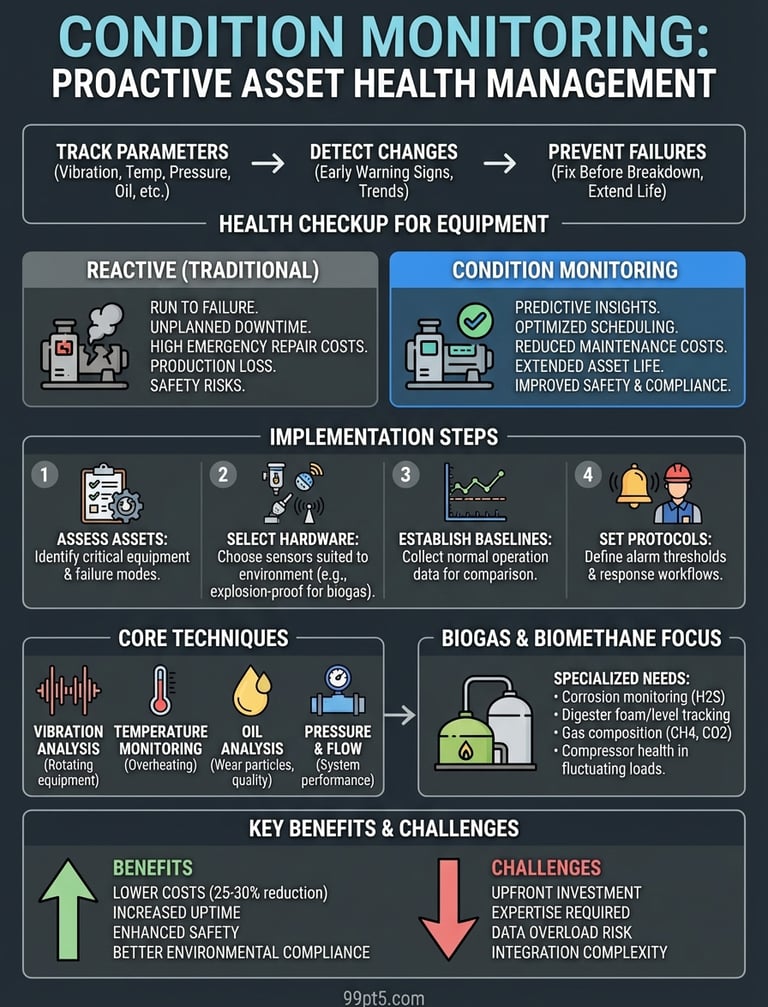
Condition monitoring is the practice of tracking specific parameters in machinery and equipment to detect changes that signal developing problems. Think of it as a health checkup for your industrial assets. Instead of waiting for equipment to fail or servicing everything on a fixed schedule, you measure things like vibration, temperature, pressure, and oil quality in real time. When something shifts from normal operating conditions, you get an alert. This approach lets maintenance teams fix issues before they cause breakdowns, avoiding costly unplanned downtime and extending asset life.
This article breaks down what condition monitoring actually means for your operations. You'll see how it works from installation through daily monitoring, explore the most common techniques and sensors used, and understand the specific benefits for biogas and biomethane systems. We'll also cover practical implementation steps, weigh the advantages against potential challenges, and show you what makes an effective condition monitoring program. Whether you're considering your first system or looking to improve existing practices, you'll find actionable information to make better decisions about protecting your equipment investment.
Why condition monitoring matters
Your equipment represents a massive investment, and how you maintain it directly impacts your bottom line. Traditional reactive maintenance means running machinery until it breaks, then scrambling to fix it. This approach leads to unplanned downtime that can cost tens of thousands to millions per day, depending on your operation. Scheduled preventive maintenance is better but still inefficient, because you replace parts and perform service based on operating hours rather than actual condition. You end up maintaining equipment that doesn't need attention while potentially missing real problems developing between scheduled intervals.
The cost of reactive maintenance
When critical equipment fails unexpectedly, the financial impact goes far beyond repair costs. You face lost production, missed deadlines, and potentially damaged reputation with customers who depend on your deliveries. Emergency repairs cost more than planned maintenance because you pay overtime rates, expedited shipping for parts, and emergency callout fees. Catastrophic failures can also damage other connected components, multiplying your repair costs. The hidden costs of reactive maintenance can reach five times higher than direct maintenance expenses when you account for all the ripple effects throughout your operation.
Operational and safety advantages
Beyond the condition monitoring definition as a technical practice, this approach fundamentally changes how you run your facility. You gain predictive power that lets you schedule maintenance during planned downtime windows, servicing multiple machines at once and coordinating with production schedules. Your maintenance teams work more efficiently because monitoring data tells them exactly which component needs attention, eliminating time spent troubleshooting. Safety improves dramatically when you can identify and fix problems before they create hazardous conditions for workers.
Monitoring equipment before failure occurs protects your people and prevents environmental incidents that could result from catastrophic breakdowns.
Environmental compliance becomes easier to maintain, and you can maximize revenue through carbon credits by demonstrating consistent, efficient operation of emissions-control equipment. Remote monitoring capabilities mean you can oversee operations across multiple sites without constant physical presence, reducing travel costs and response times when issues arise.
How to implement condition monitoring
Building an effective condition monitoring program requires a structured approach that goes beyond simply installing sensors. You need to understand your equipment, choose the right instrumentation, establish meaningful benchmarks, and ensure your team can act on the data. The condition monitoring definition covers the technical aspects, but successful implementation depends on careful planning and execution tailored to your specific operation. Each facility has unique requirements based on equipment type, operating environment, and business criticality of different assets.
Assess your assets and priorities
Start by identifying which equipment needs monitoring based on failure consequences and maintenance costs. Your most critical assets are those where unplanned downtime causes the greatest production loss or safety risk. Look at your maintenance history to find machines with frequent failures or high repair costs. In biogas operations, this typically includes compressors, blowers, generators, pumps, and digesters. You don't need to monitor everything at once. Focus first on the equipment that makes or breaks your operation, then expand coverage as you prove value and build expertise.
Document the operating conditions and performance parameters for each asset you plan to monitor. Record normal vibration patterns, temperatures, pressures, and other relevant measurements during healthy operation. This baseline information becomes essential later when you interpret monitoring data. Understand the failure modes specific to each machine type, because different equipment develops problems in different ways. A centrifugal pump shows different warning signs than a reciprocating compressor, and your monitoring approach should reflect these differences.
Select and install the hardware
Choose sensors and instrumentation that match your equipment and environment. Vibration sensors work for rotating machinery like motors and compressors, while temperature probes and pressure transducers suit heat exchangers and vessels. Your biogas environment may require explosion-proof or corrosion-resistant sensors due to moisture and potentially hazardous gas presence. Work with experienced suppliers who understand your industry's specific requirements and can recommend appropriate equipment ratings and certifications.
Installation quality determines whether your monitoring system delivers reliable data or constant false alarms. Mount sensors according to manufacturer specifications, paying attention to orientation, mounting torque, and location on the equipment. Poor mounting creates noise and inaccurate readings that undermine confidence in your system. Run cables properly to avoid electrical interference and mechanical damage. Many facilities benefit from wireless sensors in hard-to-reach locations, though you need to ensure reliable signal transmission and battery management in your specific environment.
Establish baselines and set up protocols
Once your sensors are operational, you need to collect baseline data during normal operation across different load conditions and seasons. This data shows you what healthy equipment looks like and provides the reference point for detecting changes. Take measurements during startup, steady-state operation, and shutdown to understand the full operational cycle. The more comprehensive your baseline data, the more accurately you can distinguish real problems from normal variations.
Your monitoring system becomes effective only when you define clear alarm thresholds and response procedures for each monitored parameter.
Configure alert levels based on your baseline data and manufacturer recommendations. Set warning thresholds that trigger investigation before reaching critical levels, giving you time to plan maintenance. Establish escalation procedures so the right people receive notifications based on severity. Document response protocols that tell your team exactly what actions to take when specific alarms trigger. Create a maintenance workflow that connects monitoring alerts to work order generation, ensuring issues get addressed promptly rather than ignored or forgotten. Train every team member who will interact with the system, from operators who receive initial alerts to maintenance technicians who act on the data. Regular reviews of your protocols help you refine thresholds and procedures based on actual experience.
Core techniques and data sources
The condition monitoring definition encompasses various measurement approaches, each suited to detecting specific types of equipment problems. Your choice of techniques depends on the equipment type, operating environment, and failure modes you need to detect. Most effective monitoring programs combine multiple methods because different sensors reveal different aspects of machine health. Understanding what each technique measures and what problems it can detect helps you build a monitoring strategy that catches issues early while avoiding excessive complexity and cost.
Physical parameter monitoring
Vibration analysis remains the most widely used condition monitoring technique for rotating equipment like motors, pumps, compressors, and fans. You measure vibration frequency and amplitude using accelerometers mounted on equipment casings or bearing housings. Changes in vibration patterns reveal problems including bearing wear, shaft misalignment, imbalance, looseness, and gear damage. Each fault type produces a characteristic vibration signature that experienced analysts can identify, often weeks or months before the problem causes failure. Modern systems can automatically compare current vibration patterns against your baseline data and trigger alerts when deviations exceed preset thresholds.
Temperature monitoring uses thermocouples, resistance temperature detectors (RTDs), or infrared cameras to detect thermal anomalies. Overheating often signals inadequate lubrication, excessive friction, electrical resistance, or cooling system problems. Infrared thermography scans entire equipment surfaces to identify hot spots that indicate developing issues. You can find overheated electrical connections, insulation breakdown, mechanical binding, and heat exchanger fouling through thermal imaging. Temperature trending over time shows gradual degradation, while sudden temperature spikes indicate acute problems requiring immediate attention.
Pressure and flow monitoring tracks system performance in pumps, compressors, and process equipment. Declining discharge pressure or flow rate indicates wear, blockages, or leaks affecting performance. Pressure drop across filters shows contamination buildup requiring service. These measurements help you understand whether equipment operates within design parameters and alert you to conditions that reduce efficiency even before causing failure.
Combining multiple measurement types gives you a complete picture of equipment condition that no single technique can provide alone.
Chemical and material analysis
Oil analysis examines lubricating oil samples from gearboxes, compressors, engines, and hydraulic systems to detect wear particles, contamination, and lubricant degradation. Laboratory tests measure particle count and composition, viscosity, acidity, water content, and additive depletion. Metal particles in oil samples tell you which components are wearing, while contamination reveals seal failures or ingress of dirt and moisture. Trending oil analysis results over time shows whether wear rates are normal or accelerating, giving you advance warning before wear particles indicate imminent failure.
Ferrography provides detailed analysis of wear particles, identifying their size, shape, composition, and concentration. This technique distinguishes between normal wear and abnormal wear modes like cutting, fatigue, and corrosion. You can determine which bearing, gear, or sliding surface is wearing and whether the wear rate is increasing. Results guide maintenance decisions about whether to continue operation, increase monitoring frequency, or schedule immediate service.
Advanced diagnostic techniques
Ultrasonic monitoring detects high-frequency sounds generated by friction, impacts, turbulence, and electrical discharge. You use ultrasonic detectors to find compressed air leaks, steam leaks, valve problems, bearing defects, and electrical arcing that produce characteristic acoustic signatures. This technique works well in noisy environments because it operates at frequencies above ambient background noise. Ultrasonic testing also measures material thickness and detects internal flaws in pressure vessels, piping, and structural components.
Motor circuit analysis evaluates electrical parameters including voltage, current, power factor, and phase balance to assess motor health. Imbalances and distortions in electrical characteristics reveal problems with stator windings, rotor bars, insulation, and connections. You can detect these electrical faults before they cause motor failure or create safety hazards. Power signature analysis examines how motors draw current under load, identifying both electrical and mechanical problems including misalignment and coupling issues.
Performance trending monitors process variables like throughput, energy consumption, efficiency, and product quality. Gradual performance degradation often appears in these metrics before traditional condition monitoring detects physical problems. You establish expected performance curves at different load levels, then track deviations that indicate fouling, wear, or control system drift affecting overall equipment effectiveness.
Condition monitoring in biogas and biomethane
Biogas and biomethane operations face unique challenges that make condition monitoring especially valuable. Your equipment operates in corrosive environments with moisture, hydrogen sulfide (H2S), and other contaminants that accelerate wear and failure. You handle potentially explosive gas mixtures requiring continuous safety monitoring beyond typical industrial applications. Process upsets in digesters or upgrading systems can cascade through your entire facility, turning minor issues into expensive shutdowns. The condition monitoring definition applies fully here, but your implementation needs to account for these specific operational realities that distinguish biogas from other industries.
Equipment-specific monitoring needs
Your compressors and blowers represent critical failure points requiring intensive vibration and temperature monitoring. These machines work continuously under varying loads as biogas production fluctuates with feedstock changes and seasonal temperatures. Bearing failures in compressors can release biogas into your facility or allow air ingress that creates explosive mixtures. You need to track discharge temperatures, vibration patterns, and motor current signatures to catch problems before they compromise safety or production.
Digesters and upgrading equipment require monitoring of parameters that standard industrial condition monitoring often overlooks. You track foam levels, mixing efficiency, temperature stratification, and pressure differentials across membranes or packed beds in upgrading systems. Fouling in heat exchangers reduces heat transfer efficiency, while membrane degradation in upgrading systems decreases methane recovery and purity. Chemical sensors monitor H2S concentrations, oxygen levels, and methane slip to ensure your process stays within safe and efficient operating ranges.
Your biogas processing equipment demands specialized sensors that can survive corrosive, moisture-rich environments while maintaining accuracy and reliability.
Generators and combined heat and power (CHP) units burning biomethane require oil analysis combined with exhaust gas monitoring. You measure siloxane buildup that can damage engine components, track NOx and CO emissions for environmental compliance, and monitor coolant conditions to prevent overheating. Thermal imaging identifies hot spots in electrical connections and exhaust systems before they cause fires or failures.
Process parameter tracking
You measure biogas composition continuously throughout your facility because methane content, CO2 levels, and contaminant concentrations affect both equipment performance and product quality. Changes in methane percentage indicate digester upset or upgrading system problems, while rising H2S levels signal increased corrosion risk and potential catalyst poisoning. Monitoring these parameters lets you adjust operations before problems develop or product falls outside specifications.
Flow rates and pressure drops across your system reveal blockages, leaks, and performance degradation. You track pressure throughout your process from digester operating pressure through compression stages to final delivery pressure. Unexpected pressure drops indicate leaks or restrictions requiring investigation. Flow measurements at multiple points confirm mass balance and help you identify where losses occur, whether from fugitive emissions, flare events, or system inefficiencies that reduce your biomethane production and revenue. Remote monitoring through systems like BioView software lets you oversee these parameters across your facility from any location, responding quickly to developing issues before they impact production or safety.
Key benefits and potential challenges
Understanding both sides of condition monitoring helps you make informed decisions about implementation. The condition monitoring definition covers the technical process, but your return on investment depends on how well benefits align with your specific situation versus the resources required to overcome implementation challenges. You need realistic expectations about what condition monitoring delivers and what obstacles you might face during deployment and operation.
Financial and operational advantages
Your maintenance costs drop significantly when you shift from reactive or time-based approaches to condition-based strategies. You eliminate unnecessary parts replacement and service on healthy equipment while avoiding expensive emergency repairs and production losses from unexpected failures. Studies across multiple industries show that hidden costs of reactive maintenance can reach five times the direct repair expenses when you account for lost production, overtime labor, expedited parts shipping, and secondary equipment damage. Condition monitoring prevents these cascading costs by catching problems early.
Equipment lifespan extends when you address developing issues before they cause catastrophic damage. A bearing running with inadequate lubrication will destroy itself and potentially damage the shaft, housing, and connected components if left unchecked. Your monitoring system alerts you to the lubrication problem when you can still fix it with a simple oil top-up or adjustment. This proactive approach means you get full value from your assets rather than replacing them prematurely due to preventable failures.
Facilities using comprehensive condition monitoring programs typically see 25-30% reduction in maintenance costs combined with 35-45% decrease in unplanned downtime within the first two years.
Safety improvements protect your people and facility while reducing liability exposure and insurance costs. You identify hazardous conditions like overheating electrical equipment, pressure vessel degradation, or mechanical defects that could cause injuries before accidents occur. Environmental compliance becomes easier when you demonstrate continuous monitoring and control of emissions equipment performance.
Implementation hurdles to consider
Your upfront investment in sensors, software, and installation can be substantial, especially for comprehensive plant-wide coverage. Budget constraints may force you to prioritize which assets get monitored first, potentially leaving gaps in coverage that let critical equipment problems develop undetected. You need to carefully evaluate which equipment justifies monitoring costs based on failure consequences and maintenance history rather than trying to monitor everything at once.
Technical expertise requirements present another challenge because effective condition monitoring demands people who understand both the equipment and the monitoring technology. Your team needs training to interpret vibration spectra, oil analysis results, thermal images, and other diagnostic data. Finding or developing this expertise takes time and money, particularly in specialized applications like biogas processing where standard industrial experience may not fully prepare technicians for unique failure modes and operating conditions. Facilities without adequate analytical capability often implement monitoring systems that generate alerts nobody understands or acts upon effectively.
Data overload can paralyze decision-making when systems generate excessive alarms or false positives from poorly configured thresholds. You must invest time in proper baseline establishment, threshold tuning, and alarm management to ensure your team receives actionable information rather than noise. Integration challenges arise when connecting modern monitoring systems with older equipment or existing maintenance management software, potentially requiring custom interfaces or manual data transfer that reduces efficiency gains.
Bringing it all together
You now understand the condition monitoring definition and how it transforms equipment maintenance from reactive firefighting into proactive asset management. This approach protects your investment while maximizing operational uptime through early problem detection and strategic maintenance scheduling. The combination of real-time data collection, baseline comparison, and automated alerts gives you control over equipment performance rather than leaving you at the mercy of unexpected failures.
Your implementation success depends on choosing appropriate monitoring techniques for your specific equipment and environment, establishing meaningful baselines, and ensuring your team can interpret and act on the data. In biogas and biomethane operations, where equipment faces corrosive conditions and handles potentially hazardous materials, condition monitoring becomes even more critical for maintaining safety and production efficiency. If you're looking to maximize the performance and reliability of your biogas processing equipment while minimizing operating costs, explore how 99pt5's BioTreater™ system integrates advanced monitoring capabilities with industry-leading efficiency guarantees.