What Is Life Cycle Assessment? A Beginner's Guide & Examples
Learn what is Life Cycle Assessment (LCA), why it's crucial for environmental decisions, and how to conduct one step-by-step. Discover its value for biogas projects.
Life cycle assessment measures the environmental impact of a product or process from start to finish. It tracks everything from raw material extraction through manufacturing, transportation, use, and disposal. You get a complete picture of energy consumption, emissions, waste generation, and resource depletion across every stage. This methodology helps you spot where environmental impacts concentrate and where you can make improvements that matter.
This guide walks you through the fundamentals of life cycle assessment. You'll learn why organizations use it to make better environmental decisions and how to conduct your own assessment step by step. We break down the four main stages that form the backbone of every LCA, show you real examples from different industries, and explain the data and tools you need to get started. You'll also see how life cycle assessment applies specifically to biogas projects, where it reveals opportunities to reduce emissions and improve system efficiency. By the end, you'll understand both the strengths and limitations of this approach, giving you the practical knowledge to apply it in your own work.
Why life cycle assessment matters
You need reliable data to make environmental claims that stand up to scrutiny. Life cycle assessment provides that evidence by quantifying actual impacts rather than relying on assumptions or marketing language. This methodology helps you identify the most significant environmental hotspots in your operations, which often appear in unexpected places. You might discover that transportation generates more emissions than manufacturing, or that the use phase outweighs production impacts. Understanding what is life cycle assessment reveals why organizations across industries now depend on it to guide sustainability strategies and investment decisions.
Business and regulatory drivers
Regulatory requirements increasingly demand environmental transparency from manufacturers and suppliers. The European Union's Ecodesign Directive, for instance, requires life cycle thinking in product development. Carbon reporting standards now expect you to account for emissions across your entire value chain, not just direct operations. Customers and procurement teams request environmental product declarations backed by credible life cycle data before signing contracts. Financial institutions consider life cycle impacts when evaluating investment risks and opportunities. You face real business consequences if you cannot demonstrate environmental performance with verifiable metrics.
Organizations that conduct life cycle assessments gain competitive advantages by turning environmental data into strategic decisions.
Environmental and economic benefits
Life cycle assessment reveals cost-saving opportunities that improve both environmental performance and profitability. You discover which process changes reduce energy consumption, waste disposal costs, and raw material purchases simultaneously. Resource efficiency improvements identified through LCA often deliver rapid payback periods while cutting emissions. The methodology helps you avoid shifting environmental burdens from one life stage to another, a common mistake when you optimize only one part of the system. Projects in the biogas sector use life cycle assessment to prove emission reductions and qualify for carbon credits that generate additional revenue streams. You make better choices about materials, suppliers, and technologies when you understand their full environmental consequences from extraction through disposal.
How to carry out a life cycle assessment
You start by defining precise boundaries for your analysis before collecting any data. This foundational step determines which processes, materials, and impacts you will include and which you will exclude. You need to establish a functional unit that serves as your reference point for all measurements. For a biogas system, your functional unit might be "one megawatt-hour of energy produced" or "treatment of one tonne of organic waste." Understanding what is life cycle assessment requires you to recognize that these boundary decisions shape your entire analysis and determine whether your results will support meaningful decisions.
Set clear boundaries and objectives
You must decide which life cycle stages you will examine in your assessment. A cradle-to-grave analysis covers extraction, production, transportation, use, and disposal. You might choose a cradle-to-gate approach that stops at the factory door, excluding use and disposal phases. Your objectives guide these choices based on what you need to learn. You define geographical boundaries, time horizons, and technology assumptions that reflect your actual operations or planned improvements. The scope document you create becomes your roadmap, preventing scope creep and ensuring your results answer the specific questions you posed at the start.
Your boundary decisions determine whether your assessment reveals the information you need to drive real improvements.
Gather and organize your data
You collect quantitative data on every input and output within your defined boundaries. Material quantities, energy consumption, water use, transportation distances, and emissions all need measurement or estimation. Primary data comes directly from your operations through utility bills, production records, and supplier specifications. You obtain this information through data collection sheets distributed to relevant departments and partners. Secondary data fills gaps where primary data proves unavailable, drawing from industry databases and published studies. Your data quality directly affects result reliability, so you document sources, assumptions, and uncertainty levels for every data point. Biogas projects require detailed information on feedstock composition, digester performance, gas cleaning efficiency, and end-use applications.
Select your assessment tools
You need specialized software to model complex interactions between life cycle stages and calculate environmental impacts. Professional LCA tools incorporate databases containing thousands of materials and processes with associated environmental profiles. These platforms help you avoid calculation errors and ensure methodological consistency. Spreadsheet-based approaches work for simpler assessments but become unmanageable as complexity increases. You consider whether you need full compliance with ISO 14040 standards or whether a streamlined assessment meets your needs. The tool you select should match your technical capabilities, budget constraints, and reporting requirements. Many organizations start with simplified assessments to identify hotspots before investing in comprehensive studies that demand more resources and expertise.
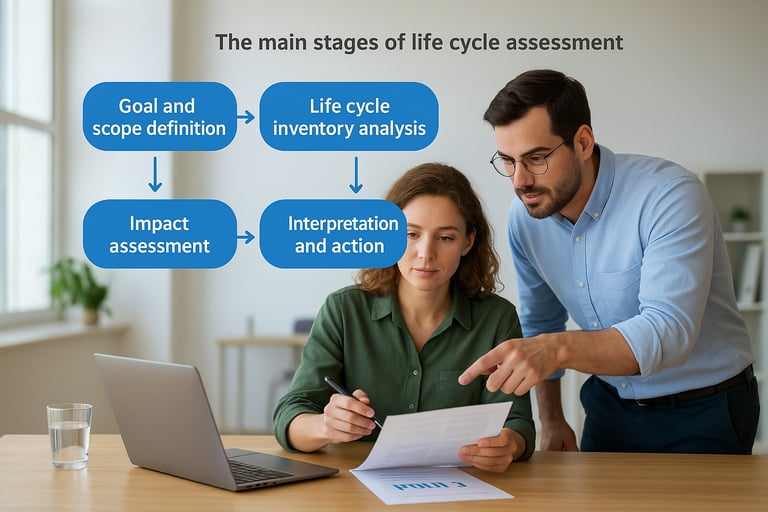
The main stages of life cycle assessment
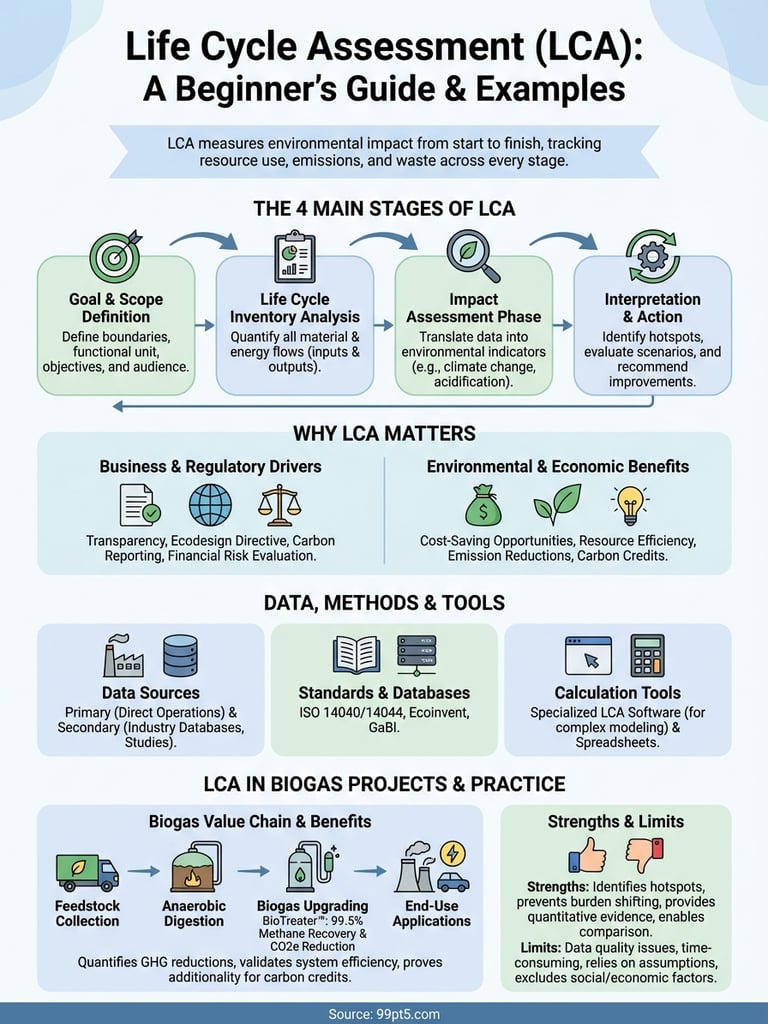
Every life cycle assessment follows four distinct phases that build on each other to deliver comprehensive results. These stages form an iterative framework where you refine your approach based on emerging insights rather than following a rigid linear path. The ISO 14040 and 14044 standards establish these phases as the international benchmark for credible environmental analysis. You move through goal definition, inventory compilation, impact evaluation, and interpretation, with each stage contributing essential information that shapes your final conclusions. Understanding what is life cycle assessment means recognizing how these interconnected phases work together to transform raw data into strategic environmental insights.
Goal and scope definition
You establish the analytical framework by documenting exactly what you intend to measure and why the assessment matters. This phase requires you to specify your functional unit, system boundaries, impact categories, and intended audience for the results. Stakeholder engagement during this stage prevents scope disagreements later and ensures your analysis addresses questions that matter to decision makers. You identify which life cycle stages fall within your boundaries and which processes you will treat as background activities. Your scope document clarifies assumptions about technology performance, geographical context, and temporal relevance. Biogas systems demand particularly careful boundary setting because they intersect with agriculture, waste management, and energy sectors that each bring distinct environmental considerations.
Life cycle inventory analysis
You quantify all material and energy flows entering and leaving your system boundaries during this data-intensive phase. Every input gets documented with amounts and sources, from feedstock quantities to electricity consumption and water use. Output streams including products, emissions to air and water, and waste materials all require measurement or estimation based on credible data sources. You track these flows through each unit process within your system, creating a detailed material and energy balance. Data collection sheets help you gather information from suppliers, utility records, and process monitoring systems. The inventory phase typically consumes more time than other stages because comprehensive data proves difficult to obtain. You document data quality, noting whether you used primary measurements from your operations or secondary averages from industry databases.
Impact assessment phase
You translate inventory data into environmental impact indicators that reveal actual consequences for ecosystems and human health. This phase applies scientific models that link emissions and resource use to specific damage categories like climate change, acidification, or resource depletion. Characterization models convert different substances into equivalent units, such as expressing all greenhouse gases as carbon dioxide equivalents. You calculate impact scores for each category you identified in your goal definition, showing where your system creates the largest environmental burden. Optional normalization and weighting steps help you compare different impact categories against regional averages or stakeholder priorities. The impact assessment transforms hundreds of inventory data points into a manageable set of indicators that support decision making.
Your impact assessment reveals which environmental concerns deserve immediate attention and investment.
Interpretation and action
You analyze results to identify significant hotspots where targeted improvements deliver the greatest environmental benefits. This phase requires you to check data quality, test sensitivity to key assumptions, and verify that your conclusions remain valid despite uncertainties. Comparative scenarios help you evaluate alternative materials, processes, or technologies against your baseline system. You document limitations that might affect how stakeholders should use your results. Recommendations emerge from this interpretation work, pointing to specific changes in design, procurement, or operations that reduce environmental impacts while supporting business objectives. Your interpretation phase closes the loop by answering the questions you posed during goal definition and suggesting next steps for continuous improvement.
Life cycle assessment examples in practice
You see life cycle assessment applied across diverse industries to solve environmental challenges and guide investment decisions. Manufacturing companies use it to compare materials and reduce product footprints. Energy producers apply it to evaluate renewable technologies. Construction firms rely on it to select building materials with lower lifecycle impacts. Understanding what is life cycle assessment becomes clearer when you examine these real-world applications that demonstrate how organizations translate methodology into measurable improvements.
Consumer products and packaging
You find extensive life cycle assessment work in the packaging industry, where companies compare different materials and formats. A beverage producer might assess glass bottles against aluminum cans and plastic containers, accounting for production energy, transportation weight, recyclability, and consumer behavior patterns. Results often show that lightweight packaging reduces transportation emissions more than switching to materials perceived as more sustainable. Electronics manufacturers use life cycle assessment to identify which components contribute most to carbon footprints, discovering that use-phase energy consumption often exceeds manufacturing impacts. This insight drives design changes toward energy efficiency rather than focusing solely on material selection. Clothing brands assess textile choices, revealing that cotton cultivation and fabric dyeing create significant water use and chemical pollution before garments reach consumers.
Agricultural and food systems
You apply life cycle assessment to food production to understand environmental tradeoffs between farming methods, processing approaches, and distribution networks. Dairy operations compare conventional and organic production systems, measuring differences in methane emissions, fertilizer use, land requirements, and energy inputs. Meat products typically show higher climate impacts than plant-based alternatives, but assessment reveals where specific improvements deliver the greatest benefits within each system. Food processors use life cycle assessment to evaluate packaging decisions alongside product shelf life, recognizing that reducing food waste sometimes matters more than eliminating packaging materials. Transportation mode choices affect fresh produce differently than shelf-stable goods, requiring analysis of refrigeration energy and spoilage rates.
Life cycle assessment reveals that environmental performance depends on context-specific factors that simple rules cannot capture.
Infrastructure and built environment
You see construction projects using life cycle assessment to select materials with lower embodied carbon and operational impacts. Concrete manufacturers compare traditional cement with alternatives that incorporate industrial byproducts or carbon-cured formulations. Results show that material choices made during design have decades-long consequences through building energy use and eventual demolition. Road builders assess asphalt versus concrete for durability, maintenance frequency, and end-of-life recycling potential. Renewable energy installations require life cycle assessment to prove they generate more energy than their production consumed and deliver net environmental benefits over conventional power sources.
Data, methods and tools for life cycle assessment
You need quality data and appropriate methods to produce life cycle assessment results that support reliable decisions. The accuracy of your findings depends directly on the information you collect and how you process it. Methodological choices shape which environmental impacts you can measure and how confident you can be in the results. Understanding what is life cycle assessment includes recognizing that the tools and data sources you select determine whether your analysis reveals actionable insights or misleading conclusions.
Primary versus secondary data sources
You obtain primary data directly from your operations through measurements, utility bills, supplier specifications, and process monitoring systems. This information reflects your actual performance rather than industry averages, giving you the most accurate picture of your specific environmental impacts. Data collection efforts require coordination across departments and partners who control different pieces of information. You document electricity consumption from energy bills, material quantities from purchasing records, transportation distances from logistics data, and emissions from stack monitoring or process calculations. Primary data collection takes significant time but delivers results that truly represent your system.
Secondary data fills gaps where primary information proves unavailable or too costly to obtain. You access this information through life cycle inventory databases that aggregate environmental data for thousands of materials, processes, and transportation modes. Industry associations, research institutions, and government agencies publish average values for common activities like electricity generation, steel production, or freight transport. These averages help complete your assessment when suppliers cannot provide specific data or when you need information about background processes outside your direct control. The tradeoff between data accuracy and practical feasibility requires you to balance completeness against available resources.
Methodology standards and databases
You follow ISO 14040 and 14044 standards to ensure your assessment meets internationally recognized quality benchmarks. These frameworks establish how to define system boundaries, classify environmental impacts, and document assumptions that affect your results. Database selection influences your findings because different sources use varying data quality, geographical coverage, and technology assumptions. Ecoinvent, GaBi, and other major databases provide background data for materials and energy, though you need to verify their relevance to your specific context. Quality indicators help you evaluate whether data comes from measured values, calculated estimates, or literature averages.
Calculation tools and software options
You perform calculations using specialized LCA software that handles complex modeling requirements and impact assessment methods. These platforms integrate inventory databases, apply characterization factors, and generate results across multiple environmental indicators. Spreadsheet approaches work for simple systems but become error-prone as your analysis grows more complex. Professional tools automate calculations and ensure methodological consistency, though they require investment in licenses and training.
Your tool selection should match your technical capabilities and the complexity of decisions your assessment needs to support.
Using life cycle assessment in biogas projects
You apply life cycle assessment to biogas systems to quantify environmental benefits and optimize operational performance across the complete value chain. Biogas projects convert organic waste into renewable energy while reducing methane emissions from decomposition, but understanding what is life cycle assessment helps you prove these benefits with verifiable data. Assessment scope typically includes feedstock collection, transportation, anaerobic digestion, biogas upgrading to biomethane, and end-use applications. You need this comprehensive view because environmental impacts concentrate in different stages depending on your specific system design, feedstock types, and local conditions.
System boundaries and key stages
You define boundaries that capture all significant activities from waste generation through energy delivery. Feedstock collection and preprocessing create transportation emissions and energy consumption that vary with distance and waste characteristics. Digester operations consume electricity and heat while generating biogas with varying methane content and contaminant levels. Gas upgrading processes remove hydrogen sulfide, moisture, and carbon dioxide to meet pipeline specifications or vehicle fuel standards. Your assessment accounts for digestate management because this byproduct either becomes fertilizer replacing synthetic alternatives or requires disposal that generates additional impacts. Equipment manufacturing contributes embodied carbon, though this typically spreads across decades of operation.
Quantifying environmental benefits
You measure greenhouse gas reductions by comparing biogas systems against baseline scenarios where organic waste decomposes in landfills or conventional energy sources meet the same demand. Methane capture alone delivers significant climate benefits because this gas has 25 times the warming potential of carbon dioxide over a century. System efficiency metrics matter because biogas upgrading equipment with 99.5% methane recovery captures more energy value and reduces fugitive emissions compared to systems losing 3-5% of product gas. You quantify avoided fertilizer production when digestate replaces synthetic nitrogen, potassium, and phosphorus. Carbon credit calculations depend on these life cycle assessment results to demonstrate additionality and permanence requirements that qualify your project for revenue from environmental markets.
Life cycle assessment transforms biogas projects from waste management solutions into quantified climate mitigation assets.
Strengths and limits of life cycle assessment
You gain systematic environmental insights that reveal the full impact of your decisions when you conduct a life cycle assessment properly. This methodology prevents burden shifting where you solve one environmental problem while creating another elsewhere in the value chain. Comprehensive scope distinguishes life cycle assessment from simpler analyses that examine only one stage or one impact category. The standardized approach enables you to compare different products, processes, or technologies on equal footing using consistent boundaries and methods. Understanding what is life cycle assessment requires recognizing both its capabilities and constraints to apply it effectively in your decision-making process.
Where life cycle assessment excels
You use life cycle assessment to identify improvement opportunities that deliver the greatest environmental benefits relative to implementation costs. The methodology provides quantitative evidence that supports sustainability claims and helps you avoid greenwashing accusations that undermine credibility. Regulatory compliance becomes straightforward when you possess verified life cycle data that meets government standards for environmental declarations. Procurement decisions improve because you compare suppliers based on actual impacts rather than marketing materials or certifications alone. Strategic planning benefits from understanding which investments reduce environmental burdens most efficiently across your operations and supply chain.
Life cycle assessment transforms environmental performance from qualitative aspirations into measurable targets you can manage and improve.
Recognized limitations and challenges
You face data quality issues that affect result reliability because supply chain information often remains incomplete or relies on industry averages rather than specific measurements. Assessment costs escalate quickly when you need primary data collection across multiple suppliers and geographical regions. Time requirements mean results may become outdated before you complete the study, particularly in fast-moving industries where technologies and processes change frequently. The methodology captures environmental impacts but excludes social and economic factors that influence real decisions. System boundary choices introduce subjectivity that affects which impacts you measure and which you ignore. Results depend heavily on assumptions about future conditions like energy grid composition, recycling rates, and technology performance over product lifespans you cannot predict with certainty.
Bringing it all together
You now understand what is life cycle assessment and how it reveals environmental impacts across every stage of a product or system. This methodology gives you quantifiable evidence to support better decisions about materials, processes, and technologies. Data collection and boundary setting determine whether your assessment delivers actionable insights or misleading conclusions. The four-stage framework provides structure while allowing flexibility to match your specific needs and objectives.
Biogas projects benefit particularly from life cycle assessment because it proves emission reductions and validates system efficiency improvements with credible data. The BioTreater™ system achieves 99.5% methane recovery and 99.5% CO2e emission reduction, performance metrics validated through comprehensive life cycle analysis. You gain competitive advantages and regulatory compliance when you understand the full environmental story behind your operations and can prove it to stakeholders.