What Is A Variable Speed Drive? How VSDs Work & Benefits
Learn what is a variable speed drive, how it works, and how VSDs cut energy costs by up to 50% while reducing mechanical wear on industrial motors.
Electric motors consume roughly half of all electricity used in industrial settings. Running them at full speed when partial output suffices wastes significant energy and shortens equipment life. Understanding what is a variable speed drive helps engineers and operators address this inefficiency directly.
At 99pt5, we design BioGas processing equipment where every percentage point of efficiency matters. Our BioTreater™ systems use motor-driven components, including rotary vane compressors, that benefit from precise speed control to minimize operating costs and maximize uptime for our clients.
This article covers how VSDs function, their practical benefits for industrial applications, and the technical differences between VSDs and VFDs. By the end, you'll have a clear understanding of why these devices matter for energy-intensive operations like BioMethane processing.
Why variable speed drives matter
Traditional motor systems run at fixed speeds regardless of actual load requirements. When your process needs only 60% capacity but your motor delivers 100%, you waste electricity, generate excess heat, and create unnecessary wear on components. VSDs solve this problem by matching motor output to real-time demand, delivering measurable savings across multiple operational areas.
Energy cost reduction
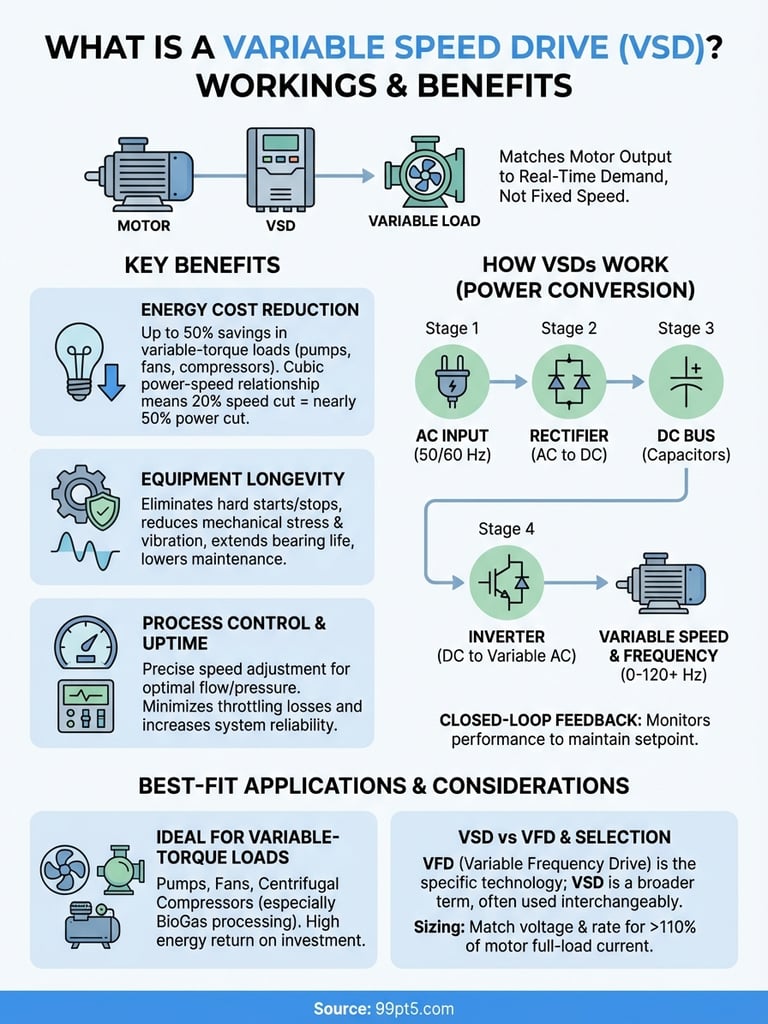
Energy expenses represent the largest ongoing cost for motor-driven equipment in industrial facilities. A motor running at 80% speed through VSD control uses approximately 50% less energy than the same motor running full speed with mechanical throttling or damper control. This reduction stems from the cubic relationship between speed and power consumption in centrifugal loads like pumps, fans, and compressors.
When you reduce motor speed by 20%, you typically cut power consumption by nearly 50% in variable-torque applications.
Consider a typical BioGas processing facility where compressors run continuously. Without speed control, operators must start and stop motors or use bypass valves to manage flow, both of which waste energy. Installing a VSD allows the motor to operate at optimal speed for current conditions, eliminating throttling losses and reducing electricity bills by 20-50% depending on load variation.
Equipment longevity and maintenance
Constant full-speed operation creates mechanical stress that accelerates bearing wear, increases vibration, and shortens component life. VSDs reduce these issues by eliminating hard starts and stops that generate damaging torque spikes. Your motors experience softer acceleration, lower operating temperatures, and reduced mechanical strain.
Maintenance intervals extend significantly when equipment runs at appropriate speeds rather than maximum capacity. You'll replace bearings less frequently, experience fewer seal failures, and reduce unplanned downtime. For applications like our BioTreater™ systems where reliability directly impacts profitability, this translates to higher uptime and lower total cost of ownership across the equipment's lifespan.
How a variable speed drive works
Understanding what is a variable speed drive requires looking at the power conversion process inside the unit. VSDs control motor speed by adjusting the electrical power frequency supplied to the motor. Standard grid electricity delivers a fixed frequency (50 Hz in Ireland, 60 Hz in the US), which determines motor speed at a constant value. The drive converts this fixed-frequency AC power into variable-frequency AC power, allowing precise speed adjustment from zero to maximum rated speed based on your process requirements.
Power conversion stages
Your VSD first converts incoming alternating current (AC) into direct current (DC) through a rectifier stage. This DC power passes through a DC bus, which smooths voltage ripples and stores energy temporarily in capacitors. An inverter stage then converts the DC back into AC power at whatever frequency your application needs, typically ranging from 0 to 120 Hz depending on motor design and operational requirements.
The inverter stage creates variable-frequency output by rapidly switching power transistors on and off thousands of times per second.
Control feedback loop
The drive monitors motor performance continuously through current sensors and optional speed feedback devices mounted on the motor shaft. You set your desired speed through a control interface (touchscreen, keypad, or external signal), and the drive automatically adjusts output frequency and voltage to maintain that setpoint precisely. This closed-loop control compensates for load changes in real time, maintaining consistent speed even when process conditions vary throughout your operating cycle. Modern VSDs include built-in protection features that prevent motor damage from overload conditions, overheating, or electrical faults.
VSD vs VFD and other drive types
You'll encounter multiple terms when researching motor speed control equipment, with VSD (Variable Speed Drive) and VFD (Variable Frequency Drive) creating the most confusion. These terms describe essentially the same technology, though subtle distinctions exist in how manufacturers and industries use them. Understanding what is a variable speed drive requires clarifying this terminology before you specify equipment for your application.
VSD and VFD terminology
VFD specifically describes drives that control motor speed by varying electrical frequency, which represents the core operating principle we covered earlier. VSD serves as a broader umbrella term encompassing any device that adjusts motor speed, including VFDs, DC drives, and other technologies. In practical terms, manufacturers use these labels interchangeably for AC motor controllers, so you'll see identical equipment marketed under both names depending on regional preferences or company conventions.
Most modern AC motor controllers sold as either VSDs or VFDs use identical frequency-conversion technology internally.
Other drive alternatives
Soft starters provide a limited alternative that reduces inrush current during motor startup but cannot adjust running speed. These devices cost less than full VSDs but offer no operational energy savings after acceleration completes. Servo drives deliver ultra-precise positioning control for robotic applications, though they carry higher costs and complexity than standard VSDs. DC drives control older direct-current motors still found in legacy installations, using armature voltage variation rather than frequency control, but you'll rarely specify these for new industrial projects given AC motor advantages in reliability and maintenance requirements.
Benefits and best-fit applications
Understanding what is a variable speed drive becomes most valuable when you match the technology to appropriate applications. VSDs deliver maximum benefit in systems where load varies throughout operation, particularly equipment that follows the affinity laws governing centrifugal machinery. You'll see the best returns in environments where process demands change frequently and where energy costs represent a significant portion of operating expenses.
Variable-torque applications
Pumps, fans, and centrifugal compressors represent ideal candidates for VSD installation because their power requirements decrease dramatically with speed reduction. A cooling tower fan that needs only 70% airflow during mild weather requires just 34% of full power when controlled by a VSD. Your payback period typically ranges from 12 to 24 months in these applications, making the investment straightforward to justify.
Variable-torque loads deliver the most dramatic energy savings because power consumption follows the cube of speed change.
BioGas processing facilities benefit particularly from VSDs on rotary vane compressors and circulation pumps that adjust output based on digester production rates. You maintain optimal system pressure without throttling losses or bypass waste, directly improving your carbon credit calculations through reduced auxiliary power consumption.
Constant-torque considerations
Conveyors, extruders, and positive displacement pumps require similar torque regardless of speed, limiting energy savings compared to variable-torque loads. VSDs still provide value through soft starting, controlled acceleration, and process flexibility, though your payback period extends to 3-5 years. Applications requiring frequent speed changes or precise process control justify VSD installation even when energy savings remain modest.
How to select and apply a VSD
Selecting the right VSD requires matching drive capabilities to your specific motor and application requirements. You need to consider motor type, voltage, current rating, and the mechanical load characteristics that determine torque demands throughout your operating range. Getting these specifications correct ensures reliable operation and prevents equipment damage or performance issues.
Motor compatibility and sizing
Your VSD must match both the motor voltage (208V, 480V, or other standard) and provide adequate current capacity for the motor's full-load amperage rating. Check the motor nameplate data carefully, then select a drive rated for at least 110% of motor full-load current to accommodate starting conditions and brief overloads. Standard VFDs work with most three-phase AC induction motors, though specialized motor designs (permanent magnet, high-efficiency IE4) may require specific drive features or parameter settings.
Size your VSD for at least 110% of motor full-load current to handle transient conditions safely.
Environmental and installation factors
Ambient temperature directly impacts drive performance and lifespan. Manufacturers rate VSDs for specific temperature ranges, typically 0 to 40°C for standard units, with derating required above those limits. Your installation location needs adequate ventilation or cooling to prevent overheating, particularly in enclosed control panels where heat accumulates. Dust, humidity, and corrosive atmospheres require protective enclosures rated to appropriate NEMA or IP standards. Understanding what is a variable speed drive includes recognizing that proper environmental protection prevents premature failures and maintains warranty coverage throughout your equipment's operational life.
Key takeaways
Understanding what is a variable speed drive gives you practical control over motor efficiency and operational costs in industrial applications. VSDs reduce energy consumption by 20-50% in variable-torque equipment like pumps, fans, and compressors by matching motor speed to actual demand rather than running at constant full capacity. You'll extend equipment lifespan through soft starting, reduced mechanical stress, and lower operating temperatures.
Your best VSD candidates include any application with varying load requirements, particularly centrifugal equipment where power consumption follows the cube of speed change. Proper selection requires matching drive specifications to motor voltage, current rating, and environmental conditions to ensure reliable long-term performance.
At 99pt5, we apply these principles directly to BioGas processing systems where energy efficiency translates into higher profitability for operators. Our BioTreater™ systems incorporate motor-driven components designed for optimal speed control. Learn how our BioMethane processing equipment delivers guaranteed 99.5% efficiency while minimizing operating expenses through precise motor control and integrated automation.