What Is Advanced Process Control (APC)? Methods & Benefits
Learn what is advanced process control and how it optimizes industrial performance. Explore MPC methods, implementation steps, and ways to maximize plant ROI.
Industrial processes generate massive amounts of data every second. The difference between average and exceptional operational performance often comes down to how that data gets used. What is advanced process control? It's the technology that transforms raw process data into real-time optimization decisions, pushing equipment closer to ideal operating conditions while maintaining safety margins.
For BioGas processing operations, where efficiency directly impacts profitability and environmental outcomes, APC represents a significant advantage. At 99pt5 Ltd, we integrate advanced control strategies into our BioTreater™ systems to achieve guaranteed 99.5% BioMethane recovery and precise contaminant removal. Our fully automated solutions demonstrate what's possible when sophisticated process control meets robust equipment design.
This article breaks down the core methods behind APC, explains how it differs from basic regulatory control, and outlines the tangible benefits for industrial and manufacturing environments. You'll come away with a clear understanding of how these systems work and where they deliver the most value.
Why advanced process control matters
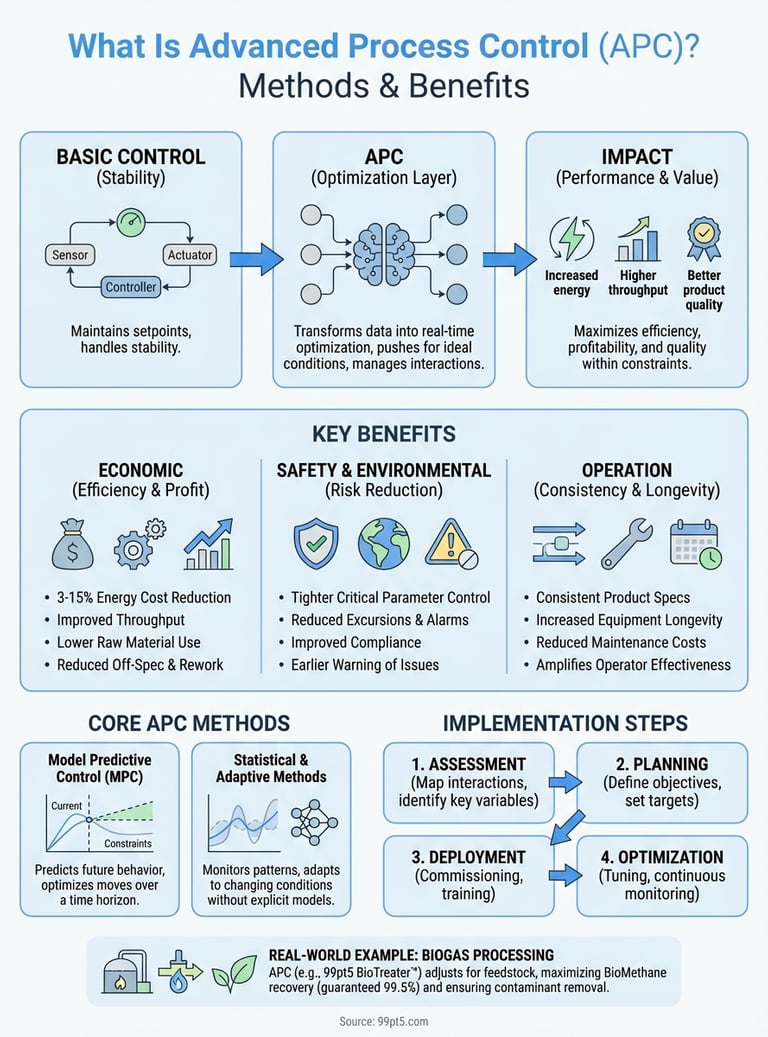
Your plant runs 24/7, and every percentage point of efficiency translates directly into profitability. Basic control systems keep processes stable, but advanced process control pushes operations toward optimal performance zones that standard PID controllers cannot reach. The difference shows up in your energy consumption, raw material utilization, and product quality. When you implement APC, you're not just maintaining setpoints; you're actively maximizing economic value from every process variable. Understanding what is advanced process control means recognizing it as the bridge between adequate operation and exceptional performance.
Economic impact on operations
Production facilities using APC typically see 3-15% reductions in energy costs and similar improvements in throughput. These systems handle complex interactions between multiple process variables simultaneously, identifying optimization opportunities that human operators miss during normal operations. Your operating expenses drop because the control system makes thousands of micro-adjustments per shift, each one calculated to move closer to ideal conditions. For BioGas processing, this translates to higher BioMethane recovery rates and lower utility consumption across the entire treatment train.
Revenue generation increases when APC maintains product specifications more consistently. You reduce off-spec material and rework costs while pushing production rates higher within equipment constraints. The payback period for APC implementation often falls between 6-18 months, depending on process complexity and current control performance.
Advanced process control doesn't replace skilled operators; it amplifies their effectiveness by handling routine optimization tasks automatically.
Safety and environmental benefits
APC systems maintain tighter control over critical process parameters, reducing the likelihood of excursions that trigger safety systems or environmental violations. You get earlier warning of developing problems because these controllers monitor dozens of variables simultaneously and detect subtle patterns that indicate process drift. Your compliance record improves as the system keeps emissions within permitted ranges more consistently than manual control. In applications where precise contaminant removal matters, such as removing H2S or controlling O2 levels in BioMethane, APC ensures specifications get met reliably shift after shift without constant operator intervention. Equipment longevity also improves when process conditions stay within optimal ranges, reducing maintenance costs and unexpected downtime.
How to implement APC in an industrial process
Implementation follows a structured path that starts with detailed process assessment and ends with continuous optimization. You need to evaluate your current control performance, identify the variables that most impact profitability, and determine where traditional regulatory control falls short. This groundwork shapes every subsequent decision about controller design and deployment strategy. Understanding what is advanced process control means recognizing that successful implementation depends more on thorough preparation than on sophisticated algorithms.
Assessment and planning phase
Your first step involves mapping process interactions and identifying which variables drive economic performance. You collect historical data spanning multiple operating conditions to understand normal process behavior and constraint patterns. This analysis reveals where control improvements deliver the highest returns, whether that's reducing energy consumption, increasing throughput, or tightening product quality. Process engineers work with operations teams to define control objectives and establish measurable performance targets before any code gets written.
The most successful APC projects focus on 3-5 key performance indicators rather than trying to optimize everything simultaneously.
Deployment and optimization
After commissioning your controllers, you enter a tuning period lasting several weeks where the system learns optimal responses under various conditions. Operators receive training on how the APC layer interacts with existing regulatory control and when manual intervention makes sense. You monitor performance metrics against baseline conditions and adjust controller parameters as the system proves its capability to handle normal disturbances and setpoint changes without degrading product quality or triggering alarms.
Core APC methods and technologies
Several distinct approaches power modern APC implementations, each suited to different process characteristics and control objectives. Model predictive control (MPC) dominates industrial applications, but statistical process control (SPC) and adaptive techniques also deliver value in specific scenarios. Your choice depends on process dynamics, available data quality, and the complexity of interactions you need to manage. What is advanced process control without understanding these foundational technologies? It's simply a collection of algorithms without context for when and why each method performs best.
Model predictive control
MPC remains the most widely deployed APC technology because it handles multiple variables simultaneously while respecting equipment constraints. The controller builds a mathematical model of your process, then uses that model to predict future behavior over a time horizon spanning minutes to hours. You define control objectives and operational limits, and the optimizer calculates moves that achieve targets without violating constraints. This approach works particularly well for processes with slow dynamics and significant variable interactions, like distillation columns or chemical reactors.
MPC controllers make 10-20 calculation cycles per minute, continuously adjusting for changing conditions and disturbances.
Statistical and adaptive methods
Statistical process control monitors process variability patterns and identifies deviations from normal operation before they impact product quality. Neural networks and machine learning approaches adapt to changing process conditions without explicit mathematical models, learning optimal responses from historical data. You deploy these methods where first-principles modeling proves difficult or where process characteristics shift over time due to catalyst aging, feedstock variations, or equipment wear.
Where APC fits in the control stack
Industrial automation operates in distinct layers, with APC positioned between regulatory control and enterprise planning systems. You have basic PID controllers handling immediate process responses at the bottom, APC optimizing operations in the middle, and business systems managing scheduling and logistics at the top. This hierarchy ensures each layer focuses on the appropriate time scale and decision complexity. Understanding what is advanced process control requires seeing how it coordinates with other automation layers to deliver integrated process management.
Layer hierarchy and integration
Your APC layer receives setpoints from planning systems and sends optimized targets down to regulatory controllers every few seconds or minutes. The system sits above the distributed control system (DCS) or programmable logic controllers (PLCs) that handle millisecond-level device control, taking responsibility for slower dynamics and economic optimization. You get separation of concerns, where fast controllers maintain stability while APC pursues performance targets. This architecture prevents conflicts between control objectives and allows operators to override either layer independently during abnormal situations without disrupting the entire automation strategy.
Communication and data flow
Data flows continuously between layers through standard industrial protocols like OPC or proprietary DCS interfaces. Your APC system pulls process measurements, equipment status, and constraint information from field devices while pushing back calculated setpoints and operating targets. The bidirectional communication happens in real time, with typical update cycles ranging from one second to several minutes depending on process dynamics. This integration allows APC to respond quickly when conditions change while maintaining coordination with both regulatory control below and scheduling systems above.
Proper integration between control layers eliminates the manual calculations and adjustments that consume operator time during normal production.
Real-world APC applications and examples
Industrial facilities across multiple sectors deploy APC to tackle specific operational challenges that basic control cannot resolve. You see these systems managing complex unit operations where multiple variables interact and small improvements compound into significant financial gains. The applications range from continuous chemical processes to batch operations in food production, with each implementation tailored to process-specific objectives. What is advanced process control in practice? It's the technology handling distillation columns in refineries, controlling reactor temperatures in pharmaceuticals, and optimizing BioGas upgrading systems where precision determines both product quality and environmental compliance.
BioGas and renewable energy processing
BioGas upgrading facilities use APC to maintain precise control over contaminant removal while maximizing BioMethane recovery rates. Your system manages multiple purification stages simultaneously, adjusting temperatures, pressures, and flow rates to respond to varying feedstock composition. The 99pt5 BioTreater™ system integrates these control strategies to guarantee 99.5% BioMethane recovery across different operating conditions, with automated responses to H2S levels, moisture content, and CO2 concentration changes that would overwhelm manual control approaches.
APC in BioGas applications typically delivers 2-5% improvements in methane recovery compared to conventional control strategies.
Chemical and refining operations
Refineries deploy APC across distillation towers, hydrotreaters, and catalytic crackers to optimize yields and energy consumption. You find these controllers managing product quality specifications while pushing equipment closer to constraint boundaries, extracting maximum value from crude feedstocks. Chemical plants use similar strategies for reactor temperature control and separation processes, where precise management of exothermic reactions and heat integration opportunities drives profitability improvements measured in millions annually.
Wrap-up and next steps
Advanced process control transforms how industrial facilities operate by converting process data into continuous optimization decisions that maximize efficiency, quality, and profitability. You now understand what is advanced process control means in practical terms: it's the technology layer that pushes operations beyond basic stability toward economic performance targets while respecting safety and environmental constraints. The methods range from model predictive control to adaptive techniques, each suited to different process characteristics and control objectives.
Your next step involves evaluating where APC delivers the highest returns in your specific operations. Identify processes where small efficiency improvements compound into significant cost savings or where tight specification control impacts product revenue. For BioGas processing operations seeking guaranteed performance with minimal operating expenses, 99pt5 BioTreater™ systems integrate advanced control strategies from day one, delivering 99.5% BioMethane recovery with fully automated operation. The combination of sophisticated control technology and rugged equipment design eliminates the complexity typically associated with APC implementation.