What Is Calorific Value? Definition, Formula, and Types
Learn what is calorific value and how it impacts project economics. Master the formulas, compare gross vs net types, and optimize your energy output.
Calorific value measures the amount of energy released when you burn a specific quantity of fuel. Think of it as the energy density of your gas. When you're processing biogas into biomethane, understanding what is calorific value helps you calculate exactly how much usable energy you're producing and what that energy is worth. This metric determines everything from your utility billing rates to your project's revenue forecasts. Higher calorific value means more energy per cubic meter, which translates directly to better economics for your operation.
This article breaks down the science behind calorific value and shows you how it impacts your biomethane projects. You'll learn the difference between gross and net calorific values, discover benchmark values for common fuels, and understand the factors that reduce biogas energy content. We'll also cover accurate measurement methods and show you how to convert gas volumes into electrical energy output. By the end, you'll know exactly how calorific value affects your project economics and why precise measurement matters for maximizing returns.
Why calorific value dictates project economics
Your project's financial success hinges on energy output, not just gas volume. When you sell biomethane to the grid or use it to generate electricity, buyers pay for energy delivered, measured in kilowatt-hours or megawatt-hours. A biogas stream with higher calorific value generates more revenue from the same cubic meters of gas. This fundamental relationship between energy density and income determines whether your facility operates profitably or struggles to cover operational costs. Understanding what is calorific value means understanding the difference between breaking even and achieving strong returns on your investment.
Revenue calculations depend on energy content
Your income from biomethane sales connects directly to calorific value measurements. Grid injection contracts typically specify payment in dollars per megawatt-hour, which means you multiply your gas volume by its energy content to calculate revenue. If your biomethane stream delivers 38 MJ/m³ instead of 40 MJ/m³, you're collecting 5% less revenue from the same gas volume. This gap compounds over months and years, creating substantial revenue differences across your project's lifetime.
Payment structures in power purchase agreements follow the same energy-based logic. When you feed biomethane into a generator, the electricity output depends on how much energy each cubic meter contains. Lower calorific values force you to process more gas to hit the same megawatt-hour targets, increasing your compression costs, maintenance intervals, and wear on equipment.
Every MJ/m³ difference in calorific value translates to real dollars in your annual operating statement.
Utility contracts price energy, not volume
Grid operators and utility companies structure their tariff schedules around energy delivery, not raw gas volumes. You'll encounter pricing formulas that convert your meter readings to energy units using a calculated calorific value. These conversion factors get updated periodically based on actual gas quality measurements. If your biomethane consistently delivers lower calorific values than the baseline used in your contract, you face automatic payment reductions that directly impact your bottom line.
Interruptible supply contracts often include minimum energy content clauses. When your gas falls below specified calorific thresholds, utilities can reject the supply or apply financial penalties. This happens because blending low-energy gas into their network disrupts the overall energy balance and creates operational headaches for downstream customers who expect consistent fuel quality.
Equipment sizing affects capital costs
Your processing equipment capacity needs to match both volume and energy targets. When you're designing a biomethane facility, you size compressors, upgrading units, and pipeline connections based on the energy throughput you need to achieve. Lower calorific value biogas means you need larger equipment to process more volume and hit your energy production goals. This drives up capital expenditure before you process your first cubic meter.
Return on investment calculations multiply these effects. If you underestimate your raw biogas calorific value during planning, you'll discover your facility can't generate the projected energy output without costly modifications. Projects designed around optimistic calorific assumptions often face budget overruns when reality delivers gas with 10-15% lower energy content than forecasts predicted.
Operations teams also struggle with efficiency losses when actual calorific values diverge from design specifications. Your upgrading system might achieve 99.5% methane recovery at design conditions but drop to 97% when processing gas with different energy characteristics. These percentage point differences accumulate into substantial economic impacts across years of operation, affecting everything from carbon credit calculations to maintenance budgets.
How to determine calorific value accurately
Measuring calorific value requires specialized equipment and standardized testing procedures to ensure your results match what utilities and regulators accept. You can't simply estimate energy content from visual inspection or basic gas analysis. Accurate measurement protects your revenue streams and keeps you compliant with contractual obligations that specify minimum energy thresholds. Three primary methods deliver the precision you need: laboratory combustion testing, continuous gas chromatography, and calculated values from composition analysis.
Laboratory testing with bomb calorimeters
Bomb calorimeters provide the most direct measurement of calorific value through controlled combustion. You place a measured gas sample in a sealed steel chamber surrounded by water, then ignite it and measure the temperature rise. This method captures the total heat release from complete combustion under precisely controlled conditions. Testing labs use this approach to establish baseline values and verify the accuracy of field instruments.
Laboratory bomb calorimetry delivers reference-grade accuracy that regulatory bodies accept without question.
The process takes 15 to 30 minutes per sample and costs between $150 and $300 per test. While you won't run bomb calorimeter tests on every batch of biomethane, periodic laboratory analysis validates your continuous monitoring systems and satisfies audit requirements when customers or regulators question your reported energy values.
Continuous gas chromatography
Gas chromatographs installed directly in your process stream measure calorific value in real time by separating and quantifying each gas component. These instruments analyze methane, carbon dioxide, nitrogen, oxygen, and trace compounds every 3 to 5 minutes, then calculate energy content using established heating values for each component. Modern chromatographs achieve accuracy within ±0.5% of laboratory results when properly calibrated and maintained.
Installation costs range from $50,000 to $150,000 for industrial-grade systems, but continuous monitoring pays for itself by maximizing your revenue. You catch composition swings immediately and adjust your upgrading process before low-quality gas reaches the sales meter. Grid injection facilities typically require this level of real-time analysis to maintain compliance with quality specifications that govern pipeline access.
Calculation from composition data
You can calculate calorific value when you know your gas composition using standard reference values for each component. Pure methane delivers 35.8 MJ/m³, while carbon dioxide contributes zero energy. Multiply each component's concentration by its individual calorific value, then sum the results to get your mixture's total energy content. Understanding what is calorific value through this calculation method helps you predict how composition changes affect energy output.
This approach works well for initial feasibility studies and process optimization, though utilities rarely accept calculated values for billing purposes without periodic verification through direct measurement.
Gross calorific value versus net calorific value
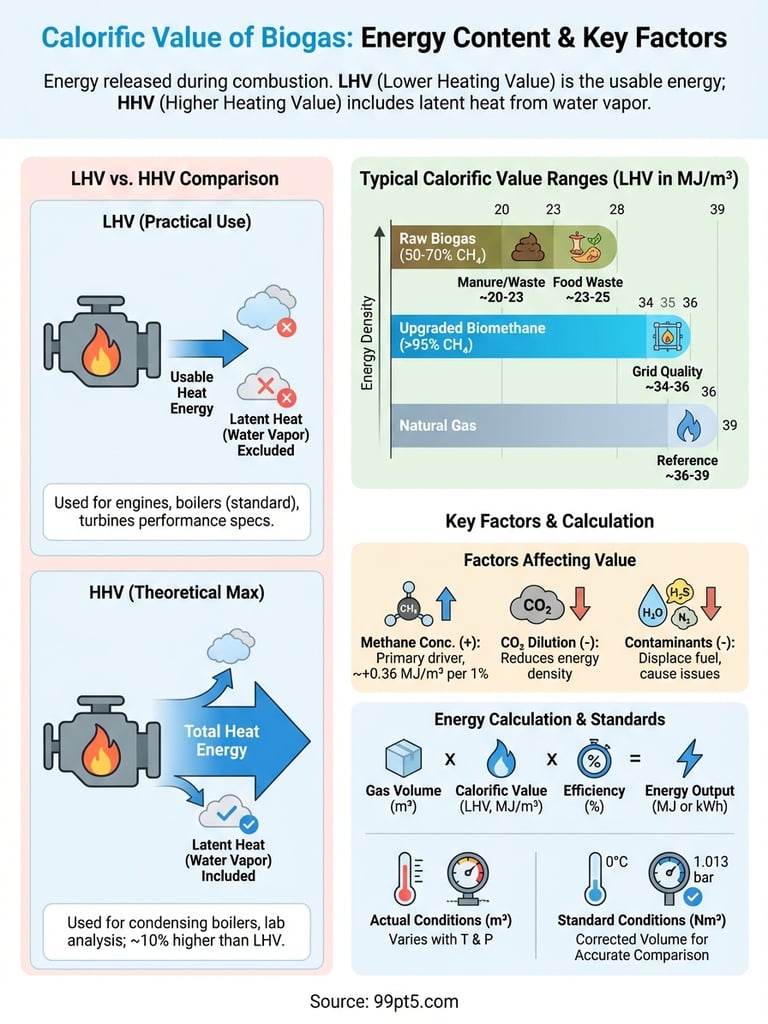
The difference between gross and net calorific value centers on water vapor treatment during combustion. Gross calorific value (also called higher heating value) assumes you capture and use all the heat released when water vapor condenses back to liquid. Net calorific value (lower heating value) accounts for the reality that combustion products leave as hot steam, taking latent heat with them. This distinction affects how you calculate energy output and what numbers appear on your utility bills.
What condensation means for your revenue
Water forms during combustion when hydrogen atoms in methane combine with oxygen. Each cubic meter of biomethane produces roughly 2 cubic meters of water vapor. When this steam condenses, it releases about 10% of the total combustion energy as latent heat. Your gross calorific value captures this condensation energy, while your net value excludes it because most combustion equipment vents steam rather than condensing it.
Biomethane with a gross calorific value of 39.8 MJ/m³ typically shows a net value of 35.9 MJ/m³. This 3.9 MJ/m³ gap represents the energy locked in departing water vapor. Grid operators in North America generally use gross values for billing, while European utilities prefer net values. Understanding what is calorific value in both forms prevents confusion when you compare project economics across different markets or review international equipment specifications.
Your contract terms specify which measurement basis determines payment, making this distinction critical for accurate revenue forecasting.
When to use each measurement type
You apply gross calorific values when analyzing condensing boilers, absorption chillers, or any equipment designed to recover latent heat from flue gases. These systems capture the condensation energy, so gross values reflect your actual energy delivery. Natural gas grid injection typically uses gross measurement because custody transfer standards in most regions mandate this approach for consistency across all suppliers.
Net calorific values make sense for conventional generators, industrial burners, and vehicle engines that exhaust hot gases without condensation. These applications can't access the latent heat, so net values give you realistic efficiency calculations. Power generation projects calculate thermal efficiency using net values to avoid overstating equipment performance with energy your system never captures.
Calorific value benchmarks for common fuels
Comparing energy content across different fuels helps you understand where biomethane fits in the global energy landscape. These benchmarks also give you reference points for evaluating your upgrading system's performance and explaining your product's value to potential customers. Natural gas utilities worldwide maintain strict quality standards based on minimum calorific values, and knowing these targets helps you design your processing system to meet market requirements consistently.
Natural gas and biomethane standards
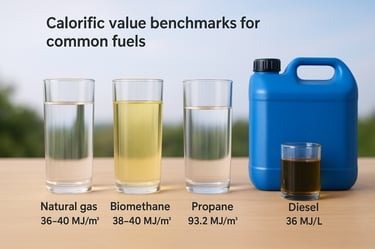
Pipeline-quality natural gas in North America typically delivers 36 to 40 MJ/m³ (gross calorific value), with most utilities specifying a minimum of 36.0 MJ/m³. European grids generally require 39.5 to 46 MJ/m³ depending on the country and specific network. Your biomethane needs to match these ranges to qualify for grid injection, which is why understanding what is calorific value matters when you're planning upgrading equipment specifications.
Pure methane provides 39.8 MJ/m³ under standard conditions (15°C, 1 atmosphere). This represents the theoretical maximum for biomethane after complete upgrading. Your actual product typically delivers 38 to 40 MJ/m³ because traces of carbon dioxide, nitrogen, and other inerts remain even after processing. Systems that achieve 99.5% methane recovery produce biomethane very close to this upper limit, maximizing the energy value per cubic meter you sell.
Grid specifications typically allow 2-4% inerts in biomethane, creating a practical calorific value range rather than a single target number.
Comparison with liquid fuels
Diesel fuel contains approximately 36 MJ per liter, which equals about 42,800 MJ/m³ when you account for its density. Gasoline delivers roughly 32 MJ/L or 34,200 MJ/m³. These liquid fuels pack far more energy into each cubic meter than gaseous biomethane, but comparing them directly by volume misleads because transport applications measure fuel efficiency differently for liquids versus compressed gases.
Propane sits between natural gas and liquid fuels at 93.2 MJ/m³ in gaseous form. When you compress biomethane to 250 bar for vehicle use, you increase its energy density but still fall short of propane's volumetric advantage. This explains why compressed natural gas vehicles need larger fuel tanks than diesel equivalents to achieve comparable driving range, despite biomethane's lower carbon footprint and renewable characteristics.
Hydrogen delivers only 12.1 MJ/m³ at standard conditions, making it the lowest-density common gaseous fuel despite its high mass-specific energy content. Coal ranges from 24 to 35 MJ/kg depending on type and moisture content.
Factors that reduce biogas energy content
Raw biogas from your anaerobic digester rarely matches the energy density of pipeline-grade biomethane because multiple components dilute the methane concentration. Every percentage point of non-combustible gas in your feedstock directly reduces the calorific value and cuts into your revenue potential. Identifying these dilution factors helps you optimize your upgrading process and understand why your raw biogas might deliver only 20 to 25 MJ/m³ compared to biomethane's 38 to 40 MJ/m³. Knowing what is calorific value means recognizing how these contaminants affect the energy equation before you invest in processing equipment.
Carbon dioxide dilution
Carbon dioxide concentrations in raw biogas typically range from 25% to 45% depending on your feedstock composition and digester operating conditions. This CO2 contributes zero energy value while occupying valuable volume in your gas stream. When your biogas contains 40% carbon dioxide, you're left with only 60% methane at most, which translates to roughly 23.9 MJ/m³ compared to pure methane's 39.8 MJ/m³. Each percentage point of CO2 you remove during upgrading adds approximately 0.4 MJ/m³ to your final product's energy content.
Digesters processing high-protein feedstocks produce more CO2 than those running on pure carbohydrates. Manure-based systems often generate biogas with 35% to 40% carbon dioxide, while food waste digesters can reach 45% or higher. Your raw material selection directly impacts how much upgrading capacity you need to achieve target calorific values for grid injection or power generation applications.
Nitrogen and oxygen infiltration
Air leaks into your digester or gas handling system introduce nitrogen and oxygen that permanently reduce energy content. Nitrogen acts as an inert diluent similar to CO2 but proves harder to remove with conventional upgrading technologies. Even 3% to 5% nitrogen contamination cuts your achievable calorific value and may disqualify your biomethane from grid injection if utilities enforce strict inert gas limits below 5% total.
Oxygen creates immediate safety concerns beyond energy dilution. Concentrations above 2% oxygen form explosive mixtures with methane, forcing you to vent gas for safety rather than processing it for revenue. Preventing air infiltration through proper seal maintenance and pressure control protects both your energy output and operational safety.
Eliminating air leaks delivers immediate returns by preserving methane concentration and maintaining safe operating conditions throughout your facility.
Water vapor saturation
Your biogas exits the digester saturated with water vapor, typically 5% to 7% by volume at digester temperatures. This moisture occupies space without contributing energy, reducing your effective methane concentration before you begin upgrading. Removing water through cooling and condensation early in your process train prevents corrosion and improves the accuracy of downstream flow measurements while recovering usable gas volume for energy production.
Converting gas volume to electrical energy
Translating your biomethane flow measurements into electrical output predictions requires you to account for both energy density and generator efficiency. Your volumetric flow meters tell you how many cubic meters of gas you're processing, but customers and grid operators care about kilowatt-hours delivered. This conversion determines your facility's power generation capacity and helps you size engines, turbines, or fuel cells to meet production targets. Understanding what is calorific value becomes critical here because the calculation multiplies your gas volume by energy content, then applies equipment-specific efficiency factors to project actual electrical output.
Energy conversion calculation method
You start with your measured gas flow rate in cubic meters per hour, multiply by calorific value in MJ/m³, then convert to kilowatt-hours using the standard factor of 3.6 MJ per kWh. A biomethane stream flowing at 300 m³/hour with a calorific value of 39 MJ/m³ delivers 11,700 MJ/hour of thermal energy, which equals 3,250 kWh of heat input. This represents the maximum theoretical energy available before any conversion losses.
Power generation equipment then converts this thermal input into electricity at manufacturer-specified efficiency rates. A typical gas engine operates at 38% to 42% electrical efficiency, meaning your 3,250 kWh thermal input produces roughly 1,235 to 1,365 kWh of electricity per hour. Combined heat and power systems capture exhaust heat to push total efficiency above 85%, but your electrical output calculation still depends on the engine's electrical conversion rate alone.
Your revenue forecasts must account for both calorific value variations and generator efficiency to avoid overestimating income from electrical sales.
Generator efficiency factors
Engine load percentage dramatically affects conversion efficiency across your operating range. Running your generator at 50% capacity reduces electrical efficiency by 5 to 8 percentage points compared to full-load operation. This matters when your biogas production fluctuates seasonally or your digester experiences feed rate variations that change gas output. Sizing your generator to match average production rather than peak capacity maintains higher efficiency most hours of the year.
Maintenance condition and ambient temperature also influence how effectively your equipment converts chemical energy to electricity. Worn spark plugs, dirty air filters, or fouled heat exchangers reduce conversion efficiency by 2% to 4%. Hot weather above 30°C cuts output by roughly 1% per 5°C temperature increase because air density decreases, reducing combustion efficiency and cooling system performance. Regular servicing protects your conversion rates and ensures your facility delivers the electrical output your financial models assume.
Summary of calorific value
Understanding what is calorific value transforms how you approach biomethane project economics. Your revenue depends on energy delivered, not just gas volume, making accurate measurement and optimization critical for financial success. The difference between gross and net values affects billing calculations, while factors like CO2 dilution and air infiltration directly reduce your energy content and income potential. Every MJ/m³ improvement in your biomethane quality translates to higher returns across your facility's operating life.
Achieving consistent 99.5% methane recovery maximizes your calorific value and protects your bottom line. When you're ready to guarantee both energy output and emission reductions for your biomethane project, 99pt5's BioTreater™ system delivers the industry's lowest operating expenses with proven performance you can measure and bank on. Your next step is securing equipment that turns theoretical energy potential into verified revenue generation.