What Is CE Marking? Meaning, Requirements, And Who Needs It
Learn what is CE marking, who needs it, and how to comply. Our guide explains the requirements and steps to ensure your equipment meets EEA safety standards.
If you're sourcing or installing BioGas processing equipment anywhere in the European Economic Area, you've likely encountered the CE marking on product labels and documentation. But what is CE marking, exactly? It's not a quality seal or a certification of origin, it's a mandatory conformity marking that indicates a product meets EU health, safety, and environmental protection standards.
For companies integrating BioMethane systems into farms, industrial facilities, or municipal operations, understanding CE marking requirements isn't optional. The equipment you specify, from gas boosters to pressure vessels, must carry this marking to be legally placed on the EU market. Non-compliant products can result in project delays, legal liability, and costly equipment replacements.
At 99pt5, we design and manufacture our BioTreater™ systems to meet stringent petroleum industry standards, including API, ASME, CSA, and EPA requirements. CE marking compliance is built into our engineering process from the start, ensuring that when you integrate our equipment into your projects, you're working with components that satisfy European regulatory demands without additional certification hurdles.
This article explains what CE marking means, which product categories require it, and how the conformity assessment process works. Whether you're evaluating equipment suppliers or preparing documentation for end-clients, you'll find the practical information you need to navigate CE marking requirements with confidence.
What CE marking is and what it is not
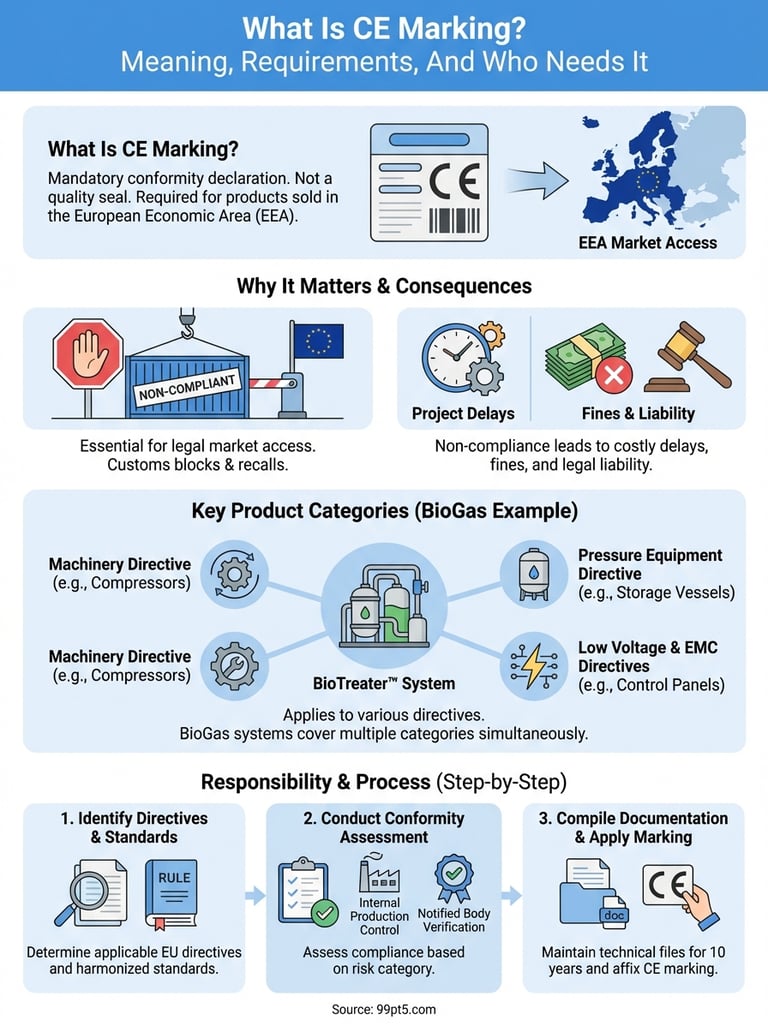
CE marking is a mandatory conformity declaration that manufacturers place on products before selling them in the European Economic Area. The letters "CE" stand for "Conformité Européenne" (European Conformity), and this marking indicates that a product meets all applicable EU directives and regulations for safety, health, and environmental protection. You'll find CE marking on everything from electrical equipment to machinery, and it functions as a product's passport into the EEA market.
The actual meaning of CE marking
When you see CE marking on equipment, you're looking at a manufacturer's declaration that the product complies with relevant EU legislation. The manufacturer (or their authorized representative in the EU) has conducted the necessary conformity assessments, compiled technical documentation, and taken responsibility for meeting all applicable requirements. This marking is not applied by external bodies in most cases; instead, manufacturers self-declare compliance after following the appropriate assessment procedures.
The conformity assessment process varies by product category. Some products require only internal production control, where you document compliance through technical files and testing records. Other products, particularly those in higher-risk categories, require third-party verification by notified bodies, independent organizations designated by EU member states to assess conformity. Pressure vessels and gas equipment often fall into these higher-risk categories, requiring more rigorous assessment procedures before you can apply CE marking.
CE marking is your legal declaration that a product meets EU requirements, not a quality certification awarded by external authorities.
What CE marking does not represent
CE marking is not a quality seal, and it doesn't indicate that a product is superior to competitors or manufactured to particularly high standards. You can have two CE-marked products with vastly different performance characteristics and build quality, both legally sold in the EEA. The marking simply confirms that minimum safety and environmental requirements have been met, nothing more.
Many people confuse CE marking with certification programs like ISO standards or industry-specific quality marks. Unlike those voluntary certifications, CE marking is a legal requirement, not a competitive advantage. Products without proper CE marking cannot legally enter the EEA market, regardless of their actual quality or performance. The marking also doesn't indicate where a product was manufactured; Chinese, American, or European products all carry the same CE marking when sold in the EEA.
CE marking is not a consumer protection mark either. While it ensures products meet baseline safety requirements, it doesn't guarantee zero defects or protect you from all product liability issues. Manufacturers remain legally responsible for the safety and performance of their products, and CE marking doesn't shield them from liability if their products cause harm despite meeting conformity requirements.
Why CE marking matters in the EEA
CE marking determines whether you can legally sell your BioGas processing equipment in the European Economic Area. Without this marking, your products cannot enter the market in any of the 27 EU member states, plus Iceland, Liechtenstein, and Norway. Customs authorities block non-compliant products at borders, and national market surveillance bodies can force you to withdraw equipment already installed if they discover missing or fraudulent CE marking during inspections.
Legal market access requirements
The European Union treats CE marking as a mandatory prerequisite for market access, not as an optional quality badge. You cannot advertise, distribute, or install equipment covered by CE marking directives without this conformity declaration. Market surveillance authorities conduct regular checks on manufacturers, importers, and distributors, and penalties for non-compliance include product recalls, fines, and criminal liability in severe cases.
Your end-clients, whether they're farmers expanding biogas operations or industrial facilities installing new anaerobic digestion systems, face immediate project delays when they discover equipment lacks proper CE marking. Installation contractors may refuse to connect non-compliant components, and insurance companies can deny coverage for accidents involving unmarked equipment. If you're integrating BioMethane systems across multiple EU countries, CE marking becomes your single point of regulatory compliance rather than navigating dozens of separate national approval schemes.
CE marking eliminates the need for separate product approvals in each EU member state, streamlining your market access across the entire EEA.
Commercial and liability implications
Beyond legal requirements, CE marking affects your professional credibility as a system integrator. End-clients increasingly verify CE marking compliance before awarding contracts, particularly on government-funded projects where regulatory compliance is non-negotiable. When you specify equipment from manufacturers who properly document conformity assessments, you protect yourself from downstream liability if products fail to meet safety standards or cause accidents during operation.
Your technical documentation, installation manuals, and maintenance protocols all reference CE marking requirements. Procurement teams want clear conformity declarations and technical files that demonstrate compliance with applicable directives. Missing this documentation creates procurement bottlenecks, extends project timelines, and raises questions about your due diligence in supplier selection.
Which products need CE marking
CE marking applies to products covered by specific EU directives and regulations, not to all products entering the European Economic Area. The EU maintains more than 20 product-specific directives that define which items require conformity marking, from toys and medical devices to machinery and pressure equipment. If your product falls under one or more of these directives, you must apply CE marking before placing it on the EEA market.
Product categories under CE marking directives
The directive system organizes products by risk level and technical characteristics rather than by industry sector. A single piece of equipment can fall under multiple directives simultaneously, requiring you to demonstrate compliance with each applicable set of requirements. Your BioGas processing equipment typically intersects with several key directives based on its components and operating parameters.
Machinery Directive 2006/42/EC covers rotating equipment, compressors, and automated systems with moving parts. Pressure Equipment Directive 2014/68/EU applies to vessels, piping, and safety accessories operating above specific pressure thresholds (typically 0.5 bar gauge for gases). Low Voltage Directive 2014/35/EU governs electrical equipment operating between 50 and 1,000 volts AC, including control panels and monitoring systems. Electromagnetic Compatibility Directive 2014/30/EU addresses equipment that generates or is susceptible to electromagnetic interference.
If you're integrating complete BioMethane systems, most components from gas boosters to pressure vessels require CE marking under multiple overlapping directives.
BioGas equipment and applicable directives
When you source rotary vane compressors or gas boosters for BioGas processing, these components fall under the Machinery Directive due to their moving parts and automated operation. Pressure vessels that store or process BioGas at elevated pressures require compliance with the Pressure Equipment Directive, particularly when handling flammable gases like methane or potentially corrosive compounds from raw biogas.
Desulphurization systems, catalytic reactors, and separation units contain pressure-bearing components and electrical controls, triggering requirements under both pressure and electrical safety directives. Control systems with sensors, valves, and automated monitoring equipment must demonstrate electromagnetic compatibility to prevent interference with other equipment on-site. Understanding what is ce marking means recognizing that your complete BioTreater system requires coordinated compliance across all these directive categories, not just a single conformity assessment.
Who is responsible for CE marking compliance
The manufacturer bears primary legal responsibility for CE marking compliance, regardless of where they're located. If you manufacture BioGas equipment in the EEA or import it from outside Europe, you hold direct accountability for conducting conformity assessments, compiling technical documentation, and affixing the CE marking. This responsibility cannot be transferred to installers, distributors, or end-clients, and you remain liable for product safety throughout its lifecycle on the EEA market.
Manufacturer and authorized representative roles
Manufacturers based outside the EEA must appoint an authorized representative within the European Economic Area to handle CE marking obligations. This representative acts as your legal contact point for market surveillance authorities and maintains copies of your technical documentation and declarations of conformity. You designate this representative in your product documentation, and they can respond to regulatory inquiries, though ultimate responsibility still rests with you as the manufacturer.
Your authorized representative does not conduct conformity assessments or apply CE marking on your behalf. They serve as your administrative interface with EU authorities, ensuring regulators can access documentation and address compliance issues without international complications. When you're evaluating what is ce marking responsibility looks like in practice, manufacturers retain full accountability while authorized representatives provide local regulatory presence required by EU law.
If you manufacture equipment outside the EEA, appointing an authorized representative isn't optional, it's a legal requirement before placing products on the European market.
Importer and distributor obligations
Importers who bring products into the EEA from non-EU manufacturers verify that CE marking is properly affixed and documentation is complete before releasing products to the market. You must confirm the manufacturer has conducted required assessments and appointed an authorized representative. Distributors further down the supply chain check for visible CE marking and accompanying documentation, though they don't repeat conformity assessments already completed by manufacturers.
Both importers and distributors face legal consequences if they knowingly sell non-compliant products. Market surveillance authorities can hold you responsible for distributing equipment without proper CE marking, even if you didn't manufacture it. Your due diligence obligations include verifying conformity declarations and maintaining records that demonstrate you took reasonable steps to ensure compliance before making products available to end-clients.
How to get CE marking step by step
Getting CE marking requires a structured conformity assessment process that you complete before placing equipment on the EEA market. The specific steps vary depending on which directives apply to your products and their risk classification, but the overall framework remains consistent across all product categories. Understanding what is ce marking compliance involves recognizing that this process is documentation-intensive and technically rigorous, requiring both engineering expertise and regulatory knowledge.
Determine applicable directives and standards
You start by identifying which EU directives cover your product based on its technical characteristics and intended use. BioGas processing equipment typically falls under multiple directives simultaneously, requiring you to assess compliance with each one. Check the scope and exclusions in each directive to confirm applicability, then identify the harmonized standards that provide presumption of conformity. These standards, published by European standardization bodies, offer technical specifications that, when followed, demonstrate compliance with directive requirements.
Conduct conformity assessment procedures
Your conformity assessment approach depends on the risk category and directive requirements for your products. Low-risk items often qualify for internal production control (Module A), where you verify compliance through your own testing and documentation without third-party involvement. Higher-risk products, particularly pressure equipment and certain machinery, require notified body assessments where independent organizations examine your design, production processes, or finished products before you can claim conformity.
For pressure vessels and gas equipment in BioMethane systems, you typically need notified body verification before applying CE marking.
Compile technical documentation and apply marking
Technical documentation forms the regulatory backbone of CE marking, containing design calculations, risk assessments, test reports, and evidence of conformity with applicable standards. You must maintain this documentation for 10 years after the last product leaves your production line, making it available to market surveillance authorities on request. Once you complete conformity assessments and compile technical files, you issue a Declaration of Conformity, affix the CE marking to your products, and can legally place them on the EEA market.
Quick recap and next steps
You now understand what is ce marking represents: a mandatory conformity declaration that manufacturers must place on products before selling them in the European Economic Area. CE marking is not a quality seal or voluntary certification, it's your legal passport into EEA markets, confirming that equipment meets EU safety, health, and environmental requirements across multiple directives. The marking applies to specific product categories, from pressure vessels to electrical equipment, and carries real consequences when missing.
Your conformity obligations depend on your role in the supply chain. Manufacturers conduct assessments and compile technical documentation. Importers verify compliance before releasing products. Distributors confirm visible CE marking and proper documentation. Each role carries specific legal responsibilities that you cannot transfer to others or ignore without facing regulatory action.
When you're specifying BioGas processing equipment for your next project, compliance shouldn't create delays or uncertainty. At 99pt5, we engineer our BioTreater™ systems with CE marking compliance built into the design, ensuring you receive equipment that meets petroleum industry standards and European regulatory requirements from day one. Your projects move forward without certification bottlenecks or documentation gaps.