Calorific Value of Natural Gas: Units, Ranges, Conversions
Understand the calorific value of natural gas, its units, and typical ranges. Learn to convert values for grid injection, billing, and equipment sizing.
The calorific value of natural gas determines how much energy you can extract from every cubic meter or cubic foot of fuel. For engineers, project managers, and procurement specialists working with BioMethane systems, this metric directly affects equipment sizing, grid injection compliance, and revenue calculations. Whether you're comparing feedstock quality or validating that upgraded BioGas meets pipeline specifications, you need accurate reference data.
At 99pt5 Ltd, we design BioGas processing equipment that achieves 99.5% BioMethane recovery, producing renewable gas that must meet the same energy content standards as conventional natural gas. That's why understanding calorific values, their typical ranges, and how to convert between units matters for every project we support.
This article provides the technical data you need: standard calorific value ranges, unit conversions (MJ/m³, kWh/m³, BTU/SCF), and comparisons with other fuels to help you make informed decisions.
What calorific value means for natural gas
Calorific value measures the total heat energy released when you completely burn a specific volume of natural gas under controlled conditions. This number tells you exactly how much usable energy sits inside each cubic meter or cubic foot of fuel, which determines everything from burner sizing to billing rates. When your BioMethane needs to enter a distribution grid, operators require that your gas delivers energy within a narrow tolerance band, typically matching the calorific value of natural gas already flowing through their pipes.
The chemical composition that drives energy content
Natural gas consists primarily of methane (CH₄), which accounts for 85 to 95 percent of the mixture in most pipeline systems. The remaining fraction includes ethane, propane, butane, and trace amounts of nitrogen, carbon dioxide, and other compounds. Each molecule contributes differently to the total energy release: heavier hydrocarbons like propane pack more energy per volume than methane, so even small variations in composition shift the calorific value noticeably.
Your gas composition determines both the energy you can extract and whether the fuel meets pipeline injection standards.
When you upgrade BioGas to BioMethane using systems like the BioTreater™, you remove CO₂ and contaminants to concentrate the methane fraction above 97 percent. This purification process raises the calorific value to match fossil natural gas specifications, letting you inject into existing infrastructure or sell at standard tariffs. Understanding this relationship between methane purity and energy content helps you predict revenue, calculate carbon credits, and validate that your processing equipment delivers the guaranteed 99.5% BioMethane recovery you need for project economics.
Units you will see and how they relate
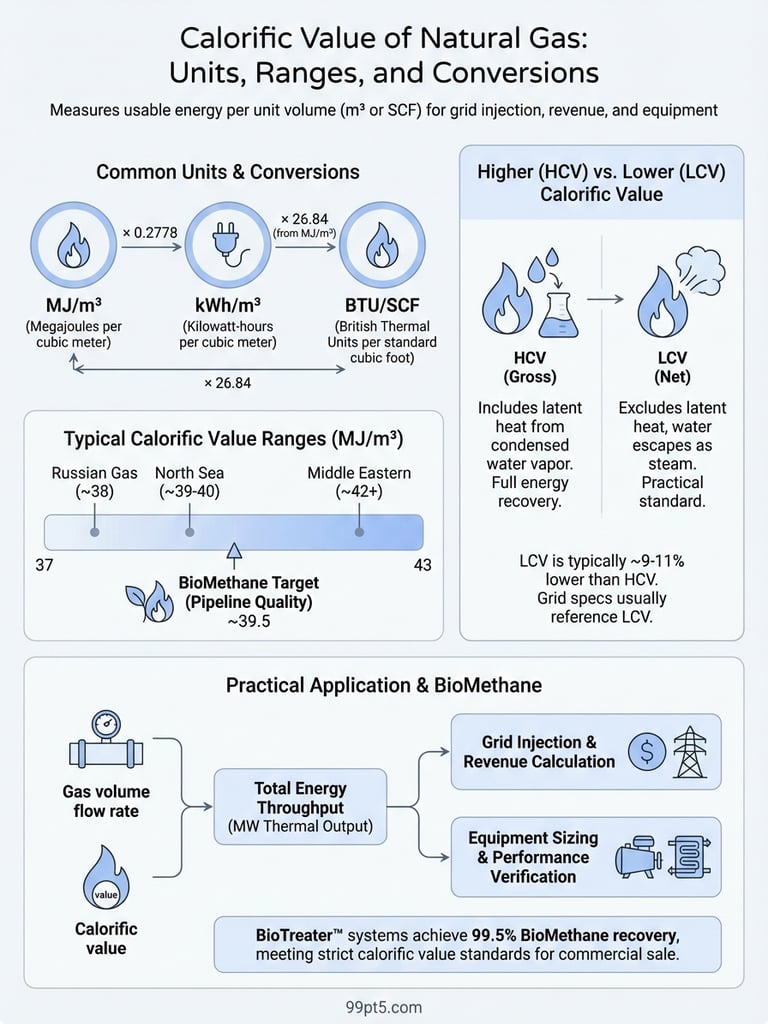
You will encounter three main units when working with the calorific value of natural gas: megajoules per cubic meter (MJ/m³), kilowatt-hours per cubic meter (kWh/m³), and British Thermal Units per standard cubic foot (BTU/SCF). European projects typically use metric units, while North American specifications still rely on imperial measurements. Understanding these conversions ensures you can compare technical data sheets, verify compliance with regional standards, and communicate accurately across international supply chains.
Metric system units
Most engineers in Europe, Australia, and Asia work with MJ/m³ or kWh/m³ because these units align with SI standards and simplify energy calculations. To convert between them, you multiply MJ/m³ by 0.2778 to get kWh/m³, or divide kWh/m³ by 0.2778 to return to megajoules. When your BioTreater™ system produces BioMethane at 39.5 MJ/m³, that equals approximately 11.0 kWh/m³, letting you match grid specifications whether they're written in joules or watt-hours.
Converting between metric units requires only one multiplication factor, keeping your calculations straightforward.
Imperial units
Natural gas specifications in the United States typically list calorific values in BTU per standard cubic foot (BTU/SCF), where one BTU represents the energy needed to raise one pound of water by one degree Fahrenheit. To convert from MJ/m³ to BTU/SCF, you multiply by 26.84, giving you 1,060 BTU/SCF for gas rated at 39.5 MJ/m³. This conversion matters when you're exporting BioMethane systems to North American markets or comparing equipment performance across different regions.
Typical ranges and why they change
The calorific value of natural gas typically falls between 37 to 43 MJ/m³ (1,000 to 1,150 BTU/SCF) for pipeline-quality fuel, though you'll see variations based on geographic source and processing methods. Russian pipeline gas often measures around 38 MJ/m³, while North Sea gas runs higher at 39 to 40 MJ/m³, and some Middle Eastern sources reach 42 MJ/m³ or above. Your BioMethane production must hit these same targets to qualify for grid injection, which means understanding what drives these differences.
Source composition and processing effects
Natural gas composition changes based on the geological formation where operators extract it. Wells tapping deeper reservoirs often produce gas with higher ethane and propane content, pushing the calorific value upward. Conversely, gas from shallow deposits or those with higher nitrogen contamination delivers less energy per volume. Processing facilities can blend different sources or adjust hydrocarbon recovery to meet specific calorific targets for regional grids.
Your feedstock composition determines whether you need blending or additional processing to meet local pipeline specifications.
BioMethane systems face similar challenges because digester gas composition varies with feedstock type, temperature, and retention time. The BioTreater™ system handles this variability by guaranteeing 99.5% methane recovery regardless of input fluctuations, ensuring your upgraded gas consistently meets the energy content standards required for commercial sale.
Higher vs lower calorific value
You will see two different calorific values listed for the same natural gas: higher calorific value (HCV) and lower calorific value (LCV). The difference comes down to whether you account for the latent heat in water vapor produced during combustion. HCV assumes you recover this heat by condensing the water vapor back to liquid, while LCV treats that energy as lost with the exhaust gases. Understanding which value applies to your situation affects everything from equipment selection to billing accuracy.
How condensation changes the energy calculation
When you burn natural gas, the hydrogen atoms combine with oxygen to form water vapor, which carries away energy as it exits your system. If your equipment includes a condensing heat exchanger that cools the exhaust below the dew point, you capture this latent heat and realize the full HCV rating. Standard boilers and turbines that vent hot gases only deliver the LCV because the water vapor escapes uncondensed. The gap between these two values typically ranges from 9 to 11 percent for natural gas.
Your actual energy recovery depends on whether your equipment condenses water vapor or exhausts it as steam.
Grid specifications usually reference LCV because most end-use equipment operates in non-condensing mode, making it the practical standard for the calorific value of natural gas in commercial transactions.
How to convert and use the value in practice
You need reliable conversion methods and practical applications to turn the calorific value of natural gas data into equipment specifications and project economics. Most technical calculations start with your gas volume flow rate and the specific calorific value for your source or upgraded BioMethane. Multiplying these numbers gives you the total energy throughput, which determines everything from heat exchanger sizing to revenue projections for grid injection contracts.
Standard conversion formulas
Converting between units requires simple multiplication factors that you can apply to any calorific value measurement. To go from MJ/m³ to BTU/SCF, multiply by 26.84, while converting to kWh/m³ needs multiplication by 0.2778. When your BioTreater™ system produces gas at 39.5 MJ/m³, you multiply flow rate in cubic meters per hour by this value to calculate megawatts thermal output, giving you the data needed for grid operator applications and equipment procurement specifications.
Your conversion accuracy directly affects billing calculations and compliance verification with pipeline operators.
Sizing BioGas processing equipment
Your calorific value data determines the capacity rating you need from purification systems and compression equipment. Higher energy content per volume means you can process fewer cubic meters to meet the same energy delivery target, potentially reducing capital costs for compressors and vessels.
Key takeaways
The calorific value of natural gas typically ranges from 37 to 43 MJ/m³ depending on source composition, with pipeline specifications requiring tight tolerances to maintain grid stability. You need to convert between MJ/m³, kWh/m³, and BTU/SCF depending on your regional standards, using the simple multiplication factors provided above. Your BioMethane must match these energy content specifications to qualify for grid injection and secure premium pricing.
Understanding the difference between higher and lower calorific values affects equipment selection and billing accuracy, since only condensing systems recover the full HCV rating. When you process BioGas into pipeline-quality BioMethane, maintaining consistent energy content matters as much as achieving high methane purity.
At 99pt5 Ltd, our BioTreater™ systems deliver guaranteed 99.5% BioMethane recovery while meeting strict calorific value requirements for commercial gas sales. Explore how our processing technology helps you achieve the lowest operating expenses and highest cash return in the industry.