Fugitive Emissions Definition: Examples, Sources, Reporting
Learn the fugitive emissions definition and explore industry examples, reporting methods, and strategies to reduce leaks and protect your facility's ROI.
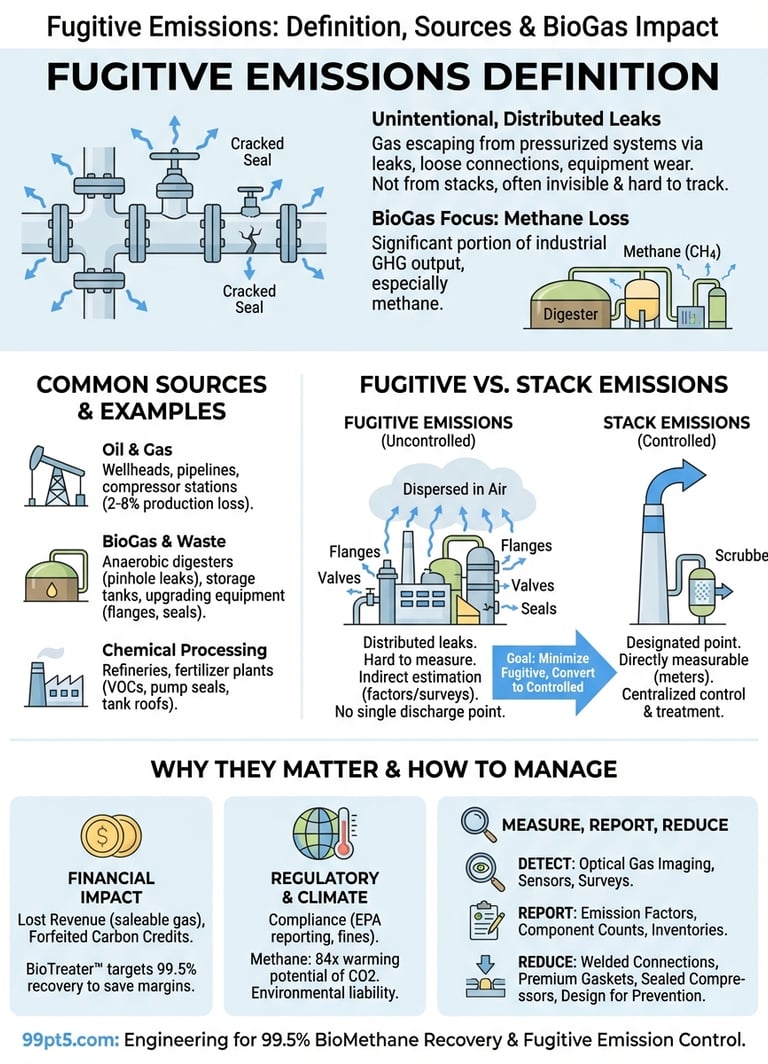
When gas escapes from a pressurized system through leaks, loose connections, or equipment wear, it doesn't show up on a smokestack monitor. These releases, known by the fugitive emissions definition, are unintended, often invisible, and notoriously difficult to track. Yet they account for a significant portion of industrial greenhouse gas output, particularly in oil and gas operations, landfills, and BioGas processing facilities.
For companies building and installing BioMethane systems, understanding fugitive emissions isn't optional. Regulators now require accurate reporting, and end-clients, whether farmers, municipalities, or industrial operators, demand systems that minimize unplanned losses. At 99pt5, our BioTreater™ system is engineered to achieve 99.5% BioMethane recovery precisely because every molecule that escapes represents lost revenue and increased environmental liability.
This article breaks down what fugitive emissions actually are, where they come from, and how they differ from point-source releases like stack emissions. You'll find real-world examples across industries, learn how reporting frameworks handle these elusive gases, and understand why they matter for anyone operating or specifying BioGas upgrading equipment. Whether you're calculating carbon credits, meeting regulatory thresholds, or simply trying to tighten up system performance, this is the foundational knowledge you need.
What fugitive emissions are
Fugitive emissions are unintentional releases of gas from pressurized equipment, pipelines, tanks, or processing units. Unlike emissions that exit through a controlled stack or vent, these gases escape through leaks, faulty seals, worn gaskets, loose fittings, or degraded equipment. You won't find a valve regulating them or a sensor measuring their flow rate. They slip out gradually, often invisibly, accumulating over time across dozens or hundreds of potential leak points in an industrial facility.
The fugitive emissions definition centers on this lack of deliberate control. When you operate a BioGas upgrading system, for example, raw BioGas enters at elevated pressure. If a flange connection loosens, a valve stem packing wears down, or a compressor seal fails, methane escapes directly into the atmosphere. That escaping methane counts as a fugitive emission because you didn't route it through a burner, scrubber, or monitored discharge point. It bypassed your containment systems entirely.
The mechanics of unintended release
Equipment components degrade under normal operating conditions. Pressure cycling causes seals to harden and crack. Temperature fluctuations expand and contract metal joints, creating microscopic gaps. Vibration from compressors or pumps loosens connections that were properly torqued during installation. Each of these failure modes creates a pathway for gas to escape, and because the leaks often develop slowly, you might not notice them until a routine inspection or emissions audit flags elevated readings.
When pressure-containing equipment operates continuously, every joint, seal, and component becomes a potential release point unless you design, install, and maintain systems to specific leak-prevention standards.
In BioGas facilities, methane's low molecular weight means it migrates through tiny openings more easily than heavier gases. A leak that releases 100 grams per hour might go undetected for months, yet over a year, that single point source emits nearly 900 kilograms of methane, equivalent to roughly 25 metric tons of CO2 in greenhouse gas impact. Multiply that by the number of flanges, valves, and fittings in a typical system, and you see why fugitive losses can rival or exceed controlled vent emissions.
What makes them "fugitive"
The term "fugitive" reflects these emissions' evasive nature. You can't install a flow meter on a leak. You can't sample what's dispersing into ambient air at an unknown rate. Traditional monitoring methods that work for stack emissions, continuous emission monitoring systems for instance, don't apply because there's no defined discharge point to monitor. Detection requires specialized equipment like infrared cameras, portable gas analyzers, or soap-bubble testing at individual components.
This characteristic creates both measurement challenges and regulatory complexity. Reporting frameworks typically require you to estimate fugitive emissions using emission factors based on equipment type, service (gas, liquid, or light liquid), and leak detection frequency. Your actual losses might be higher or lower than the calculated value, which is why process engineers increasingly design systems with inherent leak prevention rather than relying solely on after-the-fact detection and repair programs.
Common sources and examples by industry
Different industrial sectors face distinct fugitive emission challenges based on their process equipment and the gases they handle. Understanding where leaks typically occur helps you anticipate problem areas when designing or operating BioMethane systems. The fugitive emissions definition applies universally, but the specific sources vary dramatically between an oil refinery, a wastewater treatment plant, and a chemical production facility.
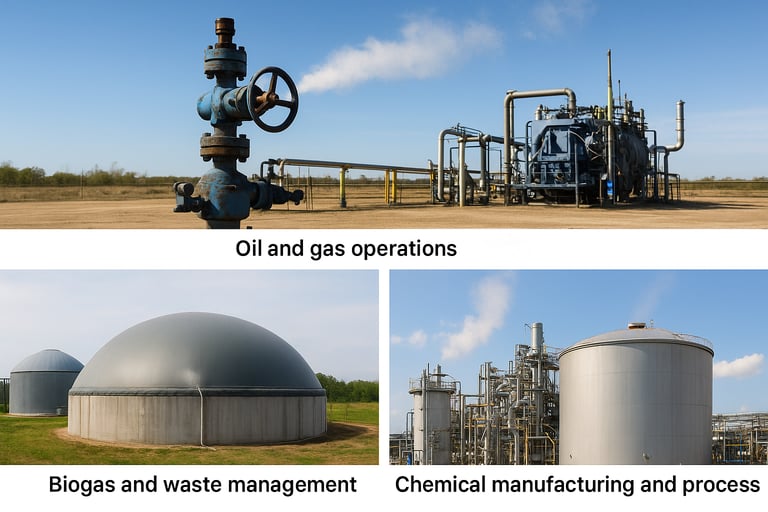
Oil and gas operations
Wellheads, compressor stations, and pipeline networks create thousands of potential leak points in upstream and midstream operations. Natural gas contains primarily methane, which escapes through worn valve packings, corroded pipe threads, and degraded flange gaskets. Pneumatic devices that use gas pressure for control functions also vent methane during normal operation, though these releases technically fall into a gray area between fugitive and process emissions.
In oil and gas facilities, fugitive methane losses of 2-8% of total production are common without active leak detection programs, representing both environmental impact and substantial revenue loss.
BioGas and waste management
Anaerobic digesters, storage tanks, and upgrading equipment handle BioGas at varying pressures, creating conditions for methane escape. Flexible membrane covers on digesters often develop pinhole leaks from UV degradation. Transfer piping between digesters and upgrading systems loses gas through compression fittings and quick-disconnect couplings. In BioMethane injection facilities, custody transfer meters and pressure regulation stations add more potential release points where gas purity exceeds 96% methane content.
Chemical manufacturing and processing
Refineries, fertilizer plants, and petrochemical facilities handle volatile organic compounds (VOCs) that escape through similar pathways as methane but often carry additional health and environmental concerns. Pump seals in liquid service release vapors as the liquid flashes to gas at atmospheric pressure. Storage tank roof seals allow breathing losses as temperature changes cause vapor expansion and contraction.
Fugitive vs stack emissions
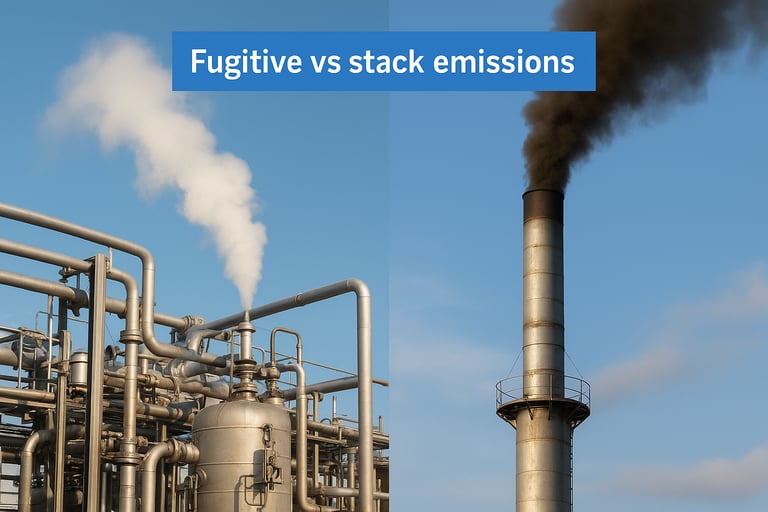
Stack emissions exit through designated discharge points where you can measure flow, concentration, and composition. Fugitive emissions, by contrast, escape through unintended pathways across multiple locations in your facility. This fundamental difference shapes how you monitor, report, and control each type of release. When your BioGas upgrading system vents treated gas through a flare or sends purge streams to a thermal oxidizer, those are stack emissions. When methane leaks from a compressor seal or a loose valve stem, that's fugitive.
The fugitive emissions definition hinges on this lack of centralized control. Stack emissions pass through equipment designed to measure or treat them before release. You install continuous emission monitoring systems on stacks, sample gas composition regularly, and apply control technologies like scrubbers or catalytic converters. Your regulatory permits specify allowable discharge rates and concentrations for stack emissions because you know exactly where the gas exits and can intervene if limits are exceeded.
Point source control vs diffuse leaks
Stack emissions originate from identifiable points where piping or ductwork terminates. Your facility might have ten stacks, but you know their exact locations, heights, and typical emission profiles. You can route process vents to a single collection header and treat the combined stream before discharge. This centralized approach makes compliance straightforward because you control when, where, and how much gas exits.
Fugitive emissions scatter across your entire facility boundary. A BioMethane production system with 200 flanges, 75 valves, and 30 pump seals creates 305 potential leak points, each requiring individual inspection. You cannot consolidate these sources or apply end-of-pipe treatment because the gas disperses before you detect it.
Measurement and monitoring differences
Stacks allow direct measurement using flow meters, gas analyzers, and opacity monitors. Your reporting relies on actual data collected continuously or at regular intervals. Fugitive emissions require indirect estimation based on leak detection surveys, equipment counts, and published emission factors. This estimation uncertainty means your reported fugitive losses might vary significantly from reality unless you implement rigorous monitoring programs.
Stack emissions give you real-time data; fugitive emissions force you to rely on periodic surveys and statistical correlations, creating larger uncertainty in your total greenhouse gas inventory.
Why fugitive emissions matter
Fugitive emissions directly affect your bottom line, regulatory standing, and environmental footprint in ways that stack emissions rarely do. When methane escapes from your BioGas system through leaks, you lose saleable product that never reaches the injection point or customer delivery. Unlike controlled releases that serve a process function, fugitive losses represent pure waste. A system processing 500 Nm³/hour of raw BioGas could lose 25,000 euros annually in revenue if just 1% escapes as fugitive methane, based on typical BioMethane pricing.
Financial impact and lost revenue
Every cubic meter of methane that leaks costs you twice. You lose the gas itself, which you could have sold at grid injection rates or used for on-site power generation. You also forfeit carbon credits associated with that displaced fossil fuel. In jurisdictions with carbon trading schemes, fugitive losses reduce your certified emission reductions, directly cutting into project returns. For facilities targeting 99.5% recovery rates, controlling fugitive emissions becomes the difference between meeting financial projections and falling short.
Regulatory compliance and reporting obligations
Most greenhouse gas reporting frameworks require you to quantify and report fugitive emissions separately from stack releases. The fugitive emissions definition under EPA regulations and international protocols demands facility-level inventories, periodic leak detection surveys, and corrective action timelines. Exceeding threshold limits triggers enhanced monitoring requirements, potential fines, and public disclosure obligations that can affect your reputation with end-clients and financing partners.
Facilities that fail to control fugitive methane often face compliance costs exceeding the value of the lost gas itself when regulators mandate accelerated leak detection programs and equipment upgrades.
Environmental and climate implications
Methane carries 84 times the warming potential of CO2 over a 20-year period, making fugitive releases disproportionately harmful relative to their mass. When you allow even small leaks to persist, your facility's climate impact multiplies rapidly. End-clients selecting BioMethane systems increasingly scrutinize whole-system emissions, knowing that uncontrolled fugitive losses undermine the environmental benefits they're purchasing.
How to measure, report, and reduce fugitive emissions
Controlling fugitive emissions requires systematic detection, accurate accounting, and proactive equipment design. You cannot manage what you don't measure, which is why effective programs start with identifying leak sources before they accumulate into significant losses. The approach differs fundamentally from stack monitoring because you're hunting for small, distributed releases rather than measuring a single discharge point. Your BioMethane system needs all three components working together: detection technology, reporting methodology, and prevention strategies built into the design phase.
Detection methods and monitoring programs
Optical gas imaging cameras reveal invisible methane plumes in real time, allowing technicians to scan hundreds of components per hour. These infrared devices detect concentration differences against background air, pinpointing leaks that would take days to locate using traditional soapy water or portable analyzers. You schedule quarterly or annual surveys depending on regulatory requirements, documenting each component's status and repair timeline. For critical equipment like custody transfer stations, you might implement continuous monitoring with fixed sensors that trigger alarms when methane concentrations exceed threshold levels.
Facilities that conduct quarterly leak detection surveys typically reduce fugitive losses by 40-60% compared to annual programs, recovering the inspection costs through captured product.
Reporting frameworks and calculation approaches
The fugitive emissions definition under EPA protocols and international standards requires you to multiply component counts by emission factors specific to equipment type and service. Your report lists flanges in gas service, valves in light liquid service, and pump seals handling volatile compounds, applying published leak rates to each category. When you perform Method 21 monitoring, you replace default factors with measured leak rates, improving accuracy. Facilities exceeding reporting thresholds submit annual inventories detailing total fugitive losses, leak detection frequency, and repair completion rates.
Reduction strategies and prevention techniques
Design choices prevent leaks more effectively than post-installation repairs. Welded connections eliminate flange leaks entirely where practical. Sealed compressors and magnetic drive pumps remove dynamic seals that inevitably wear. You specify premium gasket materials rated for continuous methane service and use bellows-sealed valves in critical applications. Equipment layout should minimize vibration transfer and allow easy inspection access, because components you cannot reach rarely receive proper maintenance.
Next steps
Understanding the fugitive emissions definition equips you to specify and operate BioMethane systems that meet both regulatory requirements and client expectations. You now know where leaks occur, how they differ from controlled releases, and why controlling them directly affects project profitability and environmental claims. This knowledge matters when you're selecting upgrading equipment, designing monitoring programs, or calculating carbon credit potential for your installations.
Your next action should focus on system design choices that prevent fugitive losses rather than simply detecting them after installation. When you evaluate BioGas processing equipment, ask suppliers for guaranteed recovery rates and documentation of leak prevention features. Request technical specifications on seal designs, connection types, and pressure containment methods. The difference between a system that achieves 95% recovery and one that delivers 99.5% determines whether your projects meet financial projections and environmental targets. Explore how 99pt5's BioTreater™ system achieves industry-leading recovery rates with built-in fugitive emission controls that protect both your margins and your clients' carbon credit value.